Mollusca Study Guide
 Mollusca
- Clams, snails, slugs, octopus
- 2nd most variety
Structure/advancement
 General Structure
- Bilateral symmetry
- Cephalized
- Triploblast
- Coelomates: Fluid filled body cavity surrounded by mesoderm
- Added movement
- Protection of organ structure
- Organs can move independently from muscles
- Circulatory system
- Alimentary canal
- Trochophore: Larval stage of development
- Sometimes hatches egg and becomes free-forming
- Cillia at the ends and middle propel the trochophore and bring food to its mouth
Anatomy
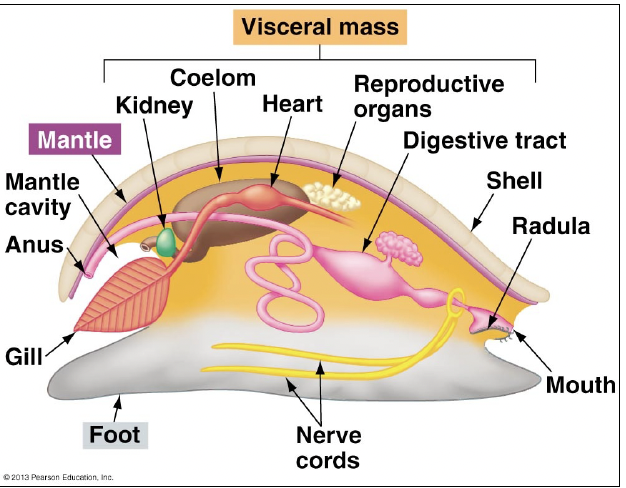
- Head foot
- Head
- Mouth, sensory structures
- Foot
- Muscular organ used for movement
- Head
- Visceral mass
- Is located above the head foot
- Heart, digestive organs, excretion, reproduction
- Mantle: layer of epidermis that covers the visceral mass
- Secretes one or more hard shells made of calcium
- These shells protect the body, but also reduce the amount of surface area for gas exchange
- So, to increase the amount of gas exchange, they adapted Gills: Provide large surface area, and have lots of blood, which helps with exchanges of gas
- Located in the Mantle cavity: the space between the mantle and visceral mass
- So, to increase the amount of gas exchange, they adapted Gills: Provide large surface area, and have lots of blood, which helps with exchanges of gas
- These shells protect the body, but also reduce the amount of surface area for gas exchange
- OR is skin with chromatophores
- Camo
- Secretes one or more hard shells made of calcium
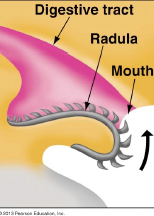
- Radula: The flexible tonguelike strip of tissue that is covered with backward teeth
- Has many functions
- Terrestrial snails
- Use it to cut leaves
- Aquatic snails
- Scrape algae
- Drill holes into other organisms shells
- Core shell
- Harpoon-shaped radula
- Captures fish and injects venom
Hunting
- Filter feeders/active hunters
- Use radula to hunt (see above)
Digestion
Reproduction
Circulatory
- Being a coelomate helps the circulatory system
- A coelom creates a space where circulatory fluid can be transported without the interference from organs
- Open circulatory system
- Cannot pressurize circulatory fluid
- Hemolymph: Their circulatory fluid
- Hemocoel: The space where the hemolymph exits the tubes
Respiratory
- Use gills
Nervous system
- Ganglia: Nerve cell clusters
- In head/foot and visceral mass, connected by two pairs of long nerve cords
Types
 Gastropoda
- Largest
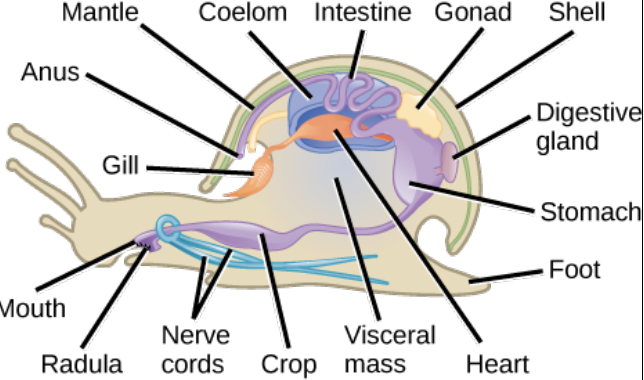
- Snails, abulones, conch (all have single shells)
- Slugs, nudibranch (have no shells)
Structure
- Torsion: Stage during larval development where the visceral mass twists 180 degrees
- The mantle cavity, gills, and anus move to the front
- Allow the head to go inwards
- The mantle cavity, gills, and anus move to the front
Circulatory system
- Have open circulatory system
- Circulatory fluid does not remain within vessels
- Hemolymph: Circulatory fluid
- Hemocoel: The cavity where hemolymph is stored, spaces between the tissues
- Collects hemolymph from the the gills/lungs, pump through the heart, released into the hemocoel, goes back to heart with gills
Snails
- On land, freshwater, ocean
Structure
- Eyes on tentacles
- These retract when they sense danger
Types
- Aquatic snails: gills in the mantle cavity
- Terrestrial snails: the mantle cavity acts as a modified lung
- Mantle cavity: acts as a modified lung
- Can only do this if the mantles membrane is moist
- Mantle cavity: acts as a modified lung
- Slugs: Terrestrial snails without shells
- Nudibranchs: Aquatic snails without shells
- Covered with fingerlike extensions for more surface area
- Pteropods: Flap their foot in a winglike motion to swim
Bivilia
- Ex. Aquatic mollusks: clams, oysters, scallops
Structure
- 2 halves (valves), with 3 layers each (secreted by mantle)
- Connected by a hinge
- Adductor muscles
- 3 layers
- Thin outer layer for protection
- Thick middle layer to strengthen (calcium)
- Smooth, shiny, inner layer to protect body
- Connected by a hinge
- Most are sessile filter feeders
- Do not radula
- Extend foot into the sand and fill with hemolymph
- No distinct head
- Nervous system = 3 ganglia pairs connected with nerve cords
- The nerve cells work with sensory cells on the edge of the mantle
- Can cause it to open and close
- The nerve cells work with sensory cells on the edge of the mantle
- Mouth
- Digestive
- Foot
- Some have eyes on mantle edge
Clams
- Live buried in mud/sand
- Sealed mantle - BESIDES siphons: hollow fleshy tubes
- Cilia on the gills beat, drawing water in through the incurrent siphons, and leaving through the excurrent siphon
- Making water circulate within the clam
- Circulating water goes through gills and filter feeds
- Circulating water exchanges gasses
- Shed sperm and egg into water, and fertilize externally
- Becomes a trochophore and then develops to an adult
Others
- Oysters: stick to hard surface
- Scallops: open and close with a snap to move
- Shipworm: drill into the wood of a ship, decomposes with the symbiotic bacteria in the intestine
Cephalopoda
- Ex. octopus, squid, cuttlefish, chambered nautiluses
Structure
- Tentacles with suction cups
- Jaws that resemble a parrots beak
- Chromatophores: Cells used to camouflage that are on the outer mantle
Hunting
- Use ink to defend selves and camouflage with chromatophores
Reproduction
Separate sexes
- the male uses a tentacle to transfer sperm from their mantle cavity to the females mantel cavity
- fertilization happens in the females mantle cavity
- She lays eggs and guards them till they hatch
- SKIP THE TROCHOPHORE stage
Circulatory
- Closed circulatory system
- Can transport fluid rapidly
Nervous
- Largest brain among the invertebrates
- Divided into several lobes