Exam 3 - Chapter 11
Chapter 11: Introduction to the Nervous System and Nervous Tissue
What structures are in the CNS versus the PNS?
- CNS: Brain and Spinal Cord
- PNS: Cranial nerves and spinal nerves and their branches
Name the neuroglial cells present in the CNS and the PNS and describe their functions.
- The neuroglial cells present in the CNS include astrocytes, oligodendrocytes, microglia, and ependymal cells. In contrast, the neuroglial cells present in the PNS include Schwann cells and satellite cells. These cells play various roles such as providing support and protection to neurons, maintaining the extracellular environment, and myelinating axons
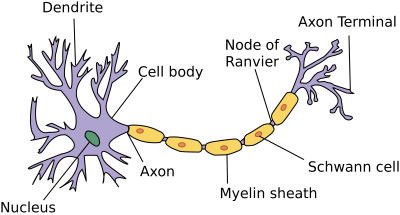
Draw a neuron and label the parts. Where do you find the different organelles of a neuron? Be able to distinguish between multipolar, bipolar, and pseudounipolar neurons and describe the location of each.
\
A neuron consists of a cell body, dendrites, and an axon. The cell body contains the nucleus and other organelles, while the dendrites receive signals from other neurons. The axon is responsible for transmitting signals to other neurons or effector cells. The different organelles of a neuron are distributed throughout the cell body, dendrites, and axon.
Multipolar neurons have multiple dendrites and a single axon, while bipolar neurons have one dendrite and one axon. Pseudounipolar neurons have a single process that splits into two branches, with one branch acting as a dendrite and the other as an axon. Multipolar neurons are located in the brain and spinal cord, while bipolar and pseudounipolar neurons are found in sensory structures such as the retina and sensory ganglia.
Describe sensory neurons, interneurons, and motor neurons.
- Sensory neurons transmit information from sensory receptors to the CNS, interneurons integrate and process information within the CNS, and motor neurons transmit information from the CNS to effector cells such as muscles and glands.
What is myelin and why are some axons myelinated?
- Myelin is a fatty substance that surrounds axons and insulates and speeds up signal transmission. Axons are myelinated to increase the speed and efficiency of signal transmission.
Describe the different types of ion channels present at different locations in the neuron.
- Sodium channels and potassium channels are present in the axon
- Ligand-gated channels are present in the dendrites and cell body.
What is the typical resting membrane potential for a neuron?
- The typical resting membrane potential for a neuron is around -70mV.
Describe the similarities and differences between local potentials versus action potentials.
- Local potentials are small depolarizations that occur in a small area and can be graded in strength. In contrast, action potentials are all-or-nothing events that occur along the length of the axon.
- The main differences between local and action potentials are their amplitude, duration, and how they propagate.
- Local potentials are generated by ligand-gated channels in the dendrites and cell body, while action potentials are generated by voltage-gated channels in the axon.
Draw an action potential, label the phases, and describe which channels are responsible for each phase.
- An action potential consists of four phases: depolarization, repolarization, hyperpolarization, and the refractory period. Sodium channels are responsible for depolarization, while potassium channels are responsible for repolarization and hyperpolarization.
Where does the action potential begin, and what triggers the action potential?
- The action potential begins at the axon hillock and is triggered when the membrane potential reaches a certain threshold.
Which ion is typically responsible for local potentials (small depolarizations in a small area)?
- Sodium ions
Why is the refractory period important?
- To prevent the neuron from firing multiple action potentials too quickly.
What is saltatory conduction, and why do only some neurons exhibit saltatory conduction?
- Saltatory conduction is a type of signal transmission that occurs in myelinated axons. It involves the rapid conduction of signals from one node of Ranvier to the next, which speeds up signal transmission. Not all neurons exhibit saltatory conduction because not all axons are myelinated.
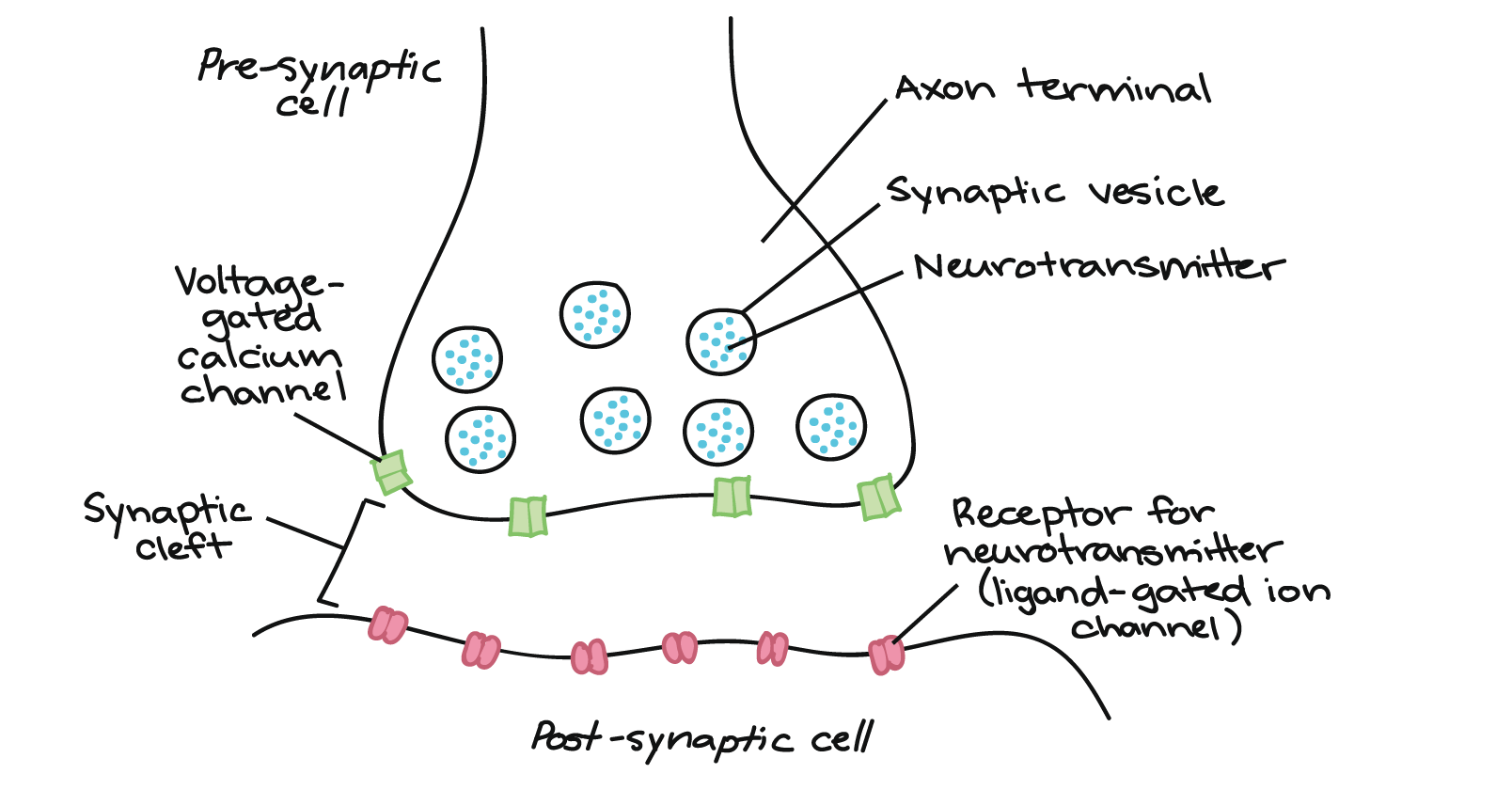
Draw a typical synapse. Label the pre-synaptic membrane, the post-synaptic membrane, and the synaptic cleft.
- \
- \
Where do you find vesicles containing neurotransmitters?
- Vesicles containing neurotransmitters are found in the axon terminals of the pre-synaptic neuron, near the pre-synaptic membrane.
What is the difference between an EPSP and an IPSP? Predict whether activation of a given neurotransmitter receptor will generate an EPSP or an IPSP. Why do we need temporal and spatial summation?
- An EPSP (excitatory postsynaptic potential) is a depolarizing potential that makes the post-synaptic neuron more likely to fire an action potential. An IPSP (inhibitory postsynaptic potential) is a hyperpolarizing potential that makes the post-synaptic neuron less likely to fire an action potential. The activation of a given neurotransmitter receptor will generate either an EPSP or an IPSP depending on whether the receptor is excitatory or inhibitory. For example, the activation of an acetylcholine receptor at the neuromuscular junction generates an EPSP.
- We need temporal and spatial summation because individual EPSPs and IPSPs may not be strong enough to cause the post-synaptic neuron to fire an action potential on their own. Temporal summation refers to the addition of multiple EPSPs or IPSPs that occur in rapid succession. Spatial summation refers to the addition of EPSPs or IPSPs that come from different synapses on the same post-synaptic neuron.
What neurotransmitter is present at the neuromuscular junction?
- acetylcholine
Name two excitatory and two inhibitory neurotransmitters.
- Two excitatory neurotransmitters are glutamate and dopamine.
- Two inhibitory neurotransmitters are GABA and glycine.
How do we terminate the action of neurotransmitters? (Name three things that can happen to the neurotransmitter.)
- The action of neurotransmitters can be terminated in several ways, including reuptake of the neurotransmitter by the pre-synaptic neuron, enzymatic degradation of the neurotransmitter in the synaptic cleft, and diffusion of the neurotransmitter away from the synaptic cleft.
Describe how interneurons are organized into neuronal pools.
- Interneurons are organized into neuronal pools, groups of interneurons responsible for a particular function or behavior. Neuronal pools can receive input from sensory neurons, other interneurons, or both, and they can also send output to motor neurons, other interneurons, or both.
Contrast diverging circuits versus converging circuits.
- Diverging circuits refer to a type of neural circuit where a single neuron sends output to multiple neurons downstream. Converging circuits refer to a type of neural circuit where multiple neurons send input to a single neuron upstream.