International Trade and Finance
International trade involves the exchange of goods and services across borders, which can lead to economic growth and diversification of markets.
Session 1: Introduction
Trade: Depends on what every country exports or imports (tourism vs. microchips). Value added and Economic Complexity.
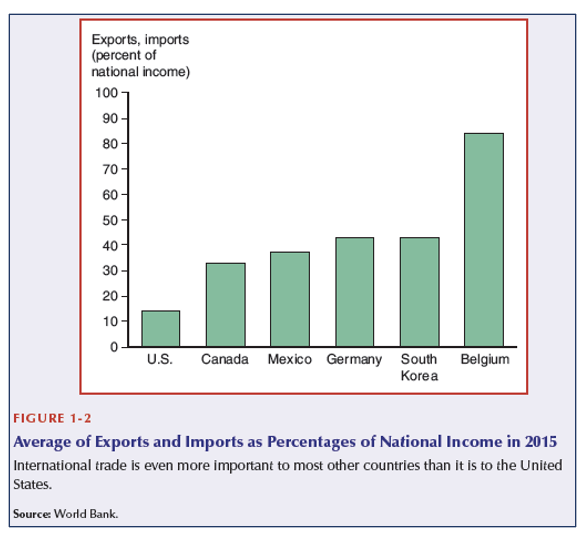
To most countries, international trade is more important than the US
The gains from trade
When a country sell goods and services to each other. Each country trades what is beneficial (cheap) to produce and then sell. Specialize in producing (large-scale production). Comparative advantage.
Even when one of them is more efficient than the other at producing everything and when producers in the less-efficient country can compete only by paying lower wages; allowing countries to export goods whose production makes relatively heavy use of resources that are locally abundant
The pattern of Trade
The pattern of intentional trade: who sells what to whom
Pattern of trade: How a country resources will make them produce something and other country another products
Comparative advantage: David Ricardo. International differences in labor productivity.
The Ricardian model shows that if we want to maximize total output in the world, then we should fully employ all resources worldwide, allocate those resources within countries to each country's comparative advantage industries, allow the countries to trade freely thereafter.
Relative abundance: how certain countries have an abundance of specific resources, which informs their ability to specialize in the production of goods that utilize those abundant resources effectively.
A country is better off importing a product than producing it (because it is cheaper)
Production possibilities Frontier: The limit of resources that can be implemented in the production of a good while being efficient. Given the resources available of production.
How to measure productivity in terms of workers: Produce a productive with the highest comparative advantage. All the factors of production that leads to a production of material in the cheapest possible way. Output x Wage
How much to trade
How international competition on the prosperity of domestic industries —> limit on imports (more protectionist policies)
Free trade was a way to promote peace and prosperity after WWII
Globalization increases the losers
Backlash
“Let’s Buy American”
Brexit
Conflicts of interest within nations are usually more important in determining trade policy than conflicts of interest between nations
Balance of Payments and Exchange rates
Trade surpluses: When you export more than you import
Balance of Payments: Think of it as a big financial record for a country that shows all the money flowing in and out. It includes things like:
Exports and imports (money from selling and buying goods/services).
Investments (money coming in or going out due to loans, stocks, etc.).
Transfers (like money sent home by workers abroad).
If more money comes in than goes out, the country has a surplus. If more money goes out, there’s a deficit.
Currency war: a situation in which countries compete against each other to devalue their currencies in order to boost their exports, making them cheaper for foreign buyers.
“Already discounted”: Already taken into consideration for future events.
Exchange rate determination:
This is about how the value of one country’s money (currency) is decided compared to another country’s money.
It depends on supply and demand for currencies. For example, if lots of people want US dollars, its value goes up.
Before the exchange rate were fixed by the government rather than determinate in the marketplace (free floating)
Exchange rate is determinate by:
1. Trade (Exports and Imports):
When a country sells a lot of goods or services to other countries (exports), there’s demand for its currency because buyers need it to pay. This can make the currency stronger (appreciate).
Example: If everyone wants Swiss watches, they need Swiss Francs to buy them, which raises the value of the Franc.
If a country buys more than it sells (imports), it might weaken the currency because they need to exchange their currency for foreign money to pay others.
2. Interest Rates:
Countries with higher interest rates attract investors because they can earn better returns on their money. Investors need that country’s currency to invest, increasing demand and boosting its value.
Example: If US interest rates go up, more people might want to invest in the US, increasing demand for US dollars.
If interest rates are low, the currency may lose value as investors look for better opportunities elsewhere.
3. Economic Stability:
Countries with strong, stable economies usually have stronger currencies because people trust that their money will hold value over time.
Example: If a country is peaceful, politically stable, and growing economically, more people will want its currency.
On the other hand, if there’s instability (like war, recession, or high inflation), people lose trust in the currency, and its value may drop as they sell it off or avoid using it.
Combined Effect:
These factors interact. For example, a country with high exports and stable politics but low interest rates might still have a strong currency because its trade balance is positive and investors see it as safe.
The Gravity Model
The strong empirical relationship between the size of a country economy and the volume of both its imports and exports. Why some countries trade more with neighboring countries. Large countries export more and further away.
Trade between any two countries is proportional to the product of their GDPs and diminishes with distance —> Analogy to Newton’s law of gravity
Large economies tend to spend large amounts on imports because they have large incomes. They also attract large shares of other countries spending because they produce a wide range of products
It is used to identify anomalies in trade
To make sense of actual trade flows, we need to consider the factors limiting international trade (Netherlands, Belgium, and Ireland trade considerably more with the United States)
Transport cost and non-tarded goods
Transport costs and on-traded goods: Transport costs can significantly influence the overall cost of traded goods, affecting the decisions of countries on where to specialize in production and how to allocate resources effectively.
Transportation costs do not change
Transportation costs have important implications for the way a trading world economy
Some main reasons why specialization in the real international economy is not extreme:
Existence of more than one factor of productions in the real international economy is not extreme
Countries sometimes protect industries from foreign trade
It is costly to transport goods and services
Limitations on specialization on trade leads to non-traded goods industries.
The Changing Pattern of World Trade
“vertical disintegration” of production: before a product reaches the hands of consumers, it often goes through many production stages in different countries
Agricultural products such as wheat, soybeans, and cotton are another key piece of the picture, and services of various kinds play an important role
1970s: The rise of globalization began, leading to increased interdependence among nations and a significant shift in trade policies.
Trade services: these include logistics, finance, and consulting, which facilitate the movement of goods across borders and support the overall trade ecosystem.
Countries developing service industry:
Philippines: Finance
India: Logistics
Brazil: Consulting
South Africa: Finance and logistics
Vietnam: Consulting and logistics
Essay “Of the Balance of Trade” by David Hume: This essay discusses how a favorable balance of trade can lead to an influx of gold and silver, ultimately impacting a nation's wealth and economic stability.
Trade theory of David Ricardo: This theory emphasizes the benefits of comparative advantage, suggesting that countries should specialize in the production of goods where they have a lower opportunity cost, thereby enhancing overall efficiency and maximizing trade gains.
Misconception about comparative advantage
Free trade is beneficial only if your country is string enough to stand up to foreign competition.
Ricardo model-that gains from trade depend on comparative rather than absolute advantage
Foreign competition is unfair and hurts other countries when it is based on low wages.
This argument, sometimes referred to as the pauper labor argument, is a particular favorite of labor unions seeking protection from foreign competition
Trade exploits a country and makes it worse off if its workers receive much lower wages than workers in other nations.
This argument is often expressed in emotional terms
Comparative advantages with many goods
The technology of each country can be described by its unit labor requirement for each good, that is, the number of hours of labor it takes to produce one unit of each good
Goods will always be produced where it is cheapest to make them. The cost of making some good is the unit labor requirement times the wage rate
This criterion for specialization tells us that there is a “cut” in the lineup determined by the ratio of the two countries’ wage rates
The Specific factors Model
Developed by Paul Samuelson and Ronald Jones. It assumes an economy that produces two goods and that can allocate its labor supply between the two sectors.
Difference with Ricadian model: the specific factor model allows for the existence of factors of production besides labor.
Whereas labor is a mobile factor that can move between sectors, other factors are assumed to be specific. They can be used in the production of particular goods
A country has 3 factors of production: Labor (L), Capital (K), and land (T for terrain).
Ecah of the specific factors, capital and land can be used in only one sector of production
International trade in the specific factors model
Intitutional forms competition in international markets can significantly influence the allocation of resources and the comparative advantage of countries.
Global citizen? Understanding the dynamics of international trade is essential for global citizens, as it allows them to appreciate the interconnectedness of economies and the impact of trade policies on local and global markets.
Democracies are failing because of globalization? This assertion suggests that the rapid integration of global markets may undermine democratic institutions by prioritizing corporate interests over public welfare, leading to increased inequality and disillusionment among citizens. Furthermore, as economies become more reliant on global trade, the need for transparent and accountable governance becomes increasingly crucial to ensure that the benefits of trade are equitably distributed.