Micro Economics
The goal of product differentiation and advertising in monopolistic competition is to make
Multiple Choice
the firm allocatively efficient even if it is not productively efficient.
the firm productively efficient even if it is not allocatively efficient.
price less of a factor and product differences more of a factor in consumer purchases.
price more of a factor and product differences less of a factor in consumer purchases.
A firm operating within an oligopoly does not invest in new technology that would reduce the costs of production. This lack of investment demonstrates
Multiple Choice
allocative inefficiency associated with oligopolies.
productive inefficiency associated with oligopolies.Correct
technological inefficiency associated with oligopolies.
deadweight loss inefficiency associated with oligopolies.
A monopolistically competitive industry is like a purely competitive industry in that
Multiple Choice
each industry produces a standardized product.
nonprice competition is a feature in both industries.
neither industry has significant barriers to entry.Correct
firms in both industries face a horizontal demand curve.
In an oligopoly, producers’ agreements to restrict output tend to be unstable because each firm has an incentive to
Multiple Choice
produce more than its output quota.Correct
lower both its price and its output.
raise its price above the cooperative price.
establish competitive price and output levels.
Use the following graph to answer the next question.
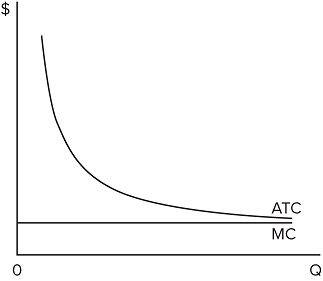
A straight line runs parallel to the horizontal axis and is labeled MC. A decreasing curve above MC that later becomes constant along MC is labeled ATC.
A firm that has the long-run cost curves shown in the graph above would not be able to
Multiple Choice
exploit economies of scale.
have an entry barrier protecting it from new entrants into the market.
serve an increasing share of the market at lower and lower unit costs.
attain lower unit costs by reducing its output level. Correct
With a natural monopoly, the normal profit price is ________ and the competitive price is ________.
Multiple Choice
allocatively efficient; not allocatively efficient
not allocatively efficient; allocatively efficient
Correct
not allocatively efficient; not allocatively efficient
allocatively efficient; allocatively efficient
Use the following graph to answer the next question.
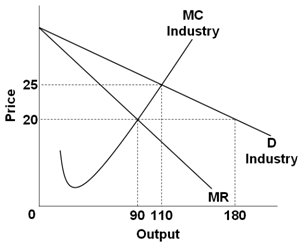
The horizontal axis from left to right lists values as 90, 110, and 180 and the vertical axis from bottom to top lists values as 20 and 25. Two decreasing lines MR and D Industry are drawn from the same point at the vertical axis. MR has a greater slope than D Industry. Another u-shaped curve labeled MC industry intersects both MR and D industry. The dotted straight lines from both the axes connects to the data points at curves as follows: data point (90, 20) at point of intersection of MC industry and MR; (110, 25) at point of intersection of MC Industry and D Industry; and (180, 20) at D Industry.
If the industry were perfectly competitive, then the market price would be
Multiple Choice
$25, which is higher than what the price would have been if the industry were a pure monopoly.
$25, which is lower than what the price would have been if the industry were a pure monopoly.Correct
$20, which is higher than what the price would have been if the industry were a pure monopoly.
$20, which is lower than what the price would have been if the industry were a pure monopoly.
Which of the following statements is a major criticism of a pure monopoly as a source of allocative inefficiency?
Multiple Choice
A pure monopoly fails to expand output to the level where the price of an additional unit is just equal to its marginal cost.Correct
A pure monopoly has no incentive to produce efficiently, because even the inefficient pure monopoly can be assured of economic profits.
A pure monopoly will always generate economic profit, and that means that prices are too high.
A pure monopoly has an unfair advantage because it can purchase labor at a lower price than perfectly competitive firms can.
Given a downward-sloping linear demand curve, if total revenue decreases as quantity of output increases, marginal revenue must be
Multiple Choice
positive and demand is elastic.
negative and demand is elastic.
positive and demand is inelastic.
negative and demand is inelastic.Correct
he following table shows cost data for a perfectly competitive firm.
Output | Average Fixed Cost | Average Variable Cost | Average Total Cost | Marginal Cost |
1 | $300 | $100 | $400 | $100 |
2 | 150 | 75 | 225 | 50 |
3 | 100 | 70 | 170 | 60 |
4 | 75 | 73 | 148 | 80 |
5 | 60 | 80 | 140 | 110 |
6 | 50 | 90 | 140 | 140 |
7 | 43 | 103 | 146 | 180 |
8 | 38 | 119 | 156 | 230 |
9 | 33 | 138 | 171 | 290 |
10 | 30 | 160 | 190 | 360 |
If the market price for the firm's product is $180, the firm will produce
Multiple Choice
7 units and earn economic profits of $278.
8 units and earn economic profits of $120.
7 units and earn economic profits of $238.Correct
8 units and earn economic profits of $278.
Which idea is inconsistent with perfect competition?
Multiple Choice
price-taking behavior
product differentiation
Correct
freedom of entry or exit for firms
a large number of buyers and sellers
Use the following graphs for a perfectly competitive market in the short run to answer the next question.
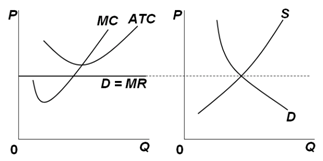
First graph depicts three curves as follows. A u-shaped curve, ATC, a straight line labeled D equals MR, and another u-shaped curve, MC. MC is near to the origin and intersects all other curves.The second graph depicts a decreasing curve, D and an increasing curve, S. S and D intersect each other and a dotted horizontal line from the end point of curve, D equals MR (in the first graph) crosses the intersecting point of curves, S and D.
Which of the following statements is true?
Multiple Choice
The firm should increase production in the short run.
The firm is generating a loss.
Correct
The firm is earning a normal profit.
The firm is making economic profits.
Use the following graph showing the average total cost curve for a perfectly competitive firm to answer the next question.
At the long-run equilibrium level of output, this firm's profit
Multiple Choice
is zero.Correct
is $400.
is $200.
cannot be determined from the information provided.
S
uppose that the market for corn is perfectly competitive. If corn farmers are currently generating losses, then we would expect that in the long run the market
Multiple Choice
supply curve will shift to the left.Correct
supply curve will shift to the right.
demand curve will shift to the left.
demand curve will shift to the right.
A perfectly competitive firm does not try to sell more of its product by lowering its price below the market price because
Multiple Choice
its competitors would not permit it.
it can sell all it wants to at the market price.Correct
this would be considered unethical price chiseling.
its demand curve is inelastic, so total revenue will decline.
Which of the following statements about perfect competition is true?
Multiple Choice
In the short run, firms can only generate economic profits.
In the long run, the entry and exit of firms will generate economic profits for firms.
In the long run, the entry and exit of firms will generate losses for firms.
In the long run, the entry and exit of firms will generate normal profits for firms.
Correct
An industry in which the firm’s cost structures do not vary with changes in production will have a long-run supply curve that
Multiple Choice
is perfectly inelastic.
is perfectly elastic.
Correct
slopes upward.
slopes downward.
Use the following graph showing the average total cost curve for a perfectly competitive firm to answer the next question.
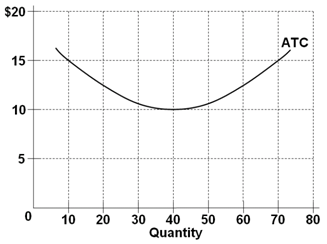
The horizontal axis ranges from 0 through 80, in increments of 10 and the vertical axis ranges from 0 through 20, in increments of 5. A u-shaped curve opening upwards labeled ATC begins from data point (7, 16), reaches its minimum at data point (40, 10) and ends at data point (73, 16). All the values used in description are approximate.
At the long-run equilibrium level of output, this firm's total revenue
Multiple Choice
is $10.
is $40.
is $400.Correct
cannot be determined from the information provided.
A perfectly competitive firm does not try to raise its price above the market price because
Multiple Choice
its competitors would not permit it.
it would not be able to sell its output.
Correct
this would be considered unethical price chiseling.
its demand curve is inelastic, so total revenue will decline.
A perfectly competitive firm will be willing to produce even at a loss in the short run, as long as
Multiple Choice
the loss is smaller than its total variable costs.
the loss is smaller than its marginal costs.
the loss is smaller than its total fixed costs.Correct
price exceeds marginal costs.
Where do you find profit maximixing level of output?
Where marginal revenue equals marginal cost Correct
Where marginal revenue equals demand
Where ATC and AVC meet
Finding weekly profit:
Total Profit-ATC
A firm will not produce any output if:
A. Game theory is the study of
multiple choice 1
dominant strategies of consumers purchasing large goods.
the behavior of firms operating in a purely competitive market.
the strategic behavior of decision makers. Correct
b. A firm is said to have a dominant strategy if
multiple choice 2
it works with other firms in the industry to earn monopoly profits.
the highest payoff strategy is the same no matter the other player's strategy. Correct
the firm is acting using strategic behavior in order to minimize costs.
c. The market outcome when examining a payoff matrix is the
multiple choice 3
marginal equilibrium.
oligopoly equilibrium.
Nash equilibrium. Correct
d. True or False: The market outcome always yields the highest profits for all firms.
multiple choice 4
True
False Correct