MEMORY
Encoding- transformation of sensory input into a memory trace.
Coding- form in which information is stored, manly visually, acoustically or semantically.
Storage- holding and retaining memories after registering them.
Capacity- amount of information stored at a given time .
Chunking- method of increasing STM capacity by grouping information into larger units.
Duration- length of time information remains in storage.
Retrieval- locating and recalling memories.
Sensory register- short duration store holding impressions of information received by the senses.
Short term memory- a temporary store holding brief amounts of information for small periods.
Long term memory- a permanent store holding limitless amounts of information for long periods.
TYPES OF LTM:
Episodic- events and personal experiences.
Semantic- facts, knowledge and meaning.
Procedural- skills and knowing how to do things.
MULTI-STORE MODEL:
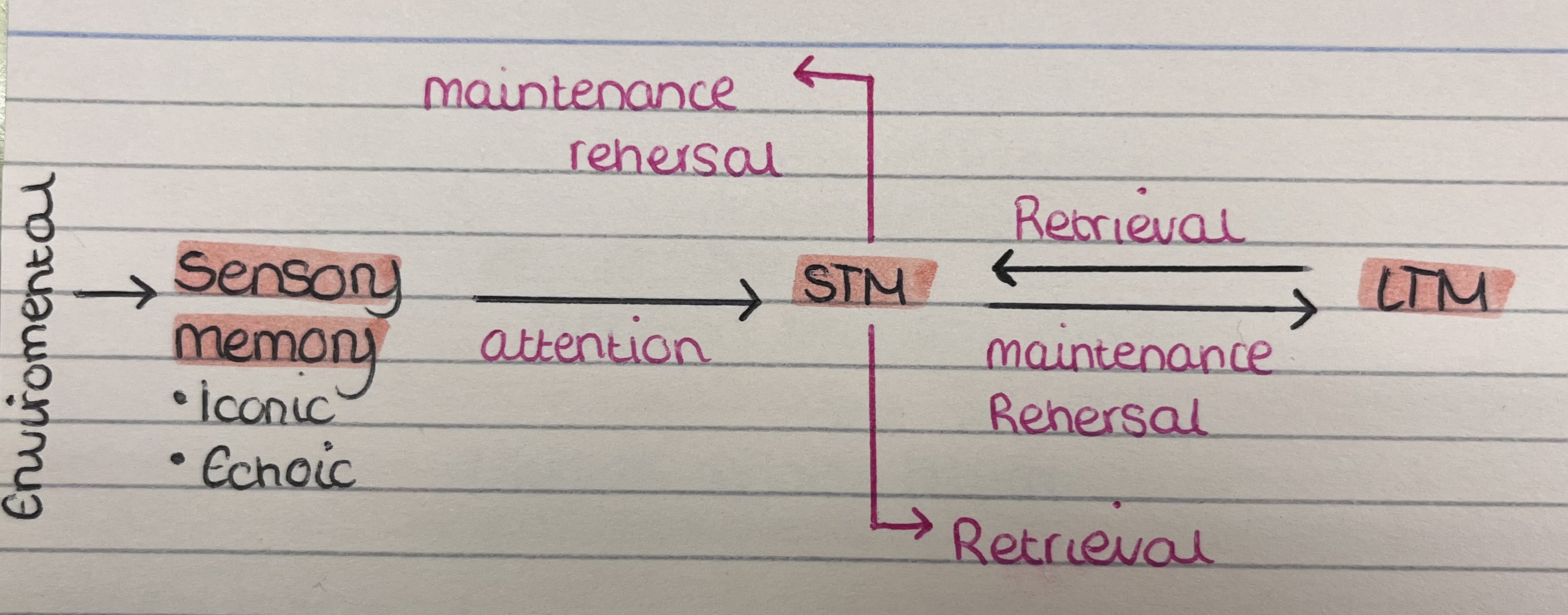
Created by Atkinson and Shiffren (1968)
STM lasts 15-30 seconds
May decay if rehearsal isn’t frequent
Sterling tested this using a tachyscope which flashed symbols to participants every one twentieth of a second.
Limitations:
Too simplistic - says STM and LTM are single stores but research (KF) shows they have different parts.
Unrealistic- MSM says rehearsal puts information into LTM but some tings are remembered without rehearsal.
WORKING MEMORY MODEL:
Central Executive- attentional process that filters incoming data, makes decisions and allocates slaves to tasks. Has limited capacity.
Phonological Loop- a slave system that deals with auditory information. Loop capacity is 2 seconds.
→ Phonological Store- speech perception
→ Articulatory Process- maintenance rehearsal
Visio spatial sketch pad- second slave system which stores visual and/or spatial data used to help people navigate and environment.
→ Visual Cache- visual data
→ Inner scribe- spatial relationships
Episodic buffer- third slave system. Acts as a temporary store for CE, containing visual, spatial, verbal information processed by CE, PL, VSS. Maintains a sense of time sequencing and links the working model to LTM.
Limitations:
Unclear- CE process is not defines and therefore cannot be directly measured.
Unreliable- case studies lack control (KF) and may not generalize the wider population.
PROACTIVE AND RETROACTIVE INTERFERENCE
Effect in STM: Argues that forgetting occurs because interference in STM prevents memories going to the LTM.
Effect in LTM:
Best explains the kind of forgetting that happens when we mix p every day life.
New information is learnt, cognitive connections get confused, especially if old information is similar to old information, which will result tin give the wrong answer.
Proactive interference- old information blocks new information recall.(Underwood 1957).
Retroactive interference- new information blocks old invofrmation recall. (Muller 1900).
ENCODING SPECIFICITY PRINCIPLE
The greater the similarity between encoding and retrieving the event, the reader the likelihood of recalling the original memory.
Tulving (1983) says that forgetting is the result of an accessibility problem due to cues at encoding not being present at the time of retrieval.
CONTXT DEPENDENT- external cues (place)
Procedure: Godden and Baddeley studied deep sea divers to see if raining on land helped their work underwater.
Divers learned a list of words either underwater or on land and were asked to recall them underwater or on land.
Findings:
Accurate recall was 32% lower in the non-matching conditions.
In the non-matching conditions, external cues available at learning were different from the ones available at recall and led to retrieval failure.
STATE DEPENDENT- internal cues (emotions)
POST-EVENT DISCUSSIONS
CONFORMITY EFFECT
Procedure: Gabbert got participants in pairs and each partner watched a different video of the same event.
Pairs in one condition were encouraged to discuss the event before recalling.
Findings: 71%who discussed the event made mistakes recalling items acquired during discussion.
REPEATED INTERVIEWING
Each time an EW is interviewed there is a possibility that comments from the interviewer will become incorporated into their recollection if events.
Interviewer may also use leading questions and alter the individuals memories of the event.
Deffenbacher reviewed 21 studies of the effect if anxiety on EW memory.
10 results had results that linked to high arousal levels to increased EW accuracy. Whilst 11 showed the opposite.
Concluded that when anxiety i too extreme, accuracy wil be reduced.
Christianson + Hubintte found evidence of enhanced recall when questioning 58 real witnesses to back robberies ( witnesses were either victims or bystandanders)
75% accurate detail.
Those who were anxious (victims) had the best recall.
Concluded that memory for emotional events is better then neutral events.
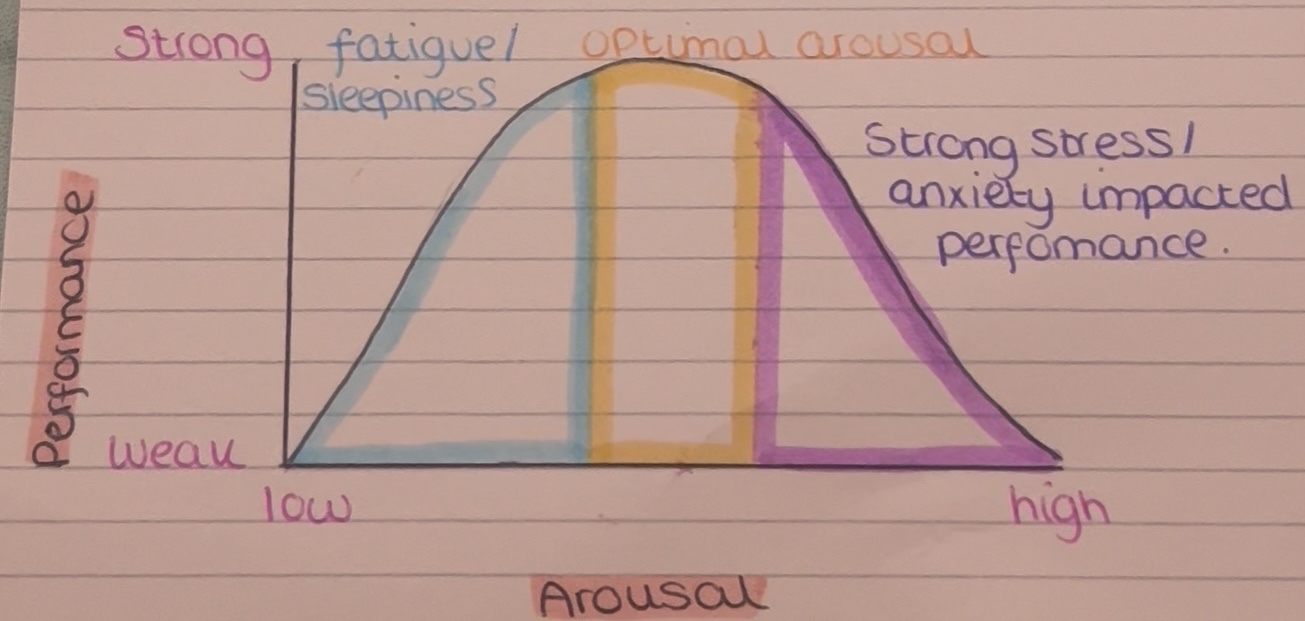
INVERTED U THEORY- observations that arousal has a negative effect on performance when it is very low or very high, but moderate levels are actually beneficial.