interpreting Data on risk factors
correlation is where a change in one variable occurs at the same time as a change in another variable
causation is where the change in one variable causes the change in another variable
correlation ( a relationship between 2 variables) between a risk factor and a disease doesn’t mean that a casual relationship exists
scientists cannot assume that because there is a correlation between variables that one has caused the other
many other factors will influence the prevalence and likelihood of disease and these factors need to be taken into account when analysing and interpreting data
evaluating validity of data
larger sample sizes are more likely to give valid results as the sample is more likely to be representative of the population in question
results = valid if they are not influenced by external variables or poor experimental design, and have been analysed correctly
studies should be repeated or there should be many studies that show the same result, before conclusions can be drawn.
e.g.
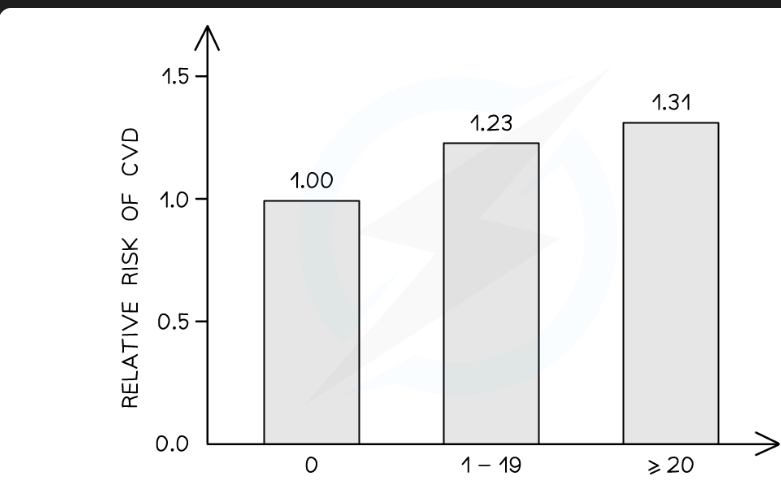
A description for this data could include the following
Non-smokers exposed to 0 cigarettes per day have the lowest relative risk of CVD, with a relative risk of 1.00
Non-smokers exposed to 20 or more cigarettes per day have the highest risk of CVD, with a relative risk of 1.31
As the number of cigarettes smoked per day increases, the relative risk of CVD increases from 1.00 at 0 cigarettes per day, to 1.23 at 1-19 cigarettes per day, and then to 1.31 at 20 or more cigarettes per day
A conclusion for the data could be
There is a correlation, or an association, between increased exposure to cigarette smoke and an increased risk of CVD
Note that while it could be concluded here that increased exposure to smoking causes an increase in the relative risk of CVD, it is best not to draw causal connections without more evidence
This is only a single study; there may be concerns over its validity, and other studies could show conflicting evidence
A commentary on the validity of the data could include
The study included 523 people; this is a fairly small sample size and may not represent an entire population
This is only one study; more studies would need to be carried out to back up these results
Being able to replicate, or repeat, the results of a study shows that the results are reliable
There is no information on how other risk factors might be interacting with smoking to influence the risk of CVD
Risk factors such as age, diet, biological sex, or exercise levels may be playing a role, as these factors may be interacting with the smoking variable e.g.
Smokers are often older
More men may smoke than women
Smokers may be less likely to exercise
The data doesn't comment on the use of any statistical tests so we cannot state the significance of the differences between the different levels of smoke exposure
Recognising conflicting evidence
Evidence from one study is not enough to conclude that a risk factor is a risk to health or associated with a particular disease
Studies similar in design would need to be analysed together to make links
Such an analysis is referred to as a meta-analysis
Similar conclusions would need to be drawn from all studies in order to accept the findings
Conflicting evidence may be found that leads to a different conclusion
Conflicting evidence is that which shows a different pattern to the evidence gained elsewhere
When conflicting evidence arises, more research is needed to show which pattern is correct
Conflicting evidence is often a sign that other variables are involved
perception of risk
Risk is defined as the chance or probability that a harmful event will occur
The statistical chance of a harmful event occurring needs to be supported by scientific evidence gained from research
An individual's perception of risk may be different to the actual risk of something occurring
Risk can be overestimated because of factors such as
Misleading information in the media
Overexposure to information
Personal experience of the associated risk
Unfamiliarity with the event
The event causing severe harm
Risk can be underestimated because of factors such as
Lack of information
Misunderstanding of factors that increase the risk
A lack of personal experience of the associated risk
Unfamiliarity with the event
The harm being non-immediate