Unit 8 Chapter 22 - 23
Chapter 22
Energy Flow Through Ecosystem
Endotherms: use thermal energy from their metabolism to maintain body temperature
Ex. Mammals and birds
Ectotherms: do not have internal mechanisms for maintains body temperature and obtain heat from their environment
Must change their behavior in order to regulate their body temperature and obtain heat from their environment
Ex. fish
Metabolic rate: total amount of energy an organism uses per unit time
Smaller organisms have a higher metabolic rate than larger organisms
As size increases → metabolic rate decreases
Access to energy is key to maintaining the health of an organism
A net gain in energy can result in energy storage (fat) or growth
A net loss in energy can result to loss of mass or death
If energy becomes less available in an ecosystem the producers’ ability to perform photosynthesis will reduce
Some will die
Leads to massive decreases in the number of species and in population sizes of these species
Trophic levels represent steps in the food and energy transfer between organisms in an ecosystem
Classified into trophic levels based on their food and energy source
Primary consumers: herbivores
Secondary, tertiary, quaternary consumers: carnivores and omnivores
Food chains show the transfer of energy between these trophic levels
Food webs show the interconnection between organisms in different food chains and provide a more complete representation
Autotrophs: energy from physical (sunlight) or chemical (small molecules) sources
Photoautotrophs: sunlight
Chemoautotrophs: small inorganic molecules
Heterotrophs: energy from carbon compounds made by others
Obtain energy from carbohydrates, lipids, or proteins via breaking down these macromolecules
Decomposers: break down dead organic material allowing the nutrients in dead organisms to be recycled through ecosystems
Detritivores: obtain energy by consuming the organic waste of dead plants and animals
Kleoptoplast: when a heterotroph consumes an autotroph that it uses as food source but removes the chloroplast an incorporates them into its own cells
Moves into the sunlight and the chloroplast performs photosynthesis
Less energy has you move up trophic levels
Bottom - up: regulation of ecosystems; if the population size of the producers decreased there may not be sufficient food or energy for the remaining trophic levels and food web may collapse
Top - down: animals at higher trophic levels may help limit the population size at lower levels
Ex. Isolated rainforest caused isolation of top predators, without predators plant eating animals grew in higher rate, reducing the number of plants in these area
Availability of food and energy affects organisms’ reproductive strategies
Organisms that live in unstable environments will produce large number so offspring at a time because the survival rate of the offspring is lower
Organisms that live in more stable environments will produce fewer offsprings at a time since the likelihood of survival is higher
Chapter 23
Population Ecology:
Population: made of individual organisms that interact with on another and with their environment in complex ways
Population growth depends on a number of factors
Population size (N)
Birth rate (B)
Death rate (D)
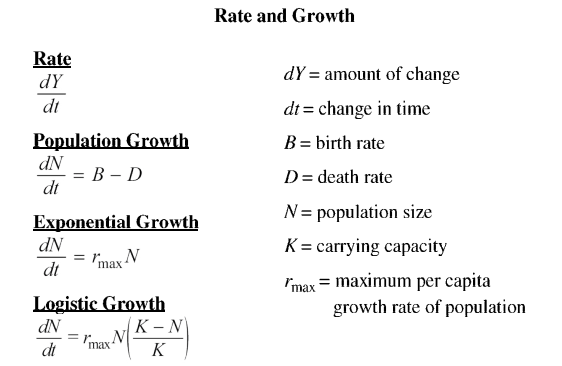
Population growth is calculated based on change in the population size over change in time
IF there is no limiting factors a population will experience exponential growth
Exponential growth curves are usually J - shaped
Some populations will eventually exceed the resources available in their environment, thus their growth will be limited
Factors that limit the growth can be either density-dependent factors or density-independent factors
These limitations result in logistic growth of a population
Carry capacity (K): the maximum population that can be supported by the available resources in an environment
Logistic growth curves start with a flat, lag phase, followed by a period of exponential growth or the log phase
K-selected vs r-selected Populations
Populations that live in more stable environments and have more energy available tend to have K-selected reproductive strategies
K - selected population have stable population sizes at or near the carrying capacity of their environment
Invest in parental care in their offspring resulting in a higher survival rate in their offspring
Populations that live in environments and have less energy available have r-selected reproductive strategies
Reproduce at a younger age and only once in their lifetime
Invest little or no parental care in their offspring
r - selected populations experience “boom or burst” cycles
Period of exponential growth followed by rapid decreases in the population size
Community Ecology and Simpson’s Diversity Index
Community: a group of interacting population living in the same habitat
Described by their species composition and diversity
Species composition is the number os species that line in an area
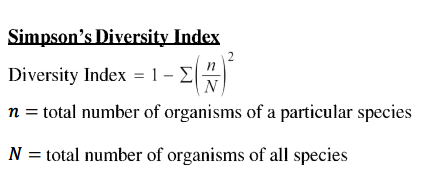
Species diversity reflects the number of species in an area and the number of members of each of those species
One way of representing species diversity is the equation for Simpson’s Diversity Index:
Relationships Within Communities
Competition: organisms compete for resources
Intrespecies: two different species
Intraspecies: same species
Predator/prey: Predator eat prey
Number of prey increase, predator numbers will follow an increase
Niche partitioning: competing species amy coexist if they ise the resources aailable in their habitat differently
Trophic cascades: far-reaching effects of the reduction of one trophic level in a food web
Parasitism: one species benefits from the relationship but the other species is harmed
Commensalism: one species benefits and the other neither benefits or is harmed
Mutualism: both are benefited
Biodiversity
Biodiversity is the variety of living organism in an ecosystem
Abiotic (nonliving)
climate and water availability
Geological events
Severe weather
Biotic (living)
Keystone species have a disproportionally large effect on an ecosystem compared to their numbers
When a keystone species is removed the ecosystem may be in danger of collapsing
Invasive species are species that are not native to a habitat
Human impact
Habitat destruction
New diseases into the ecosystem
Pollution that can make water sources less habitable
Adaption are generated by mutations