Working Memory Model
The Working Memory Model (WMM), which focuses specifically on the workings of short-term memory, was developed by Baddeley and Hitch (1974).
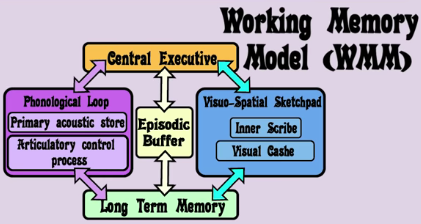
Central Executive - manages attention and controls info from other 2 stores
Phonological Loop - temporarily retains language-based information
Primary Acoustic Store
Articulatory Processes
Visuo-Spatial Sketchpad - temporarily retains visual and spatial information
Visual Cache
Inner Scribe
Supporting AO3
Baddeley (1975) asked participants to perform either 2 visual tasks or 1 visual and 1 verbal task simultaneously and found performance was better when tasks were not using the same processing. This suggests VSS and PL are separate stores and VSS has a limited capacity.
Shallice + Warrington (1970) - Case study of KF who had impaired verbal STM but visual
Prabhakaran et al (2000) - Used brain imaging to monitor which regions of the brain were activated when completing tasks involving spatial and verbal information. When tasks were intergrated, the prefrontal cortex was activated but not when tasks were separated, suggesting the EB involves the prefrontal cortex.
Limitations AO3
Central executive is vague and untestable
Many supporting studies take place in highly controlled lab settings and lack external validity (mundane realism)
Case studies can’t easily be generalised to the wider population.