Anesthesia Safety Program
Stages of Anesthetic Depth
Analgesia or Disorientation
Excitement of Delirium
Surgical Anesthesia
Overdose
Impacts
Mentation
Reflexes
Vitals
Other Physiological Effects
Recognizing the stages of anesthetic depth helps you assess how a patient is
responding to anesthesia in real time.
Pre-Anesthesia Risk Assessment and Planning
Patient Assessment
Knowing your patient's risk factors will allow you to develop your individual patient plan
Patient History
Know the History, Know the Patient.
Review Chart, Patient Hx, Medical Conditions, Current Meds, Past Anesthetic Events, Allergies, Adverse drug responses, General Temperament
Pre-Anesthesia Diagnostics
Chem Panel, CBC, Urinalysis, Blood Pressure, Radiographs, Etc.
Chem Panel - Assess overall health by evaluating the major organ systems of the body (including the liver, kidneys, and pancreas) as well as electrotypes and protein levels.
CBC - Tells us whether infection, inflammation, or anemia is present
Urinalysis (UA) - gives info on P’s kidney function, potential for infection, and hydration status. Urine sediment is also evaluated for crystals, casts, cells, and other microscopic components.
Blood Pressure - assess a P’s BP before anesthetic procedure to give us a baseline. Because drugs can cause a decrease in BP.
Radiographs - recommended before anesthetic procedures in geriatric patients or where there is a concern (like a ± FB).
Additional Testing - could be ECG, heartworm tests, thyroid level, or cloting times).
Patient Status Scale (ASA Status)
I - Normal (Normal Healthy Patients)
II - Mild (P w mild systemic disease)
Examples: Obesity, very young or geriatric patients, mild controlled conditions
III - Moderate (Patients with severe systemic disease)
Examples: Stable chronic heart disease, managed diabetes, compensated organ dysfunction
IV - Severe / Life - Threatening (Patients with severe systemic disease that is a constant threat to life)
Examples: Decompensating heart disease, acute metabolic crisis, severe respiratory compromise
V - Critical (Patients not expected to survive even with intervention)
Examples: Shock unresponsive to initial therapy, major trauma with instability, advanced systemic infection with organ involvement.
E - Emergency (Added to any ASA category to indicate an emergency)
High-Risk Patient Types
Principles of Balanced Anesthesia and Anesthetic Depth
What is balanced anesthesia? It’s a combo of drugs in smaller doses to achieve all components of anesthesia while minimizing side effects.
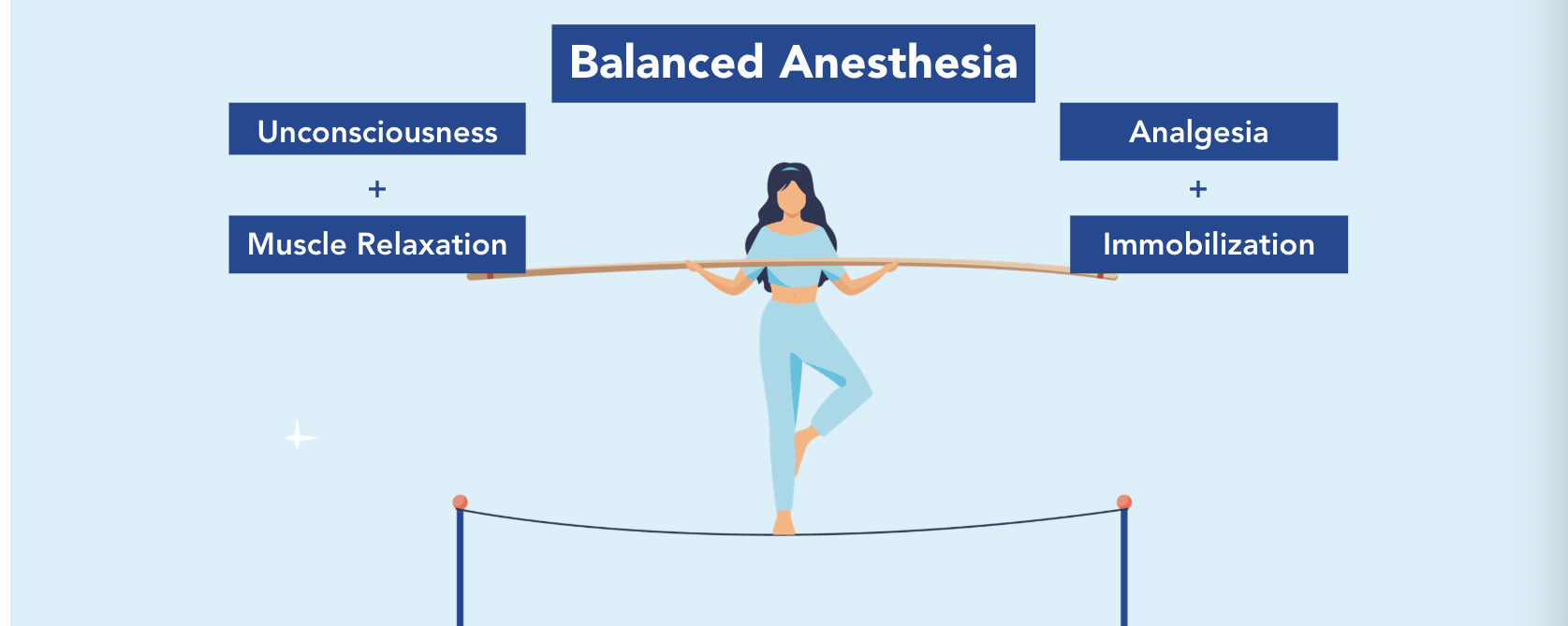
Unconsciousness - state in which P is unable to respond to stimuli or their environment
Induction Agents: Propofol, Alfaxalone, Ketamine & Tiletamine
Reversal Agents: Atipamezole, Naloxone, Flumazenil
= Muscle Relaxation - process of reducing involuntary muscle tension
Analgesia - reduction or elimination of the perception of pain w/o the complete or partial relief of pain without the loss of consciousness
Examples: Acetaminophen, Nonsteroidal Anti-Inflammatory Drugs (NSAIDs), Opioids
= Immobilization - act or process of preventing movement
Dose to effect: Knowing how much anesthetic to give isn’t just about weight or breed; it’s about how the patient responds.
Dose to effect = smallest effective dose
Avoids over- or underdosing
Drug Interaction: A factor to consider when monitoring your patient and adjusting the amount of anesthesia used, is how their body reacts to the drug.
Pharmacodynamics - The study of how a drug interacts and affects the body.
One size does NOT fit all - The P’s age, species, weight, and organ function when creating an anesthetic plan.
Anesthetic Depth - Refers to the level of central nervous system depression induced by anesthetic agents. (How deeply “asleep” or knocked out the patient is under anesthesia.)
We want an ideal middle ground: Unconscious w minimal vital function compromise.

Eye PUPIL Reaction to Anesthetic Depth - Looking at a P’s eyes during the anesthetic process and measuring the pupil size, will help you determine their anesthetic depth.
Puplilary Light Reflex - can help asses the P depth but only during the light sub-plane
Dilation is mediated by the balance between parasympathetic and sympathetic tone under anesthesia.

Four Stages of Anesthesia
Each stage has different effects on the P’s mentation, reflexes, vitals, and other factors.
Balanced anesthesia = Less inhalant
* ALSO to note: P who are pre-medicated with appropriate drugs and doses, may pass directly to stage 3 from stage 1 w/o signs of stage 2.
Stage 1: Disorientation
Mentation: Conscious but disoriented
Reflexes: Reduced sensitivity to stimuli
Vitals: RR & HR may be normal or increased
Other: P may struggle, urinate and/or defecate, and show fear or anxiety
Stage 2: Excitement
Mentation: Begins to lose consciousness
Reflexes: Present but exaggerated
Vitals: Irregular breathing, decreased RR or apnea (cessation (temporary stop) of breathing), increased HR
Other: Yawning, vocalization, and/or struggling
ALSO to note: P who are pre-medicated with appropriate drugs and doses may pass directly to stage 3 from stage 1 w/o signs of stage 2.
Stage 3: Surgical (divided into 4 sub-planes)
Light *Even though P appears unconscious, painful stimulus isn't tolerated*
Mentation: Unconscious
Reflexes: Depressed
Vitals: Respiratory pattern becomes regular
Other: Eyes are central, intubation is ±, involuntary movement ceases
Medium *Good anesthetic plane. Suitable for most procedures.*
Mentation: Unconscious
Reflexes: Diminished or absent
Vitals: Respirations are regular, but may be shallow, HR and BP may be steady or slightly increased
Other: Pupils slightly dilated, eyes are ventral, skeletal tone more relaxed, surgical stimulus may evoke mild increase in HR or RR, but P remains unconscious and immobile.
Deep *too much anesthetic! Too deep for most procedures*
Mentation: Unconscious
Reflexes: Absent
Vitals: Significant cardiovascular and respiratory depression
Other: Jaw tone slack, eyes central, pupils moderately dilated
A slack jaw means having a relaxed, loose, or dropped lower jaw with little to no muscle tension.
Very Deep *in danger of respiratory & cardiac arrest*
Mentation: Unconscious
Reflexes: Absent
Vitals: Rocking ventilatory pattern, abdominal muscles become increasingly responsible for ventilation, dramatic increase in HR, decreased BP, pale MM, prolonged CRT
Other: Fully dilated pupils
Stage 4: Overdose AVOID at all costs
Cessation of respirations
Circulatory collapse
Cell damage/death
Practice Questions:
You have a patient under anesthesia and are checking their reflexes when you notice that there is no jaw tone, no palpebral reflex, and the blood pressure has dropped. Based on your observations, which sub-plane of Stage Ill anesthetic depth do you think this patient has reached?
a. Light
b. Medium
c. Deep
d. Very Deep - “The lack of reflexes and drop in BP indicate that this patient is very deep sub plane. Action must be taken.”
On your next procedure, you check your patient's reflexes and find that jaw tone is relaxed, the third eyelid is present, and their heart rate and blood pressure appear regular and stable. When the veterinarian makes an incision, there is very minimal increase in the heart rate and the patient remains immobile. Based on your observations, which sub-plane of Stage Ill anesthetic depth do you think this patient has reached?
a. Light
b. Medium - “The P is in the ideal medium sub-plane, best suited for most surgical proce
dures.”
c. Deep
d. Very Deep
Adjusting Anesthetic Depth
Constant
Same inhalant level throughout procedure.
Risk / Outcome: May overmedicate during low-stimulus period.
Reflexive
Adjusted only after signs of pain or reactivity.
Risk / Outcome: P already feels stimulus - too late - pain harder to control.
Preventive
Inhalant adjusted proactively based o
n vitals and patient’s response
Risk / Outcome: Ideal; balances safety and effectiveness
Inhalant: An anesthetic gas agent that is administered via inhalation, such as isoflurane or sevoflurane.
Scenarios:
Your team uses the "reflexive" adjustment method for vaporizer changes. During a procedure, the patient's heart rate jumps by 30%, and they begin paddling. What's the problem with relying only on this method?
a. It responds too late-after the patient is already reacting. “Reflexive adjustments respond only after signs appear, which may mean the patient is already under stress or feeling pain.”
b. It requires invasive monitoring
c. It prevents balanced anesthesia
d. It uses too much gas
A cat under anesthesia appears unconscious but exhibits a strong toe-pinch withdrawal. This is most likely the result of which anesthetic stage?
a. Light - Stage III. “While the P appears to be unconscious, the presence of a strong reflex indicates only a light sub-plane.
b. Medium - Ideal surgical plane Stage III
c. Deep - Stage III
d. Too deep - Stage IV
Your patient under anesthesia begins to blink and shows increased jaw tone during a routine procedure. What is the best immediate response?
a. Proceed with surgery since other parameters are normal
b. Administer a full induction dose of propofol
c. Either increase the anesthetic inhalant slightly or give a small bolus of the induction drug while monitoring the patient's response and determining if other sedatives or analgesics are needed. “A subtle increase in anesthetic inhalant or a small bolus of the induction drug helps deepen the anesthetic plane while giving you time to observe the patient's response safely and decide with the team if more sedation or analgesia is needed.”
d. Stop the procedure immediately and wait for signs to resolve
You're preparing a patient for a routine anesthetic procedure. What elements should your balanced anesthesia plan include?
a. Drugs that each contribute to sedation, pain control, and unconsciousness, while reducing risk. “Balanced anesthesia combines different drug types to meet all patient needs while reducing risk.”
b. One primary anesthetic agent supported by oxygen and fluids
c. Inhalant anesthesia supported by oxygen, without additional injectable medications
d. A simplified protocol using only the minimum drugs needed to induce and maintain anesthesia
You are slowly administering an induction agent to a patient. After giving half of the planned dose, the patient becomes relaxed, loses jaw tone, and shows no palpebral reflex. What should you do next?
a. Proceed with intubation and stop further administration. “Dose-to-effect means stopping when the desired level of anesthesia is reached, even if you haven't used the full calculated dose.”
b. Continue giving the rest of the dose to be safe
c. Administer a reversal to lighten the plane
d. Pause and observe the patient for another 5 minutes
Final Assessment Questions:
Balanced Anesthesia: Which Statement best describes the goal of balanced anesthesia?
a. Prioritizing immobilization over analgesia
b. Maintaining a constant inhalant level throughout the oricedyre
c. Using a single anesthetic agent to achieve unconsciousness
d. Combining multiple drugs to achieve anesthesia wile minimizing side effects. “Balanced anesthesia uses multiple agents in smaller doses to achieve unconsciousness, analgesia, and muscle relaxation while reducing adverse effects.”
Dose to Effect Application: What is the primary advantage of administering anesthetic drugs using a dose-to-effect approach?
a. It allows dosing to be adjusted based on individual patient response. “Dose-to-effect prioritizes patient response over preset doses, helping avoid over- or under-dosing.”
b. It eliminates the need for most monitoring
c. It shortens recovery time for patients
d. It standardizes anesthesia and patient response across species