Intuitionism
Key Terms:
Intuitionism: The idea that moral truths are indefinable and self-evident
Naturalistic Fallacy: The idea that it is a mistake to define moral terms with reference to other non-moral or natural terms
Key Quotes:
‘If I am asked What is good?, my answer is that good is good, and that is the end of the matter. Or if I am asked, How is good to be defined?, my answer is that it cannot be defined, and that. is all I have to say about it’ - G.E Moore, Principia Ethica
What is intuitionism?
Intuitionism believes that moral truths can't be discovered by observation of the world. Right and wrong are not able to be defined, but are self-evident. We are able to know then by our intuition. Like naturalism, a is a moral realist theory, believing that moral facts or truths actually exist, and is also cognitivist, believing that statements made about right and wrong are subject to being either true or false. Like naturalists, they believe that ethical terms are meaningful; however, they differ from naturalism regarding how moral values come to be known.
Moore's intuitionism
The most famous thinker to argue for intuitionism is G.E. Moore
(1873-1958). The following is a summary of his views.
• Moore identifies the naturalistic fallacy as the key error that naturalism makes. For any natural property - for example, pleasure - we can still ask the question, 'Is pleasure really good?' The fact that it is possible to answer 'No' shows that pleasure (and other natural properties) are not the same as good
We don't recognise goodness through empirical facts; the 'good' is self-evident to our intuition.
• Moore uses the analogy with the colour yellow to explain how this intuition might work. If we were asked to describe yellow or present an argument that an object was yellow we would find the task difficult We only answer the question of 'What is yellow?' by pointing to an object that is yellow. We are similarly able to recognise goodness. It cannot be defined but it can be shown and known.
Moore explains the difference between simple and complex ideas: complex ideas - for example, a horse - are ideas that can be broker down into parts: the legs, the neck, etc. Simple ideas, such as the c yellow, cannot be divided into parts. Moore states that goodness is simple idea and simple ideas are grasped by intuition.
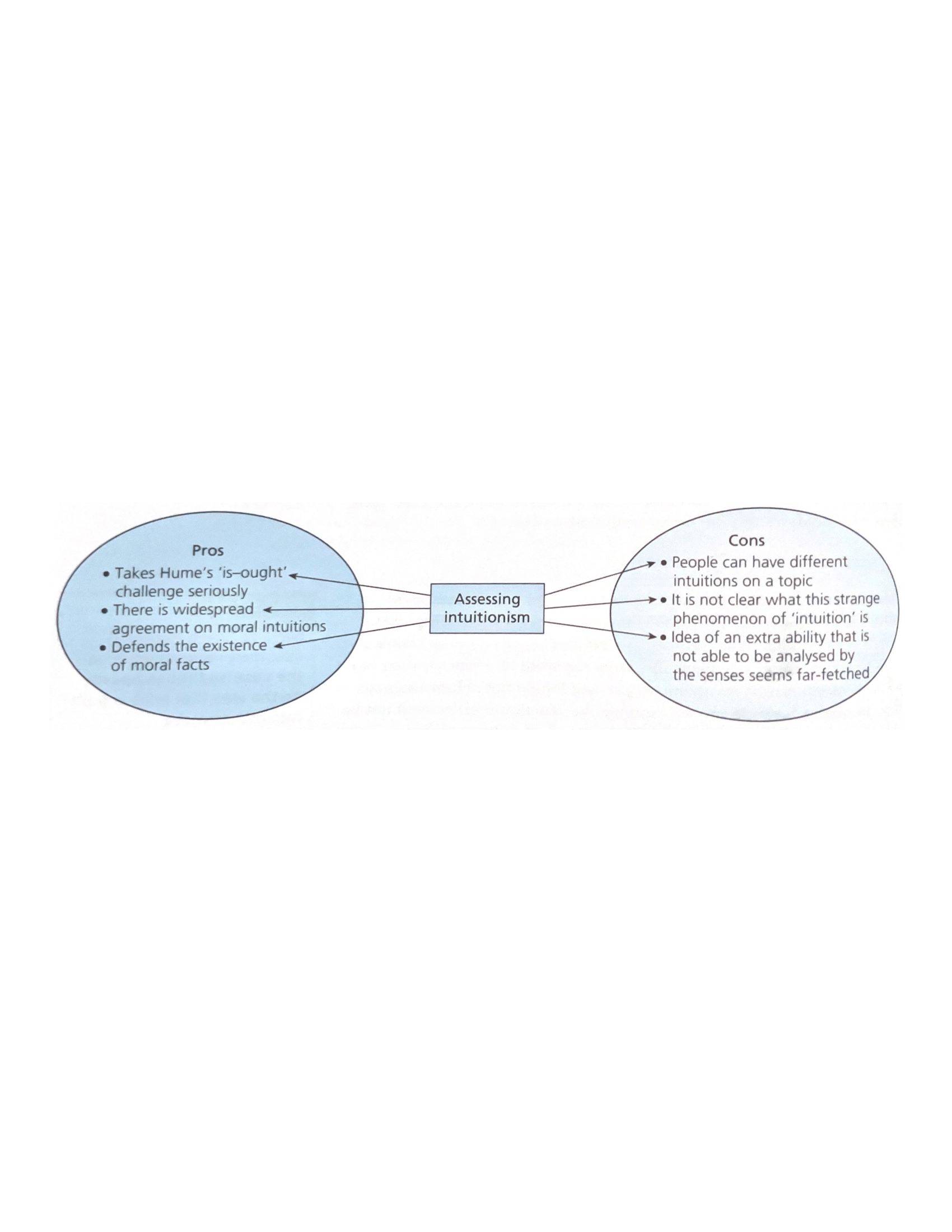
Assessing Intutionism: Do people just know what is right and wrong?