Mass communication: Unit 1
Meaning
Communication is a process of sharing or exchange of ideas, information, knowledge, attitudes or feelings among two or more persons through certain signs and symbols.
Definition
“The transfer or conveying of meaning” Oxford dictionary
“transmission of stimuli” Colin Cherry
“one mind-affecting others” Claude Shannon
“One system influences another” Charlies E Osgood
“The mechanism through which human relations exist and develop” Wilbur Schramm
Functions of Communication
The primary function of communication is to inform, educate and influence people to make them function smoothly and effectively
Information: Communication provides us with enormous information about the environment in which we live. Information such as news of war, danger, crisis, famine etc is important because that helps us take appropriate steps to safeguard our interests.
Instruction: One of the major functions of communication is to instruct, educate and socialize the members of the society. Communication provides a fund of knowledge, expertise and skills that enable people to operate as effective members of society. It also creates awareness and gives direction and opportunity to people so that they actively participate in public life.
Entertainment: Humans must be entertained to divert their attention from the troubles and tensions of daily life. Communication provides boundless entertainment to people through pictures, films, music, drama, dance, art, literature, comedy, sports, games etc
Persuasion: Persuasion helps in reaching decisions on public policy so that it is possible to control and govern.
Debate and discussion: It is through debate and discussion in media that the public can clarify different points of viewpoint on issues of public interest and arrive at a general agreement
Cultural promotion: Communication provides an opportunity for culture to be preserved and promoted. It stimulates the individual to pursue and fulfil their creative urges
Integration: Communication is a great integrating tool. Through a fund of knowledge of information, groups come to know one another and appreciate each other’s way of life.
Process of communication
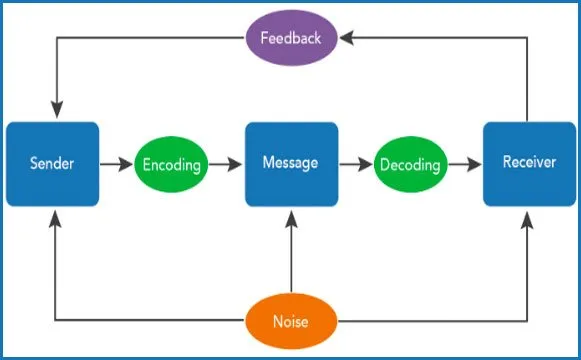 The Communicator (sender or encoder) is the one who initiates the communication process. Before one speaks or writes the message is first conceptualised and then encoded.
Encoding is the formulation of messages in the communicator’s mind the communicator not only translates his purpose into a message but also decides the medium to communicate.
Message is what a communicator actually produces for transmission using spoken or written words, photographs, paintings, films, posters etc. The success of communication depends on what we say and how we say it.
The Channel is the vehicle through which a message is carried from the communicator to the receiver.
The Receiver at the other end of the communication is the recipient of the message. If the receiver does not have the ability to listen, read, or think they will not be able to receive and decode the message.
Decoding is the interpretation of the message by the receiver. The receiver looks for the meaning in the message which is common to both receiver and sender.
Feedback is the response of the receiver to the communicator’s message. The exchange is only possible if the receiver responds.
Elements of communication (SMCR)
Sender: Sends the message
Message: Any piece of information that we exchange
Channel: Medium/Platform
Receiver: Receives the message
Process —→ Decoding
Kinds of communication
Intrapersonal Communication
It refers to communication that takes place inside a person. It is like talking to oneself and listening to oneself. Intrapersonal is important to conceptualize and formulate our thoughts or ideas.
Interpersonal Communication
This is a universal form of communication that takes place between two individuals. Since it is person-to-person contact, it includes everyday exchanges that may be formal or informal and can take place anywhere by means of words, sounds, facial expressions, gestures and postures.
Group Communication
Group communication is an extension of interpersonal communication where more than two individuals are involved in the exchange of ideas, skills and interests. Groups provide an opportunity for people to come together to discuss and exchange views of common interest.
Mass Communication
Any mechanical device that multiplies messages and takes it to a large number of people simultaneously is called mass communication.
Mass communication is a special kind of communication in which the nature of the audience and the feedback is different from that of interpersonal communication.
Components of Mass communication:
Audience: : Whosoever is the recipient of mass media content constitutes its audience.
For instance, individuals reading newspapers, watching a film in a theatre, listening to radio or watching television, are situations where the audience is large, heterogeneous, anonymous in character and physically separated from the communicator both in terms of space and time.
Feedback: Feedback in mass media is rather a cumulative response that the source gets after a considerable gap in time. it is often expressed in quantitative terms: like circulation figures of newspapers and magazines, the popularity of a movie at the box office, the success of a book based on its sales, or the findings. a public opinion poll and based on other feedback &vices which are used to determine what is acceptable or unacceptable to different audiences
Mass Media
Stages of Communication
Age of signs and symbols: Used noises/body movements.
Age of speech and language:
Cro Magnonman used his full efficiency and ability to communicate.
Human beings moved from place to place and learnt new languages.
Developed words, alphanumerical and basic syntax
Age of writing
After speech and language almost after few thousand years, started writing with practical and photographic presentations.
It led to the development of the phonetic system
Age of printing
Johannes Gutenberg is known as the father of printing.
The first print was of 200 copies
Age of Mass Communication
Newspapers are the first step in mass communication
Newspapers were introduced in the 19th century
Age of revolution
The Internet has given rise to the “age of information” an age in which information has been turned into the primary commodity of commerce and trade.
Barriers in communication
Semantic Barrier
It is also called the language barrier
It is caused due to improper communication
There is a lack of clarity/complexity
Poor quality of words
Psychological Barrier
Premature evolution of the information by the receiver
Inadequate attention by the receiver
Information being passed within multiple sources leads to distortion
Organization barrier
Structure/Multiple leaders: Multiple resources for the same information or information being passed down from one hierarchy to down
Cultural Barrier
Difference in similarity
Difference in slangs
Physical barrier
Any physical object that is a medium of communication dysfunctions leads to this barrier
Eg: Mic not working
Physiological barrier
The sender/receiver is not able to communicate because of some medical conditions/disorders
Eg: Nerve disorder or anything that alters speaking/listening abilities.