Ethics Ch 3
Chapter 3: Values and the Helping Relationship
Controversies Regarding Integrating Personal Values With a Professional Identity
Counselors must respect the values of their clients and have the ability to work with a range of clients with diverse views and values
Unconditional positive regard
Religious values of some counselors are in conflict with the affirmation of diverse sexual orientation
15 CACREP-accredited programs in faith0based institutions were found to have anti-LGBT codes/disaffirming codes
Counselors here may feel justified in exposing their clients to their religious beliefs…even though ethical practice requires counselors to refrain from imposing their personal beliefs on clients
17 CACREP-accredited faith-based programs were found with LGBT-affirming codes
“it is time for the field to provide clarification on the systematic issue of how to negotiate accreditation practices related to religious institutions that disaffirm/disallow LGB-identified students/faculty”
Clarifying Your Values and Their Role in Your Work
Ethical bracketing: intentional setting aside of the counselor’s values to provide ethical counseling to all clients
Counselors must develop the ability to manage their personal values so they do not unduly influence the counseling process
This does not mean surrendering/changing values
“Can I put values statements in my informed consent that communicate the nature of my values to clients so they can make an informed decision about whether to enter a professional relationship with me?”
Doing this would put an emphasis in the wrong place…on the counselor’s value
Can come off as judgemental to clients…
The process of counseling is meant to help clients discover their OWN resources for dealing with problem
The Ethics of Imposing Your Values on Clients
Value imposition: counselors directly attempting to influence a client to adopt their values, attitudes, beliefs, and behaviors
This can happen intentionally or unintentionally
A key aspect of informed consent is clarifying with clients the potential ways values can influence psychotherapy
This can guard against undue influence by the therapist
Example: In some addiction treatment programs, the client must accept there is a power higher than themselves…some addiction counselors may be tempted to impose their own personal beliefs of what the higher power is (which raises ethical issues)
In group work, value imposition may come from both the leader and the members of the group
Some members may inappropriately respond by advising another member
Leader have a responsibility to intervene so members do not impose their values on others
Function is to help members with answers congruent to their own values
Value Conflicts: To Refer or Not to Refer
All counselors are expected to have basic competencies across race, ethnicity, gender, sexual orientation, and all other characteristics listed in the non-discrimination statement of the ACA Code of Ethics
Disagreeing with a client’s values are not ethical grounds for a referral
Value conflicts can be worked through successfully
A referral can be considered only when you lack the skills and knowledge to deal with the issues presented by the client
In this case, you should seek further education to become competent in dealing with the issue
To handle value conflicts, you must maintain awareness of potential conflict areas with clients
You can monitor your own internal reactions to clients throughout the therapeutic process
Referring clients because their religious beliefs conflict with your values can and DOES lead to feelings of abandonment
Violates the ethical principle of “do no harm”
Before considering a referral, explore your part of the difficulty through consultation/supervision
What internal barriers would make it difficult for you to work with a client who has a different value system?
Seeking supervision is the ethical course of action is to seek supervision and learn ways to manage the differences effectively
If a counselor discloses not being able to get beyond value differences, clients may interpret it as a personal rejection and suffer harm as a result
Discriminatory Referrals
The mandate to avoid discriminatory referrals is consistent with Carl Roger’s unconditional positive regard
Different professions have different positions on the justification for referral
Insufficient training is sometimes used as an excuse to disguise the real reason for making a referral
The counselor’s difficulty with the client’s values
Counselors also inappropriately rationalize referrals as a way to provide the client with the best services, but this may ultimately be discriminatory
A study on family therapists’ beliefs and practices found that a majority of participants believe it is ethical to refer LGBTQ+ clients based on counselors:
values and religious beliefs
negative beliefs about LGBTQ+ people and relationships
lack of competence in working with LGBTQ+ individuals
^ This was surprising because referral based on sexual orientation is a discriminatory practice
Ask these questions if you want to make a referral based on a value conflict:
what skills and I lacking in counseling a client struggling with a critical life decision?
Is this my issue and feelings of discomfort or are these my client’s feelings?
Can I obtain the knowledge necessary to acquire competence through continuing education, consultation, or supervision?
What barriers may be preventing me from gaining that knowledge, supervision, or consultation?
How can I determine what would ethically justify referral?
The Legal Framework Regarding Values Discrimination
The Alliance Defending Freedom (ADF) is a legal organization that defends individuals and organizations whose conservative religious views or actions are challenged in various arenas of public life.
State Legislation to Protect Religious Freedom
In some states “freedom of conscience” clauses are being inserted into legislation in an attempt to protect religious freedom
Arizona’s Senate Bill 1365: ensures mental health professionals will not put their licensure status in jeopardy by denying services to clients based on religious beliefs
Tenessee passed controversial legislation in 2016 that would allow therapists with “sincerely held principles” to deny services to LGBTQ+ clients without risk of legal consequences
Mental health professionals should be able to work with the diversity of worldviews, beliefs, and cultural identities
is counseling students are not willing to learn to work with the wide range of clients they will encounter, it is suggested they reconsider if counseling is the right profession for them
Informed Consent on Managing Personal Values
Students must be informed about what is expected of them as ethical practitioners
especially their ethical responsibilities when working with clients who have diverse value systems
Values Statement: offers a path where trainees can maintain their values and offer care to diverse others…outlines the competencies expected of trainees
Training programs may use this to inform students about the competencies they will be expected to develop
Students should be told that they cannot ethically discriminate against clients because of a different in values prior to admission
Seeking Supervision Regarding Your Values
Through supervision, counselors in training can learn how to manage their values
They can guard against unintentionally imposing their values on clients
Values Conflicts Regarding Sexual Attitudes and Behavior
Ignoring talk of sexuality with clients can lead to unintended harm and negative outcomes
The more experience students have in talking openly about sexuality in their training, the greater the likelihood that they will raise relevant issues of sexuality with their clients
Value Conflicts Pertaining to Abortion
Counselors may experience a value clash with their clients on the issue of abortion.
Counselors are obligated to familiarize themselves with the legal requirements in their state that relate to abortion, especially if they are counseling minors
Striving for Openness in Discussing Values
When you experience discomfort due to a clients system of values, challenge yourself to develop ways of working with this client
Ask yourself why the different values cause you discomfort
Try to work collaboratively to identify the value system of your clients
determine the degree to which they are living in accordance with THEIR core values
The emphasis should be on the client’s problem, not on your problem with the client
The role of spiritual and religious values in counseling
In earlier years, the role of spirituality and religion in counseloring was not considered an appropriate topic
spiritual assessment provides insight into how a client relates spirituality and religion and who that may affect the client
Spiritual and Religious values in assessment and treatment
The exploration of spirituality or religious influences can be just as significant as exploring family of origin influences
Frame presents many reasons for conducting assessments in the area of spirituality in counseling
understanding the worldview and the contexts in which clients live
assisting clients in grappling with questions regarding the purpose of living and what they most value
exploring religion and spirituality as client resources
uncovering religious and spiritual problems; and determining appropriate interventions
When clients indicate they are concerned about any of their religious beliefs or spiritual concerns or practices, the therapist needs to be capable of working at this level
counselors must be mindful of how this topic is introduced into the therapy process
It is not appropriate to urge clients to explore religion and spirituality if they do not see these as relevant
Ethical and clinical considerations with nonreligious clients
We must honor the beliefs and concerns of individuals who identify as nonreligious
These clients may be seeking a safe place to discuss their doubts and distress related to internal conflicts involving nonbelief
Some may have left the religion of their family and are experiencing rejection
Personal beliefs and values of counselors
Johnson believes that therapists would do well to spend time reflecting on their own spiritual identity and journey
especially on experiences that were emotionally intrusive and fostered reactivity
An ethical decision making process model
when dealing with ethical dilemmas pertaining to a client’s religious or spiritual beliefs and concerns in the therapeutic context:
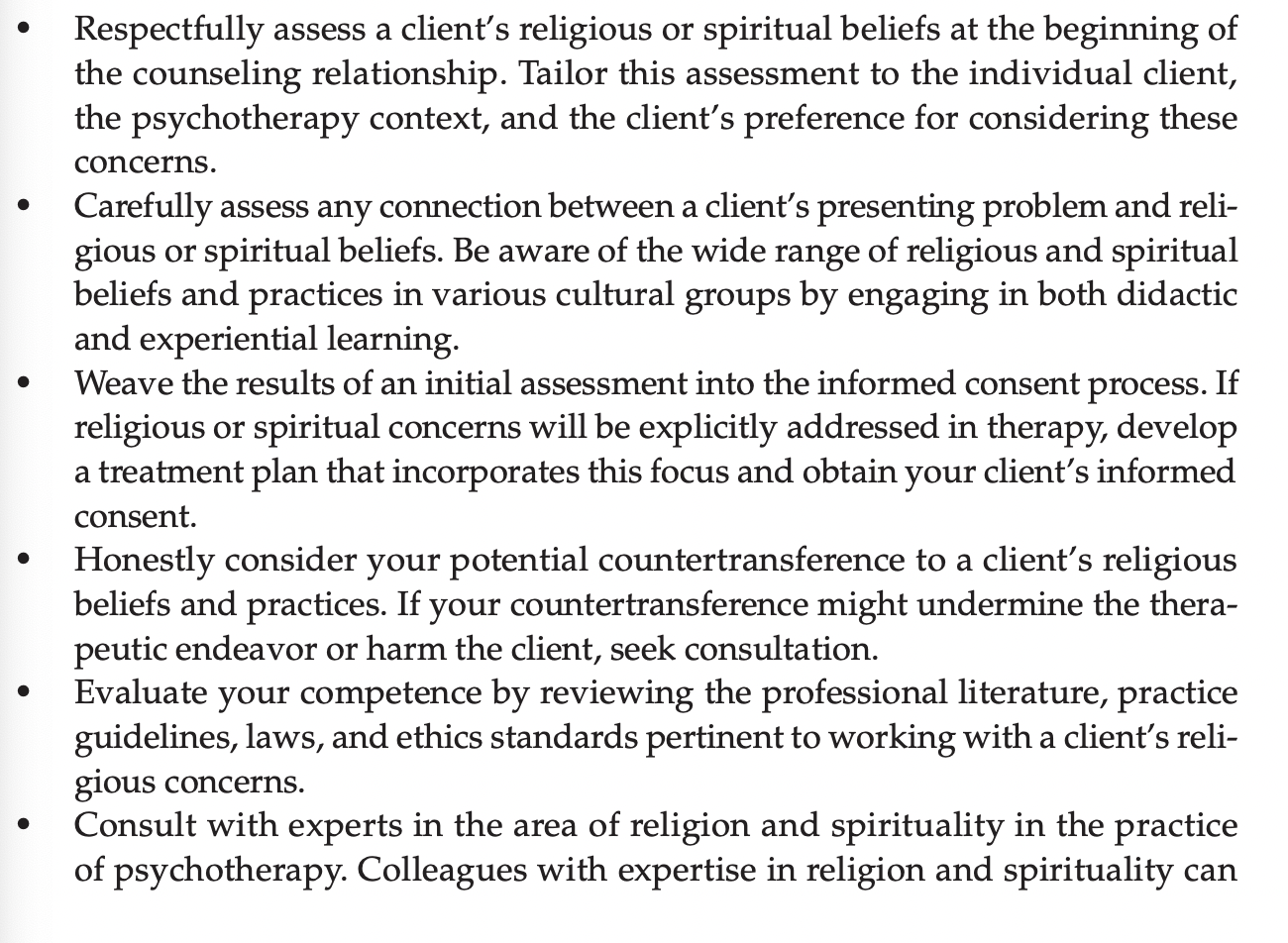
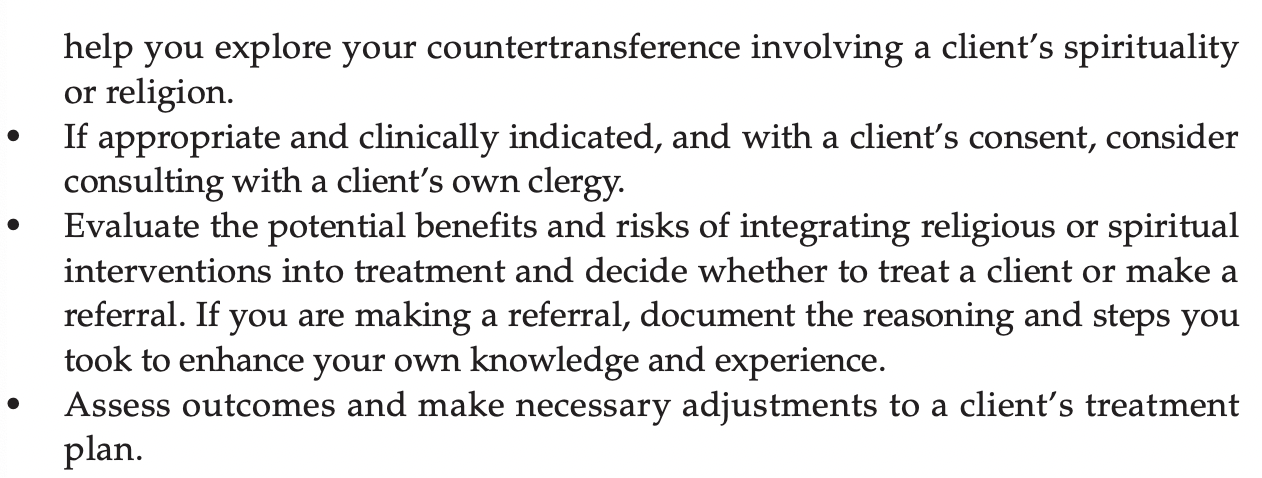
Training in dealing with spiritual and religious concerns
Practitioners should reach out to members of the religious community and to indigenous healers with whom they can collaborate on behalf of the client when it is appropriate and when written consent is given
Value conflicts regarding end-of-life decisions
If you will be working with clients concerned about end-of-life care, it is essential to know the laws in your jurisdiction and in your state and to be familiar with the ethical guidelines of your professional organization
It is essential that you seek legal consultation in cases involving a client’s request for more explicit assistance with hastened death
Advance directives: contains decisions people make about end-of-life care to protect their self-determination when they are no longer able to make decisions themselves
Living Will
the conditions under which the person wishes to receive certain treatment or to refuse or discontinue life-sustaining treatment is specified
Durable Power of Attorney
one or more individuals who are empowered to speak for the ill person if this individual becomes unable or unwilling to speak
Mental health counselors must understand their own values and attitudes about end-of-life options
need to understand their role in the decision-making process of clients who may choose to hasten their dying process
Code of ethics regarding end-of-life decisions
The National Association of Social Workers' (2003) policy on client self-determination in end-of-life decisions emphasizes that choice should be central to all aspects of life and death, including decisions by individuals with terminal conditions about their care or treatment options.
options include:
aggressive treatment of the medical condition
life-sustaining treatment
medical intervention intended to alleviate suffering (but not to cure)
withholding or withdrawing life-sustaining treatment
voluntary active euthanasia
physician-assisted suicide
The American Psychological Association has been active in end-of-life care issues
AMHCA guideline regarding quality of care:
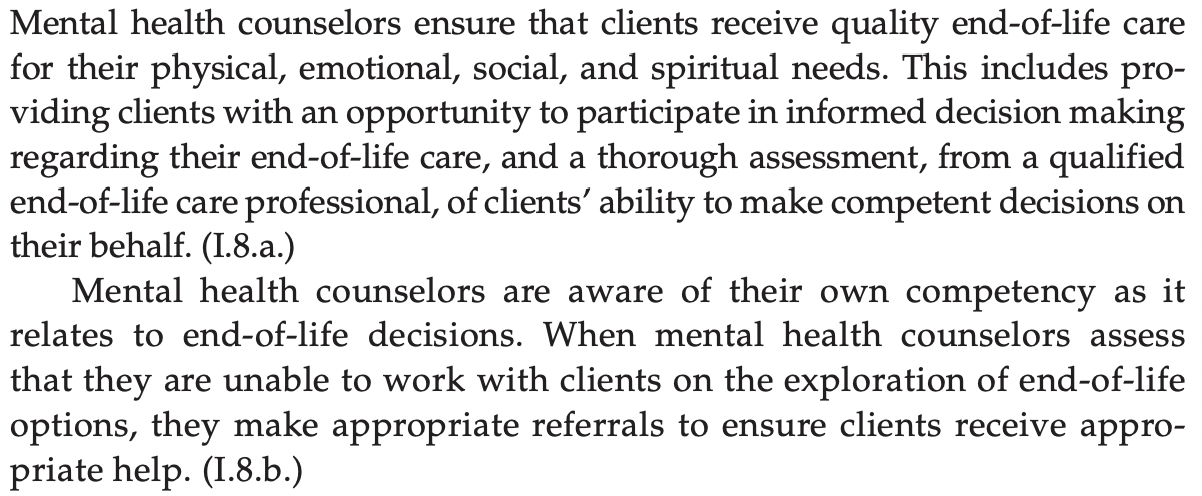
From an ethical and a legal standpoint, conducting a thorough assessment is critical in situations pertaining to end-of-life decisions
consider matters such as diagnosable mental disorders, psychological factors that may be causing distress, quality of relationships, and spiritual concerns
Role of Professionals in Helping Clients With End-of-Life Decisions
As a counselor, you need to be willing to discuss end-of-life decisions when clients bring such concerns to you