Dietary Lipid Metabolism
: a heterogeneous group of water-insoluble (hydrophobic) organic molecules.
- In aqueous solutions they compartmentalize due to their insolubility
- ==major source of energy== for the body
- deficiencies or imbalances of lipid metabolism can lead to major clinical problems encountered by physicians, such as: atherosclerosis, diabetes, and obesity.
Digestion
The average daily intake of lipids by U.S adults is ~78g, of which >90% is triacylglycerol (TAG), that consists of three fatty acids (FA) esterified to a glycerol backbone. The remainder of the dietary lipids consists primarily of cholesterol, cholesteryl esters, phospholipids, and nonesterified (free) FA (FFA).
- begins in the stomach
- completed in the small intestine
Digestion in the stomach
- is limited
- catalyzed by acidic ==lingual lipase== (glands at the back of the tongue) and ==gastric lipase== (secreted by the gastric mucosa)
* hydrolyze fatty acids from TAG molecules, particularly those containing short- or medium-chain-length
* found in milk fat
* play an important role in lipid digestion, help patients in degrading TAG molecules
* in infants whom milk fat is the primary source of calories
* individuals with pancreatic insufficiency (e.g. people with cystic fibrosis (CF))
Cystic fibrosis (CF)
- most common lethal genetic disease in Caucasians of Northern European ancestry
- autosomal-recessive disorder
- caused by mutations to the gene for %%CF transmembrane conductance regulator (CFTR) protein%% that functions as a chloride channel on epithelium in the pancreas, lungs, testes, and sweat glands
- defective CFTR results in decreased secretion of chloride and increased uptake of sodium and water
- in the pancreas, the depletion of water on the cell surface results in thickened mucus that clogs the pancreatic ducts, preventing pancreatic enzymes from reaching the intestine
Emulsification in the small intestine
- critical process occurs in the duodenum
- increases the surface are of hydrophobic lipid droplets, so that digestive enzymes can act effectively
- accomplished by two mechanisms:
* use of detergent properties if conjugated bile salts
* mechanical mixing due to peristalsis - bile salts: made in the liver and stored in the gallbladder, are amphipathic derivatives of cholesterol
* stabilize dietary lipid droplets
* preventing them from coalescing
Degradation by pancreatic enzymes
Dietary TAG, cholesteryl esters, and phospholipids are enzymatically degraded (digested) in the small intestine by pancreatic enzymes, whose secretion is hormonally controlled.
Triacylglycerol (TAG) degradation:
- molecules are too large to be taken up effectively by mucosal cells (enterocytes) of the intestinal villi
- hydrolyzed by esterase, pancreatic lipase, which removes the FA at carbons 1 and 3
- primary products: 2-monoacylglycerol (2-MAG) and FFA
- colipase restores activity to lipase in the prescence of inhibitory substance like bile salts
Cholesteryl ester degradation:
- most dietary cholesterol is present in the free (nonesterified) form
- hydrolyzed by pancreatic cholesteryl ester hydrolase (cholesterol esterase)
* which produces cholesterol and FFA
* activity of enzyme increases in presence of bile salts
Phospholipid degradation:
- pancreatic juice is rich in the proenzyme of phospholipase A2, that is activated by trypsin and requires bile salts for optimum activity.
- phospholipase A2 removes FA from carbon 2 of a phospholipid, leaving lypsophospholipid
Absorption by enterocytes
- primary products of lipid digestion in the jejunum: FFA, free cholesterol, and 2-MAG
- these, as well as bile salts and fat-soluble vitamins (A, D, E, and K) form (disc-shaped clusters of a mixture of amphipathic lipids that coalesce with theri hydrophobic groups on the inside and their hydrophilic groups on the outside
* soluble in aqueous environment of the intestinal lumen . - approach the primary site site of lipid absorption, the ==brush border membrane of the enterocytes==
- because short- and medium-chain FA are water soluble, they ==do not require assistance of mixed micelles== for absorption by the intestinal mucosa
Triacylglycerol and cholesteryl ester resynthesis
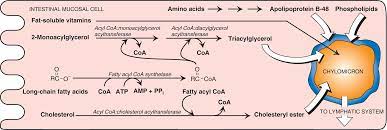
- mixture of lipids absorbed by the enterocytes migrates to the smooth endoplasmic reticulum (SER), where biosynthesis of complex lipids takes place
- long-chain FA are first converted into their activated forms by %%fatty acyl coenzyme A (CoA) synthetase (thiokinase)%%
- using the fatty acyl CoA derivatives, the 2-MAG absorbed by the enterocytes are converted to TAG through sequential reacylations by two acyltransferases, %%acyl CoA:monoacylglycerol acyltransferase%% and %%acyl CoA:diacylglycerol acyltransferase%%
- lysophospholipids are reacylated to form phospholipids by a family of acyltransferases
- cholesterol is acylated primarily by %%acyl CoA:cholesterol acyltransferase%%
- short and medium-chain FA are not converted to their CoA derivatives nor reesterified to 2-MAG (do not require incorporation into chylomicrons and directly enter into the blood)
* they are released into their portal circulation
* and carried by ^^serum albumin^^ to the liver
Lipid Malabsorption
- resulting in increased lipid in the feces ()
- can be caused by disturbances in lipid digestion and/or absorption
- can result from several conditions:
* CF (causing poor digestion)
* short bowel syndrome (causing decreased absorption)
Secretion from enterocytes
- newly re-synthesized TAG and cholesteryl esters are very hydrophobic and aggregate in an aqueous environment
- therefore, they must be
* this layer stabilizes the particle and increases its solubility, preventing multiple particles from coalescing - lipoprotein particles are released by exocytosis from enterocytes into the (lymphatic vessels in the villi of the small intestine)
- the presence of these particles in the lymph after a lipid-rich meal gives it a milky appearance
* the lymph is called chyle
* the particles are named - chylomicrons follow the lymphatic system to the thoracic duct and are then conveyed to the left subclavian vein, where they enter the blood
Use by tissues
- most of the TAG contained in chylomicrons is broken down in the capillary bed of ==skeletal, cardiac muscle, and adipose tissue==
- TAG degraded to FFA and glycerol by lipoprotein lipase (LPL)
* enzyme synthesized and secreted primarily by adipocytes and muscle cells - deficiency of LPL or its coenzyme apo C-II: familial chylomicronemia (type I hyperlipoproteinemia)
* rare, autosomal-recessive disorder
* result: fasting chylomicronemia and severe hypertriacylglycerolemia
* can cause pancreatitis
Fate of free fatty acids
The FFA derived from the hydrolysis of TAG may either directly enter adjacent muscle cells and adipocytes or be transported in the blood in association with serum albumin until they are taken up by cell
Fate of glycerol
Glycerol released from TAG is taken up by from the blood and phosphorylated by liver glycerol kinase to produce glycerol 3-phosphate , which can either enter glycolysis or gluconeogenesis by oxidation to dihydroxyacetone phosphate or be used in TAG synthesis
Fate of chylomicron remnants:
After the removal of most of the TAG, the chylomicron remnants (which contain: cholesteryl esters, phospholipids, apolipoproteins, fat-soluble vitamins, and a small amount of TAG) bind to receptors on the liver and are endocytosed.
The intracellular remnants are hydrolyzed to their component parts.
Cholesterol and the nitrogenous bases of phospholipids (e.g. choline) can be recycled by the body.