Topic 2: Salivary Glands
Salivary glands are classified into major and minor based on size and function.
Major Salivary Glands
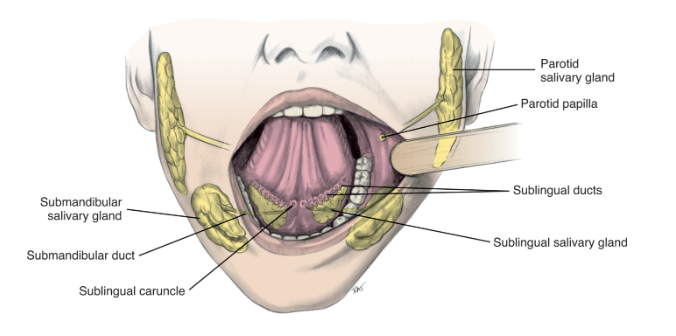
There are three paired major salivary glands
Parotid Glands
Largest salivary glands
Located near the ear, in front of the masseter muscle
Secretes serous (watery, enzyme-rich) saliva
Drains via Stensen's duct into the oral cavity opposite the upper second molar
Submandibular Glands
Located beneath the jaw (mandible)
Produces mixed saliva (mostly serous, some mucous)
Drains via Wharton’s duct near the lingual frenulum
Sublingual Glands
Smallest of the major glands, located under the tongue
Produces mainly mucous saliva
Drains via multiple small ducts (Rivinus ducts) into the floor of the mouth
Minor Salivary Glands
Minor salivary glands are scattered throughout the oral mucosa, lips, tongue, and palate.
They mostly produce mucous secretion (except for Von Ebner’s glands, which produce serous secretion).
They play a significant role in keeping the oral cavity moist and lubricated. They are named based on the area of their location:
Labial glands (lips)
Buccal glands (cheeks)
Palatine glands (hard and soft palate)
Lingual glands (tongue)
Functions of Salivary Glands
Salivary glands play a crucial role in maintaining oral and overall health. Their primary functions include:
Lubrication & Protection
Mucous secretion keeps the oral mucosa moist, preventing dryness and irritation.
Forms a protective barrier against mechanical injury, pathogens, and toxins.
Digestion
Amylase begins carbohydrate digestion by breaking down starch into maltose.
Lipase helps in the digestion of lipids.
Antimicrobial Action
Lysozyme, lactoferrin, and IgA (antibodies) help inhibit bacterial growth and maintain oral microbiome balance
Helps prevent infections like dental caries and periodontal disease.
Buffering & pH Regulation
Bicarbonate in saliva maintains an optimal pH (6.2-7.6), preventing acid erosion and dental caries.
Taste Perception
Saliva dissolves food particles, enabling taste buds to detect flavours.
Tooth Remineralization
Calcium and phosphate in saliva help remineralise enamel, reducing the risk of cavities.
Wound Healing
Growth factors in saliva aid in tissue repair and healing of minor oral wounds.