APES 2.4 Ecological Tolerance
Enduring Understanding:
- Ecosystems have structure and diversity that change over time.
Learning Objective:
- Describe ecological tolerance.
Essential Knowledge:
- Ecological tolerance refers to the range of conditions, such as temperature, salinity, flow rate, and sunlight that an organism can endure before injury or death results.
- Ecological tolerance can apply to individuals and to species
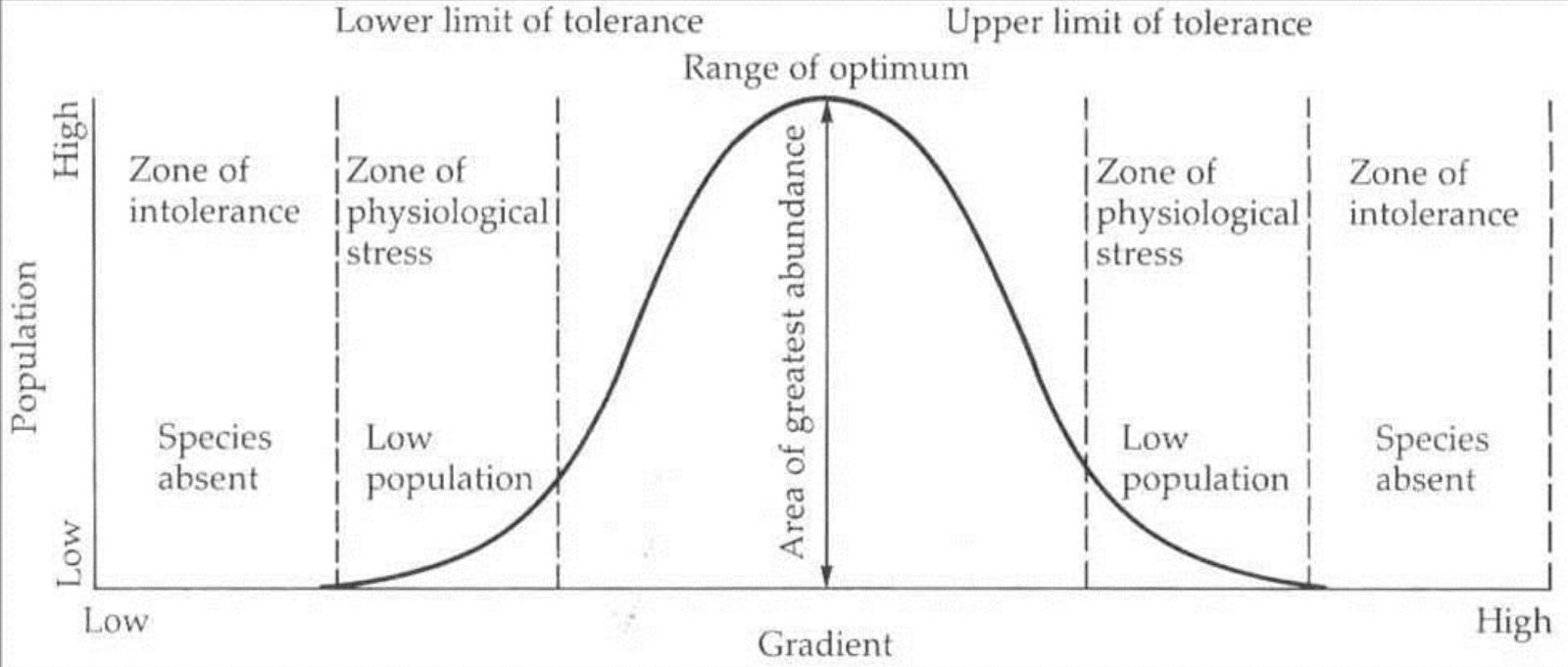
- Graphs of tolerance show a species’ ability to survive in various conditions.
- There are a few constants that all species will have, albeit at different limits.
- In the lower zone of intolerance there is a near to complete deprivation of any given resource.
- The species cannot survive and it is absent from the ecosystem.
- In the lower sone of physiological stress there is a low population of surviving organisms of the species due to the low levels of any given resource.
- In the range of optimum, the population is thriving.
- There is not too much nor too little of any given resource which allows the species to reproduce at the most efficient rate.
- In the higher zone of physiological stress, there is too much of any given resource.
- The population is once again lowered.
- In the higher zone of intolerance, there is so much of any given resource that the species cannot survive in the ecosystem.
- The species is absent.