Spanish Semester One Study Guide Notes
ORIGINAL STUDY GUIDE:
Present Tense p.6, 7
Present Progressive p.9
Talking about the future p.11
Preterite Tense -ar, er -ir verbs p.17, 18
Irregular Preterite verbs p.31
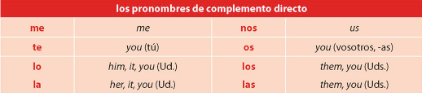
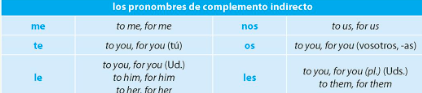
Direct and indirect Object Pronouns p.42
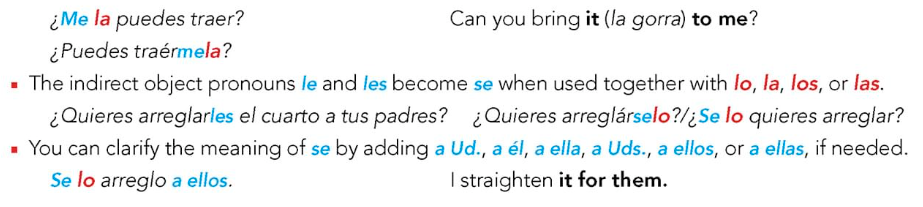
Using Direct and Indirect Object Pronouns Together p.44
Reflexive Verbs p.64
Preterite Tense of Reflexive Verbs p. 75
Telling Someone What to do: Informal Affirmative Commands p.120
Formal and Plural commands p.129
Vocabulario lessons 1, 2 y 3
ANSWERED STUDY GUIDE:
Present Tense:
something that is currently happening
-ar verbs
yo → o
tú → as
el/ella/Ud. → a
nosotros → amos
ellos/ellas/Uds. → an
example:
yo → hablo
tú → hablas
el/ella/Ud. → habla
nosotros → hablamos
ellos/ellas/Uds. → hablan
-er verbs
yo → o
tú → es
el/ella/Ud. → e
nosotros → emos
ellos/ellas/Uds. → en
example:
yo → como
tú → comas
el/ella/Ud. → comla
nosotros → comamos
ellos/ellas/Uds. → comen
-ir verbs
yo → o
tú → es
el/ella/Ud. → e
nosotros → imos
ellos/ellas/Uds. → en
example:
yo → vivo
tú → vives
el/ella/Ud. → vive
nosotros → vivimos
ellos/ellas/Uds. → viven
Present Progressive:
basically adding -ing to the end of a verb
something that is currently happening and continues going on
estar + verb
-ar → -ando
estudiar → estudiando
-er/-ir → -iendo
comer → comiendo
vivir → viviendo
Future Tense:
something that is going to happen in the near future
ir + a + infinitivo
examples:
vas a hacer
voy a navegar
Past Tense:
something that has already happened in the past
-ar verbs
yo → é
tú → aste
el/ella/Ud. → ó
nosotros → amos
ellos/ellas/Uds. → aron
example:
yo → lavé
tú → lavaste
el/ella/Ud. → lavó
nosotros → lavamos
ellos/ellas/Uds. → lavaron
-er/-ir
yo → í
tú → iste
el/ella/Ud. → ió
nosotros → imos
ellos/ellas/Uds. → ieron
example 1:
yo → dormí
tú → dormiste
el/ella/Ud. → dormió
nosotros → dormimos
ellos/ellas/Uds. → dormieron
example 2:
yo → pedí
tú → pediste
el/ella/Ud. → pedió
nosotros → dormimos
ellos/ellas/Uds. → dormieron
example 3:
yo → preferí
tú → preferiste
el/ella/Ud. → preferió
nosotros → preferimos
ellos/ellas/Uds. → preferieron
Irregular Past Tense:
dar: di, diste, dimos, dieron
estar: estuve, estuviste, estuvo, estuvimos, estuvieron
hacer: hice, hiciste, hizo, hicimos, hicieron
fui: fuiste, fue, fuimos, fueron
tener: tuve, tuviste, tuvo, tuvimos, tuvieron
ver: vi, viste, vio, vimos, vieron
decir: dije, dijiste, dijo, dijeron
ir: fui, fuiste, fue, fuimos, fueron
ir and ser have the same form in past tense
Direct Object Pronouns:
Indirect Object Pronouns:
Using Indirect & Direct Object Pronouns Together:
Reflexive Verbs:
examples of what reflexive verbs look like:
maquillarse
levantarse
ducharse
cepillarse (los dientes)
peinarse
vestirse
acostarse
afeitarse
sentirse
divertirse
llamarse
irse
ponerse
quitarse
caerse
notice the “se” at the end? that’s the reflexive part to change. the steps to do so are below.
Steps:
take “se” off the end of the verb
conjugate the verb
change (if necessary) “se” to one of the following forms:
yo → me
tú → te
el/ella/Ud. → se
nosotros → nos
ellos/ellas/Uds. → se
Past Tense of Reflexive Verbs:
it is the same as regular tense, but the verb is in past tense instead of present tense.
Informal Affirmative Commands:
often used to give instructions and to tell others what to do.
instead of using the form tú, you use the form él/ella because the tú form is implied, but generally omitted
Examples:
Visita la catedral.
Aprende a ir en metro.
Escribe un blog sobre el viaje.
verbs that require a spelling change will most likely also require the same change in the informal affirmative command
Examples:
Consigue información por Internet.
Envía el paquete en la oficina de correos.
Vuelve a México.
some verbs have irregular affirmative tú commands:
decir → di
hacer → haz
ir → ve
poner → pon
salir → sal
ser → sé
tener - ten
venir - ven
object and reflexive pronouns follow and are attached to affirmative tú commands:
Dime la verdad.
most commands with more than one syllable that have an attached pronoun require an accent mark
Siéntate aquí.
when using two object pronouns with the same verb, the indirect object pronoun always comes first
préstamelo
Formal & Plural Commands:
used to tell people you address as usted or ustedes what to do
formed by substituting the -o of the present-tense yo form of a verb with an -e for -ar verbs, or with an -a for -er and -ir verbs
to form a plural version, add the letter -n to the singular formal command
changes that happen to the present tense usually change in the formal command
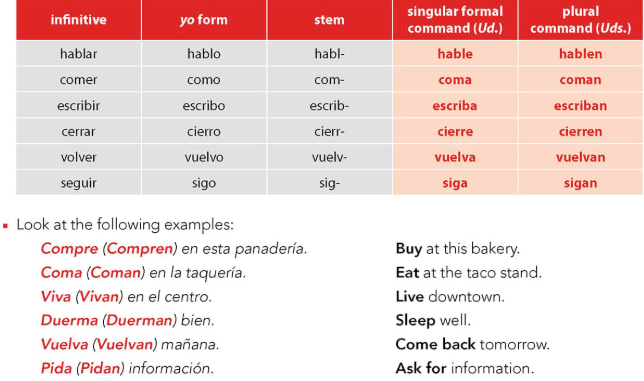
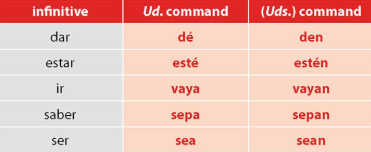
object and reflexive pronouns are attatched to the end of affirmative formal commands.
accent mark may be required in order to maintain the original stress of the verb
Vocabulary Lessons from Unit 1, 2, & 3:
Unit 1:
la aplicacion - app
la asignatura - (school) subject
bajar (un programa) - to download (a program)
las bermudas - bermuda shorts
el bote - boat
el camping/ir de camping - camping/to go camping
el cargador - charger
chatear - to chat
el celular - cell phone
el chisme - gossip
la comunicacion - communication
conectado/a - connected
conseguir (i, i) - to obtain, to attain, to get
la contaminacion ambiental - enviornmental pollution
creer - to believe
el crucero/ir de crucero - cruise/to go on a cruise
la ecolgia - ecology
el e-mail - e-mail
encontrar (ue) - to find
las gafas de sol - sunglasses
la gorra - hat
la informacion - information
instalar - to install
Internet - Internet
el mensaje de texto - text message
el mundo - world
el navegador - browser
navegar (uso en informatica) - to surf (in the computer field)
la noticia - news
la novia - girlfriend
el novio - boyfriend
pasado/a - past/last
el picnic/hacer un picnic - picnic/to go on a picnic
el programa - program
quisiera - would like
la red - Web
las sandalias - sandals
seguir (i, i) - to continue, to keep on, to go on; to follow, to pursue
los shorts - shorts
solo/a - alone
la tableta - tablet
la tecnologia - technology
los tenis - tennis shoes
ultimo/a - last
el vinculo - link
visitar - to visit
la web - Web
Unit 2:
abre (command) - open
acostarse (ue) - to go to bed, to lie down
acostumbrarse - to get used to
afeitarse - to shave
almorzar (ue) - to have lunch, to eat lunch
aquel, aquella (aquellos, aquellas) - that (one) (those [ones])
aquello - that
asi - thus, that way
banarse - to bathe
la boca - mouth
broncearse - to tan
caerse - to fall (down)
calmarse - to calm down
la cara - face
la cena - dinner, supper
cenar - to have dinner, to have supper
cepillarse - to brush
el cepillo - brush
el champu - shampoo
la cita - appointment; date
el codo - elbow
comerse - to eat up
la comida - midday meal
la comida rapida - fast food
el corazon - heart
la crema de afeitar - shaving cream
el cuello - neck
el cuerpo - body
cuidarse - to take care of oneself
dejar de - to stop, to quit
derecho/a - right
desayunar - to have breakfast
el desayuno - breakfast
descansar - to rest, to relax
desde luego - of course
el desodorante - deodorant
despedirse (i, i) - to say goodbye
despertarse (ie) - to wake up
di (command) - say
el diente - tooth
divertirse (ie, i) - to wake up
el doctor, la doctora - doctor
doler (ue) - to hurt
dormirse (ue, u) - to fall asleep
la ducha - shower
ducharse - to shower
el ejercicio - exercise
el enfermero, la enfermera - nurse
equivocarse - to be mistaken
ese, esa (esos, esas) - that (one) (those [ones])
eso - that (neuter form)
la espalda - back
el espejo - mirror
esperar - to wait (for)
este, esta (estos, estas) - this (one) (these [ones])
esto - this (neuter form)
el esomago - stomach
fumar - to smoke
la garganta - throat
el grifo - faucet
la gripe - flu
la guitarra - guitar
el hombro - shoulder
el inodoro - toilet
irse - to leave, to go away
izquierdo/a - left
el jabon - soap
el lago - lake
el lavabo - sink
lavarse - to wash
la lengua - tongue
levantarse - to get up
llamarse - to be called
llevarse - to get along
el maquillaje - makeup
maquillarse - to put on makeup
la medicina - madicine
la nariz (pl. las narices) - nose
el nino, la nina - child
el oido - (inner) ear
el ojo - eye
olvidarse - to forget
la oreja - (outer) ear
el pecho - chest
peinarse - to comb
el peine - comb
el pelo - hair
pescar - to fish
pescar un resfriado - to catch a cold
el pez (pl. los peces) - fish
ponerse - to put on
preguntarse - to wonder; to ask oneself
preocuparse - to worry
quedarse - to remain, to say
quemarse - to get burned
quitarse - to take off
el resfriado - cold
reunirse - to get together
la rodilla - knee
saca (command) - stick out
la salud - health
sentarse (ie) - to sit down
sentirse (ie, i) - to feel
sientate - (command) sit down
tarde - late
la tina - bathtub
la toalla - towel
tocate - (command) touch
vestirse (i, i) - to get dressed
Unit 3:
a la dercha (izquierda) - to the right (left)
adelante - ahead
el aeropuerto - airport
el almacén - department store, grocery store, warehouse
el apartmento - apartment
el caballero - gentleman
la carnicería - meat market, butcher shop
la carretera - road
la catedral - cathedral
la cuadra - city block
la dama - lady
la derecha - right
derecho - straight ahead
las direcciones - directions
el dulce - candy
la dulceria - candy store
la enchilada - enchilada
la esquina - corner
la estacion (de autobuses/del metro/del tren) - station (bus, subway, train)
la floreria - flower shop
la fruiteria - fruit store
hacia - toward
la heladeria - ice cream parlor
la iglesia - church
la izquierda - left
mexicano/a - Mexican
el monumento - monument
la oficina de correos - post office
la panaderia - bakery
la papeleria - stationery store
parar - to shop
el policia, la policia - police (officer)
el proximo/a - next
el puente - bridge
el taco - taco
la taqueria - taco stand
la torre - tower
la tortilla - cornmeal pancake (Mexico)
la vitrina - store window, glass showcase
la zapateria - shoe store