Basal Ganglia
Basal Ganglia: Group of interconnected subcortical nuclei in the brain that regulate voluntary motor control, procedural learning, and emotional and cognitive functions. They do not directly control movement but modulate signals between the cortex and motor pathways.
Motor Control: Regulate initiation, smooth execution and cessation of voluntary movements
Cognitive Functions: Involvement in learning motor sequences and facilitate decision making processes.
Emotion and Motivation: Plays a role in processing emotions and reinforcing motivation-driven behaviour
Anatomy
Striatum: Part of the basal ganglia that functions as the main input centre, integrating signals from multiple brain regions and relaying them to other basal ganglia components. (Receives all input to the basal ganglia)
Caudate Nucleus: C-shaped subcortical structure located in the brain (Closely follows the lateral ventricle). It is part of the striatum and functions as the primary input nucleus of the basal ganglia, integrating signals from the cerebral cortex and relaying them to other parts of the basal ganglia. It has a head, body and tail and separated from the putamen by the internal capsule.
Putamen: Rounded subcortical structure located in the basal ganglia and part of the striatum. It is also part of the lentiform nucleus, which consists of the putamen and the globus pallidus. The putamen primarily regulates motor control but also contributes to cognitive and emotional functions. It is extensively connected to the cortex, thalamus, and other basal ganglia structures.
Nucleus Accumbens: Subcortical structure located at the head of the caudate nucleus in the ventral striatum. It serves as a critical relay for signals related to reward, motivation, and goal-directed behavior, receiving input from cortical and subcortical regions and influencing motor systems via its outputs.
Globus Pallidus: Structure within the basal ganglia, functioning primarily as an output nucleus that regulates voluntary movement and motor control. It plays a critical role in modulating motor signals by sending inhibitory outputs to other brain areas, ensuring smooth and coordinated motor activity. Through connections with the nucleus accumbens and other limbic structures, it also influences reward-related behavior and emotional responses.
Internal Segment (GPe): Involved in the indirect pathway, regulating unwanted motor activity by inhibiting the thalamus and reticular formation. (Reticulospinal tract)
External Segment (GPi): Functions as a major output nucleus of the basal ganglia, influencing motor control via inhibitory projections.
Subthalamuc Nucleus: Part of the indirect pathway of the basal ganglia circuitry and contributes to the inhibition of unwanted motor activity. It is the only excitatory nucleus in the basal ganglia and is essential for modulating motor control by influencing the activity of the globus pallidus and substantia nigra.
Substantia Nigra: Critical structure in the basal ganglia that plays a key role in modulating motor control, reward processing, and learning. It consists of two distinct parts:
Pars Compacta (SNc): Produces dopamine, which modulates the activity of the direct and indirect motor pathways, facilitating smooth and coordinated movement while reinforcing reward-driven behaviors.
Pars Reticulata (SNr): Functions as an output nucleus, sending inhibitory signals to the thalamus, superior colliculus, and reticular formation to regulate voluntary motor actions, eye movements, and posture. (Tectospinal and reticulospinal tract)
Functional Divisions
Neostriatum: Caudate nucleus + putamen.
Lentiform Nucleus: Putamen + globus pallidus.
Input to the Basal Ganglia
The striatum - specifically the putamen - serves as the primary input center of the basal ganglia. It integrates signals from several brain regions, which include the cortex, thalamus, and midbrain.
Corticostriatal Pathway: The cerebral cortex provides glutamatergic (excitatory) input to the striatum. It carries information about motor commands, sensory feedback, cognitive decisions, and emotional states.
Motor Cortex & Premotor Cortex → Putamen: Provides motor-related information, including movement planning and execution.
Association Cortices (e.g., Prefrontal Cortex) → Caudate Nucleus: Conveys cognitive and executive signals for decision-making and attention.
Limbic Cortex → Ventral Striatum (Nucleus Accumbens): Delivers emotional and motivational signals.
Substantia Nigra (Pars Compacta): Provides dopaminergic (modulatory) input to the striatum and modulates motor activity by balancing excitation and inhibition in the direct and indirect pathways.Also facilitates motor learning and reward-driven behavior.
D1 Receptors (Direct Pathway): Excitatory effect, facilitating movement.
D2 Receptors (Indirect Pathway): Inhibitory effect, suppressing unwanted movement.
Interthalamic Nuclei: Provide glutamatergic (excitatory) input and provide feedback based on motor and sensory processing. Plays a role in arousal and attention regulation.
Raphe Nuclei: Provide serotonergic (modulatory) input and modulates mood, motivation, and reward-related processes in the striatum.
Internal Connections
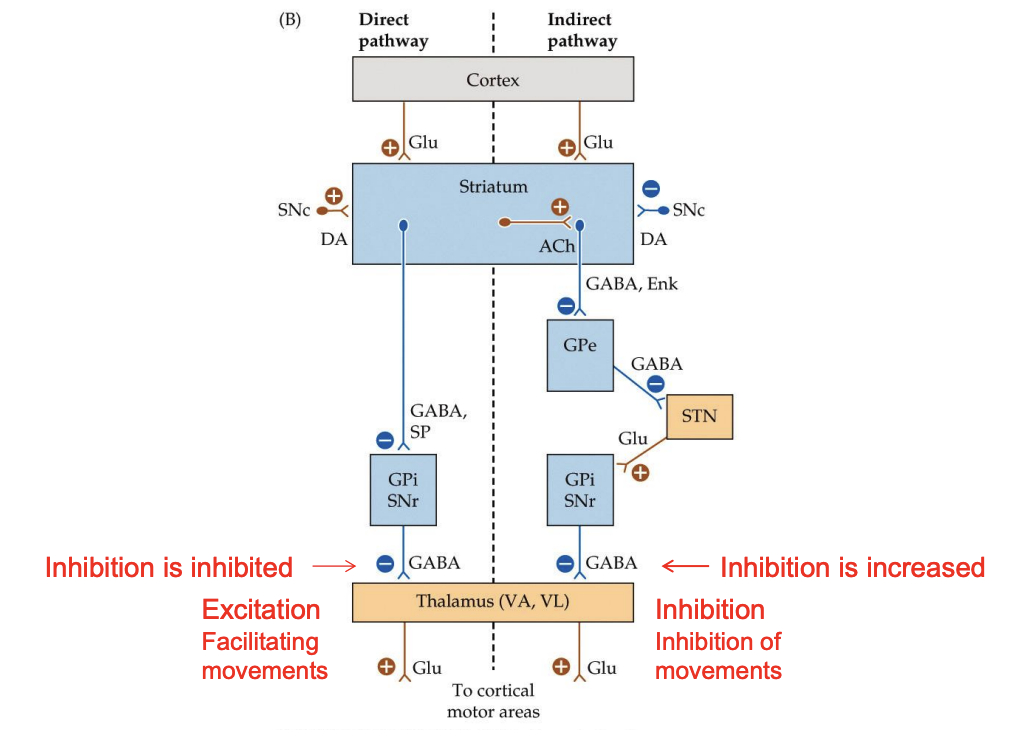
Direct Pathway
Cortex → (excites) Striatum → (inhibits) GPi/SNr → (disinhibits) Thalamus → (excites) Motor Cortex → (activates) Movement
Direct Pathway: Neural circuit within the basal ganglia that promotes movement by disinhibiting the thalamus, allowing it to excite the motor cortex. It does so by reducing the inhibitory influence of the globus pallidus internal segment and the substantia nigra pars reticulata, which are primary output nuclei of the basal ganglia.
Cerebral Cortex: The pathway begins with excitatory (glutamatergic) input from the motor cortex and premotor cortex. These cortical areas send signals to the striatum (specifically the putamen for motor-related functions).
Striatum: The putamen contains D1 dopamine receptors that project inhibitory (GABAergic) signals to the globus pallidus internal segment (GPi) and substantia nigra pars reticulata (SNr).
GPi and SNr: The GPi and SNr are the primary output nuclei of the basal ganglia. They normally send tonic inhibitory (GABAergic) output to the ventral lateral (VL) and ventral anterior (VA) nuclei of the thalamus. The direct pathway reduces this inhibition, a process known as disinhibition.
Thalamus: The VL/VA nuclei of the thalamus, when disinhibited, send excitatory (glutamatergic) signals back to the motor cortex, enhancing its activity.
Neurotransmitters:
Glutamate: Excitatory signals from the cortex and thalamus.
GABA: Inhibitory signals from the striatum and GPi/SNr.
Dopamine: Modulatory input from the substantia nigra pars compacta (SNc).
Role of Dopamine: Dopamine from substantia nigra pars compacta (SNc) enhances this pathway via D1 receptor activation in the striatum (putamen). This amplified the inhibitory output of the striatum to the GPi/SNr, further disinhibiting the thalamus and promoting movement.
Component
Role
Neurotransmitter
Cerebral Cortex
Excites the striatum to initiate motor commands
Glutamate
Striatum
Inhibits GPi/SNr to reduce thalamic suppression
GABA
GPi/SNr
Normally inhibits thalamus however reduced by GABAergic stimulation
GABA
Thalamus (VL/VA)
Executes voluntary movement via the corticospinal tract
Glutamate
Substantia Nigra Pars Compacta
Enhances striatal activity trough dopamine release
Dopamine
Indirect Pathway
Cortex → (excites) Striatum → (inhibits) GPe → (disinhibits) STN → (excites) GPi/SNr → (inhibits) Thalamus → (reduces excitation of) Motor Cortex
Indirect Pathway: Neural circuit within the basal ganglia that increases inhibition of the thalamus, reducing motor cortex activity to suppress unwanted movements. This prevents unnecessary or involuntary motor commands, allowing only desired motor programs to be executed.
Cerebral Cortex: Sends excitatory (glutamatergic) input to the striatum (caudate and putamen)
Striatum: Neurons in the striatum expressing D2 dopamine receptors, inhibit the globus pallidus external segment (GPe).
Globus Pallidus External Segment (GPe): Normally, the GPe provides tonic inhibitory (GABAergic) output to the subthalamic nucleus (STN). However, when inhibited by the striatum, the GPe reduces its inhibition of the STN, allowing the STN to become more active.
Subthalamic Nucleus (STN): The STN sends excitatory (glutamatergic) signals to the globus pallidus internal segment (GPi) and the substantia nigra pars reticulata (SNr).
Globus Pallidus Internal Segment (GPi) and Substantia Nigra Pars Reticulata (SNr): These output nuclei of the basal ganglia increase their inhibitory (GABAergic) output to the thalamus.
Thalamus: The ventral lateral (VL) and ventral anterior (VA) nuclei of the thalamus are inhibited, reducing their excitatory output to the motor cortex.
Neurotransmitters:
Glutamate: Excitatory signals from the cortex and subthalamic nucleus.
GABA: Inhibitory signals from the striatum, GPe, and GPi/SNr.
Dopamine: Modulates the pathway via D2 receptors in the striatum (inhibitory effect).
Role of Dopamine: Dopamine inhibits this pathway via D2 receptor activation, decreasing its inhibitory effect.
Component | Role | Neurotransmitter |
Cerebral Cortex | Excites the striatum to initiate movement suppression | Glutamate |
Striatum | Inhibits GPe to disinhibit the STN | GABA |
GPe | Reduces inhibition of the STN, allowing it to activate the GPi/SNr | GABA |
Supthalamic Nucleus | Excites the GPi/SNr to increase inhibition of the thalamus | Glutamate |
GPi/SNr | Normally inhibits thalamus however reduced by GABAergic stimulation | GABA |
Thalamus (VL/VA) | Executes voluntary movement via the corticospinal tract | Glutamate |
Substantia Nigra Pars Compacta | Inhibits striatal activity trough dopamine release | Dopamine |
Movement Disorders
Hypokinetic Disorder - Parkinsons Disease
Parkinson’s Disease: A hypokinetic movement disorder characterized by slowness of movement (bradykinesia), rigidity, resting tremor, and postural instability. These symptoms arise from a dysfunction in the basal ganglia circuitry, specifically due to the loss of dopaminergic neurons in the substantia nigra pars compacta (SNc), which disrupts the balance between the direct and indirect pathways of the basal ganglia.
In Parkinson’s disease there is degeneration of dopaminergic neurons in the substantia nigra pars compacta (SNc), which leads to a significant reduction in dopamine levels in the striatum.
Effect on Direct Pathway: Normally, the direct pathway reduces inhibition from the GPi/SNr to the thalamus, facilitating movement. However, without dopamine to activate D1 receptors, the direct pathway is underactive. This leads to increased inhibitory output from the GPi/SNr to the thalamus, which in turn becomes excessively inhibited, reducing excitation of the motor cortex and impairing voluntary movement.
Effect on the Indirect Pathway: Normally, the indirect pathway increases inhibition of the thalamus, suppressing unwanted movements. However, without dopamine to inhibit D2 receptors, the indirect pathway becomes overactive, increasing inhibition of the GPe by the striatum, which in turn leads to disinhibition of the SNT, allowing it to excite the GPi/SNr more stronly. Consequently, the inhibitory output from these nuclei to the thalamus increases even more, further reducing motor cortex activity.
Thus, the imbalance between the direct and indirect pathways results in:
Underactivity of the direct pathway: Reduced movement facilitation.
Overactivity of the indirect pathway: Excessive movement suppression.
These changes increase the inhibitory tone of the basal ganglia output to the thalamus, resulting in hypokinetic symptoms
Hyperkinetic Disorder - Huntingtons Disease
Huntingtion’s Disease: A hyperkinetic movement disorder characterised by involuntary, jerky movements (chorea), cognitive decline, and psychiatric symptoms. It results from a genetic mutation that causes selective neuronal degeneration, primarily in the striatum of the basal ganglia. This degeneration disrupts the balance between the direct and indirect pathways, leading to excessive motor activity.
In Huntington’s disease, There is selective degeneration of medium spiny neurons (MSNs) in the indirect pathway of the striatum, leading to reduced inhibition of the globus pallidus external segment (GPe) and downstream overactivation of motor circuits.
Effect on Indirect Pathway: The indirect pathway suppresses unwanted movements by increasing GPi/SNr activity, which inhibits the thalamus. However, loss of striatal MSNs that express D2 dopamine receptors reduces inhibition of the GPe, which leads to excessive inhibition of the subthalamic nucleus (STN). The reduced STN activity decreases excitatory input to the GPi/SNr, leading to lower GPi/SNr activity. The resulting decreased inhibition of the thalamus (disinhibition) leads to excessive thalamic excitation of the motor cortex, causing hyperkinetic movements.