5.1.2 Light Dependant Reaction
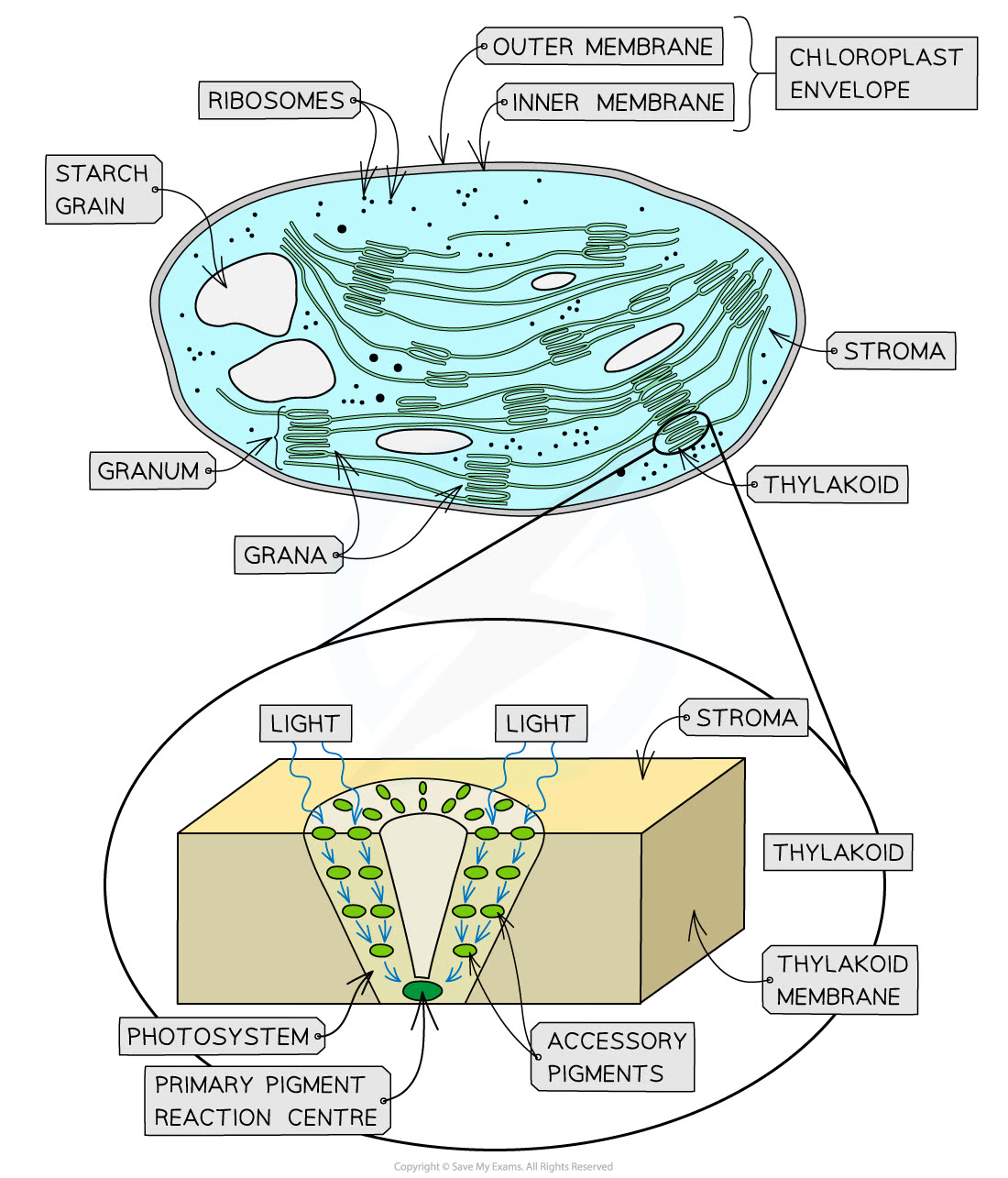
Thylakoids
- The thylakoid membranes contain the %%pigments, enzymes and electron carriers required for the light-dependent reactions%%
- These %%proteins and pigments make up an electron transport chain%% used to carry electrons through the membrane
- %%Electron energy can be used to move H+ ions across the membrane%%
- %%Electrons are donated by water molecules%% and %%accepted by NADP molecules that form NADPH%%
Photosystems
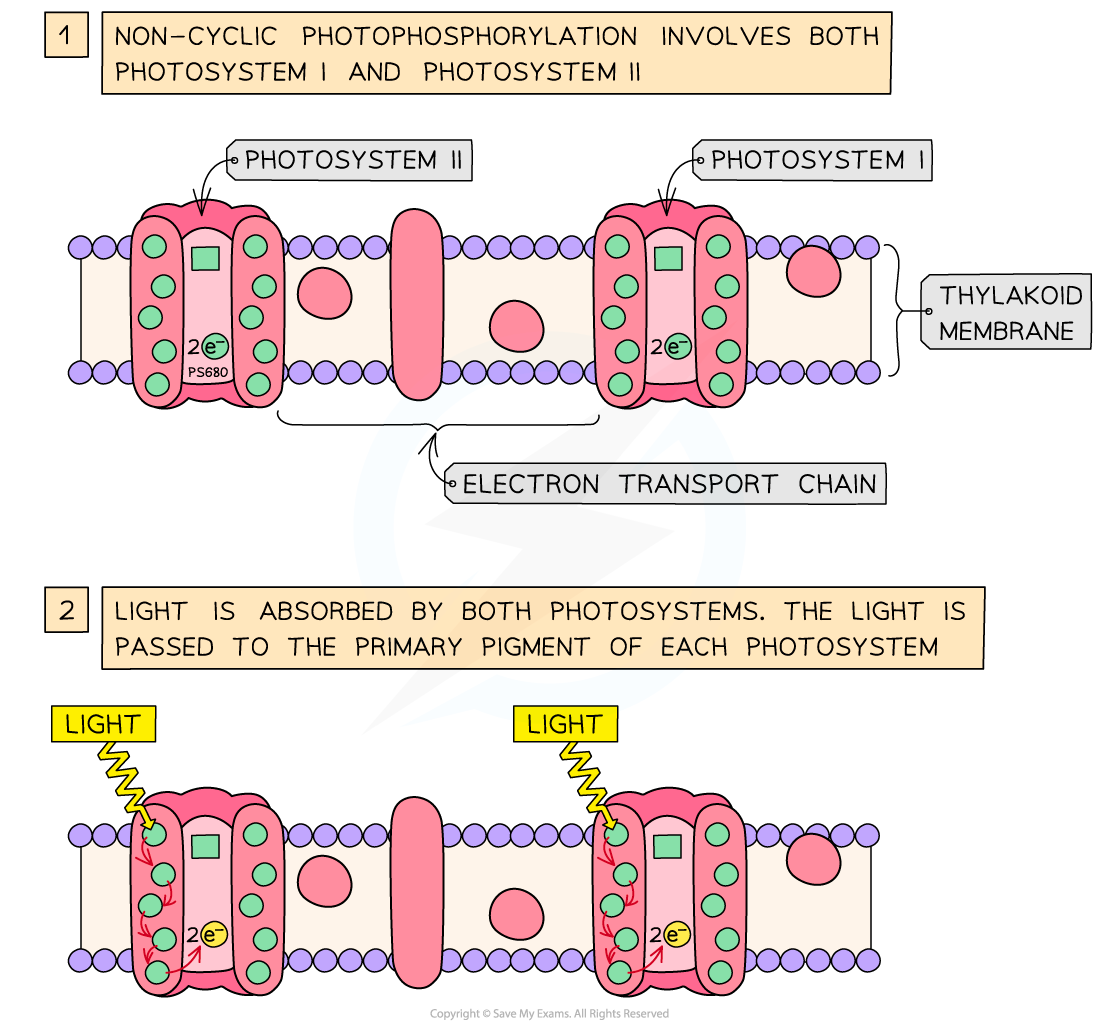
- %%Collections of photosynthetic pigments that absorb light energy%%
- Photosystem II has a %%primary pigment that absorbs light at a wavelength of 680nm and is therefore called P680%%
- Photosystem II is at the %%beginning of the electron transport chain%% and is where the %%photolysis of water%% takes place
- Photosystem I has a %%primary pigment that absorbs light at a wavelength of 700nm and is therefore called P700%%
- Photosystem I is in the %%middle of the electron transport chain%%
- When the light energy absorbed by the pigments is passed to the primary pigment, chlorophyll, this causes the photoionisation of chlorophyll
- Photoionisation is when a %%chlorophyll pigment becomes positively charged as a result of losing two electrons when it absorbs light energ%%y
- The two electrons are lost because they are %%excited by the light energy and move to a higher energy level%%
Light Dependant Reaction
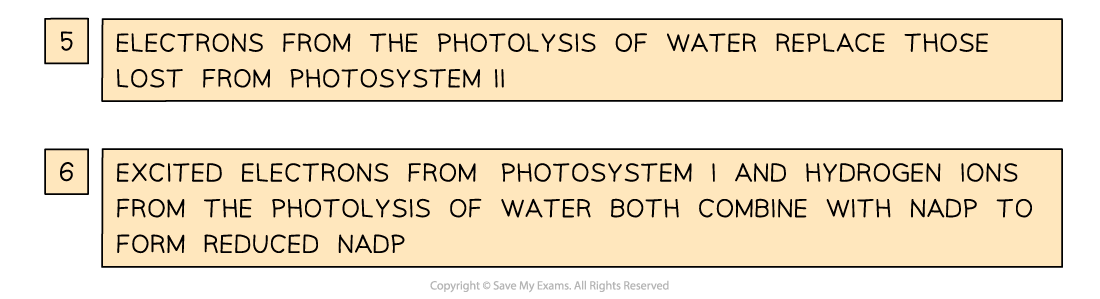
- %%Light energy is used to breakdown wate%%r in a reaction known as photolysis; this produces %%hydrogen ions, electrons, and oxygen in the thylakoid lumen%%
- %%A proton gradient is formed%% as the photolysis of water results in a %%high concentration of hydrogen ions in the thylakoid lumen%%
- %%Electrons travel through an electron transport chain of proteins%% within the membrane
- %%Reduced NADP (NADPH)%% is produced when %%hydrogen ions in the stroma and electrons from the electron transport chain combine with the carrier molecule NADP%%
- ATP is produced during a process known as photophosphorylation %%(ADP + Pi → ATP) using the proton gradient between the thylakoid lumen and stroma to drive the enzyme ATP synthase%%
Photosystem II
- %%Light is absorbed by photosystem II%% (located in the thylakoid membrane) and %%passed to the photosystem II primary pigment (P680)%%
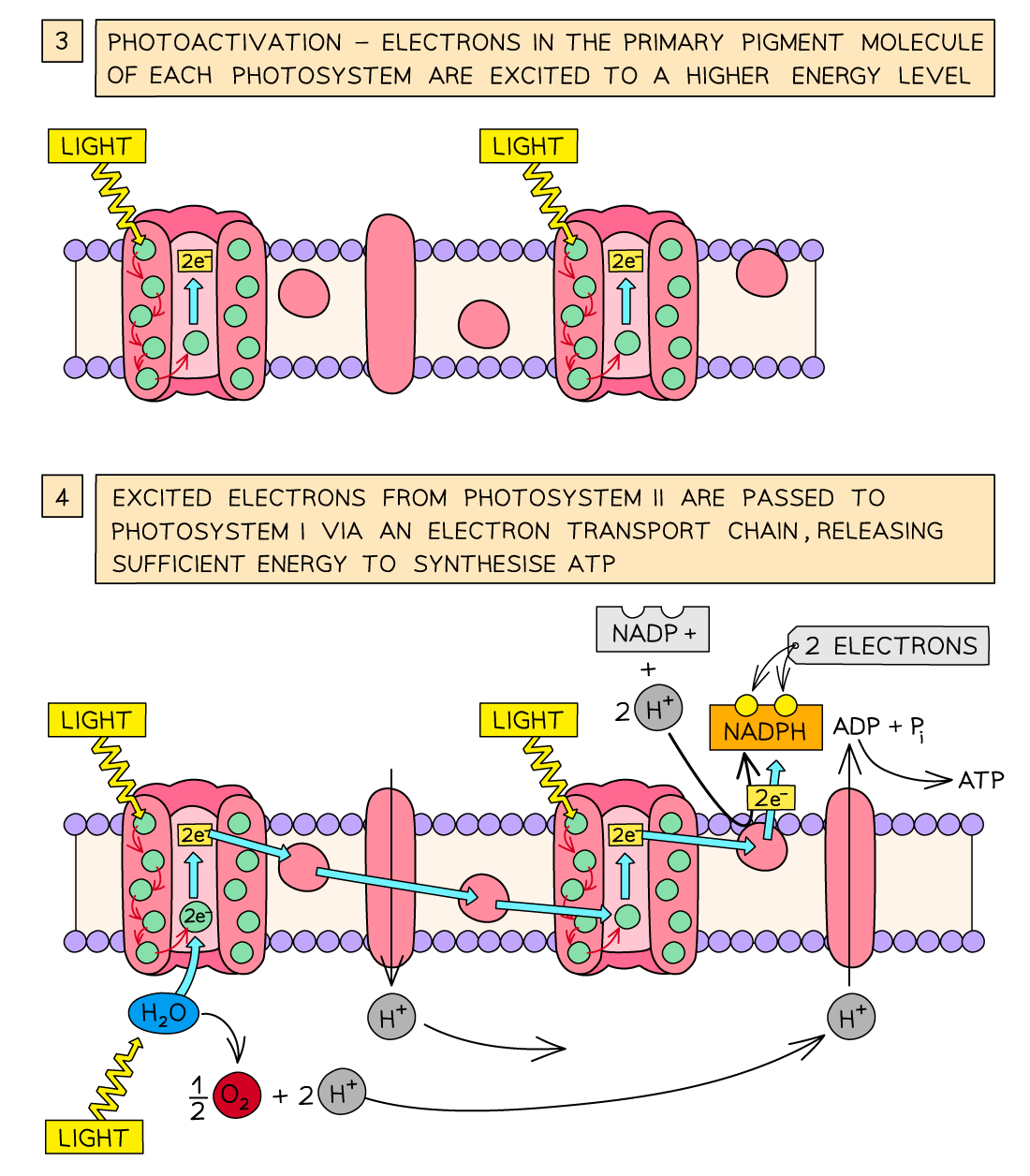
- %%Two electrons%% in the primary pigment molecule (ie. the chlorophyll molecule) are %%excited to a higher energy level and are emitted from the chlorophyll molecule%% in a process known as photoionisation
- Each excited %%electron is passed down a chain of electron carriers%% known as an electron transport chain, before being %%passed on to photosystem I%%
- During this process %%chemiosmosis occurs:%%
- The %%energy given by the electrons moving%% through the electron transport chain %%enables H+ ions (protons) to pass from a low concentration in the stroma to a high concentration in the thylakoid lumen%%
- The creation of this proton gradient across the membrane later drives the synthesis of ATP in photophosphorylation
- Photosystem II contains a %%water-splitting enzyme called the oxygen-evolving complex which catalyses the breakdown (photolysis) of water by light%%:
H2O → 2H+ + 2e- + ½O2
- As the excited electrons leave the primary pigment of photosystem II and are passed on to photosystem I, they are %%replaced by electrons from the photolysis of water%%
Photosystem I
- At the same time as photoactivation of electrons in photosystem II, %%electrons in photosystem I also undergo photoionisation%%
- The excited %%electrons%% from photosystem I also %%pass along an electron transport chain, alternatively reducing and oxidising proteins as they are accepted then passed on%%
- These %%electrons combine with hydrogen ions%% (produced by the %%photolysis of water%% and transported out of the thylakoid lumen by ATP synthase) and the %%carrier molecule NADP to give reduced NADP:%%
2H+ + 2e- + NADP → reduced NADP
- The reduced NADP %%(NADPH) then passes to the light-independent reactions to be used in the synthesis of carbohydrates%%
- The e%%lectrons lost%% by photosystem I are %%replaced by the de-energised electrons from photosystem II%%
Photophosphorylation & Chemiosmosis
Photophosphorylation is the name for the overall process of using light energy and the electron transport chain to phosphorylate ADP to ATP
- The light-dependent reaction is sometimes called 'photophosphorylation'
During photophosphorylation, %%energetic (excited) electrons are passed along a chain of electron carriers%% (known as the electron transport chain)
The electron carriers are %%alternately reduced (as they gain an electron) and then oxidised (as they lose the electron by passing it to the next carrier)%%
The excited %%electrons gradually release their energy as they pass through the electron transport chain%%
The %%released energy is used to actively transport protons (H+ ions) across the thylakoid membrane, from the stroma (the fluid within chloroplasts) to the thylakoid lumen (the space within thylakoids)%%
- A ‘proton pump’ transports the protons across the thylakoid membrane, from the stroma to the thylakoid lumen
- The energy for this active transport comes from the excited electrons moving through the electron transport chain
This %%creates a proton gradient, with a high concentration of protons in the thylakoid lumen and a low concentration in the stroma%%
%%Protons then return to the stroma%% (moving down the proton concentration gradient) by %%facilitated diffusion%% through %%transmembrane ATP synthase enzymes in a process known as chemiosmosis%%
This process %%provides the energy needed to synthesise ATP%% by adding an inorganic phosphate group (Pi) to ADP (ADP + Pi → ATP)
The whole process is known as photophosphorylation as light provides the initial energy source for ATP synthesis
The %%oxygen produced during the photolysis of water is a waste product of this process%%. The hydrogen ions and electrons produced during the photolysis of water are useful products. The %%electrons replace those that have been lost from the primary pigment molecule of photosystem II%% (as photosystem II passes its electrons on to photosystem I). %%The hydrogen ions combine with the electrons from photosystem I to form reduced NADP (NADPH)%%