WEEK 12 (Kitsch and Ornamentalism)
Kitsch
what’s the definition of kitsch?
Kitsch refers to art, objects, or design considered in poor taste due to excessive garishness or sentimentality, but sometimes valued in an ironic or knowing way
how does this relate to architecture?
In architecture, kitsch appears in overly decorative facades, sentimental monuments, or exaggerated stylistic imitations. It highlights the tension between authentic design and superficial ornamentation
what is the main theme of it?
The clash between (taste vs. excess) kitsch exaggerates decoration until it becomes artificial
Where does the word “kitsch” come from?
Its origins are debated: possibly Russian (keechteetsya, “to be puffed up”), but more accepted is Munich art markets in the 1860s, where it meant cheap paintings or sketches.
The English word may have been derived from the German verb (verkitschen) meaning (to make cheap)
How is this relevant to architecture?
Architecture often borrows “cheap” imitations of grand styles — mass‑produced ornaments, faux historical motifs, or low‑cost decorative facades. The etymology reflects how kitsch is tied to mass production and accessibility
What kinds of objects are most associated with kitsch?
Ornamental statuary, souvenirs, and decorative items that reflect childlike simplicity and comfort
How does this connect to architecture?
Buildings often incorporate souvenir‑like elements — miniature replicas, symbolic ornaments, or decorative facades meant to evoke nostalgia rather than functional design
What is the main idea?
Kitsch inflates decoration into a fake aesthetic statement, prioritizing emotional comfort over architectural authenticity
What does this example show about kitsch in architecture (Hand Car Wash Sculpture)?
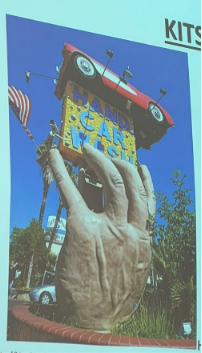
The giant hand holding a car is an exaggerated, playful sculpture used to advertise a car wash. It’s kitsch because it turns functional signage into oversized spectacle.
Why is this building considered kitsch (Corona Beer Six‑Pack Building)?
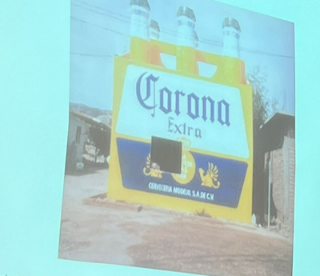
It mimics a consumer product (a six‑pack of beer) at architectural scale, turning branding into literal built form.
How does this connect to architecture?
It shows how commercial architecture uses kitsch to merge product identity with building identity. The building itself becomes an advertisement
What’s the main theme?
Kitsch architecture often relies on literal imitation of familiar objects to communicate instantly with the public.
What is a “Duck” in architecture?
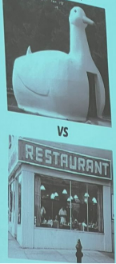
A building whose form itself represents its function (e.g., a duck‑shaped building selling ducks).
What is a “Decorated Shed”?
A generic building whose purpose is explained by signs or decoration (e.g., a plain box with “RESTAURANT” written on it).
How does this relate to kitsch?
Both typologies overlap with kitsch: Ducks exaggerate form into spectacle, while Decorated Sheds rely on surface decoration. Both highlight architecture as communication rather than pure function.
What’s the main theme?
The tension between literal form vs. applied decoration in architectural meaning
Why is this building a “Duck”?
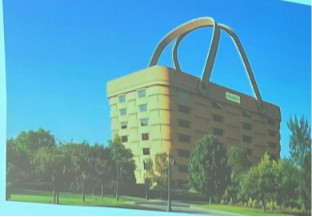
Its form directly imitates a basket, symbolizing the company’s product
How does this connect to kitsch?
It exaggerates product identity into monumental architecture, turning everyday objects into oversized spectacle
What’s the main theme?
Kitsch often overlaps with “Duck” architecture both rely on literal, oversized imitation to communicate purpose
what’s in common for all of them?
IN my opinion, what ties them together is that they all reject the idea of architecture as purely functional or abstract. Instead, they embrace kitsch strategies exaggeration, imitation, and spectacle to make architecture instantly recognizable and emotionally engaging
In architectural terms, the commonality is that these examples treat buildings as symbols and communicators, not just shelters. They blur the line between structure and sign, showing how kitsch can turn architecture into a form of popular culture storytelling
the building’s form literally represents its function
How did Andy Warhol use kitsch in his art?
Warhol drew directly from consumer culture mass‑produced soup cans and celebrity portraits turning everyday kitsch into high art through repetition and bold color (Marilyn Monroe)
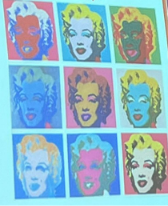
How does this connect to architecture?
Just as Warhol elevated consumer objects, architecture often elevates commercial imagery (logos, souvenirs, replicas) into monumental design. Both blur the line between popular culture and high culture
What’s the main theme?
Kitsch becomes a tool of cultural critique showing how mass production and consumerism shape aesthetics
Why are these works kitsch (Che Guevara & Mickey Mouse)?
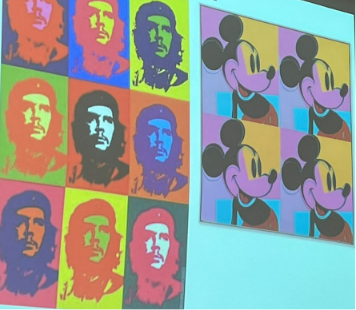
They use familiar icons (political figures, cartoon characters) in repetitive, colorful grids, transforming popular imagery into art
How does this relate to architecture?
Architecture similarly borrows icons — from national symbols to cartoonish forms — to communicate identity. Warhol’s repetition mirrors how architecture uses branding and recognizable motifs.
What’s the main theme?
Kitsch thrives on recognizable imagery whether in art or architecture, it relies on instant cultural recognition.
How does Jeff Koons use kitsch?
Koons creates giant, shiny sculptures of balloon animals, turning playful, childlike objects into monumental art.
How does this connect to architecture?
Architecture often enlarges everyday forms (baskets, bottles, animals) into buildings. Koons’ balloon dogs parallel kitsch architecture’s oversized spectacle
What’s the main theme?
Kitsch exaggerates scale and material to transform the ordinary into the extraordinary
Why is this sculpture kitsch (Balloon Rabbit)?
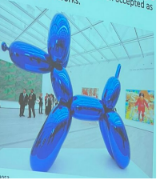
It takes a simple, disposable object (a balloon rabbit) and recreates it in reflective stainless steel, making it luxurious yet playful
How does this connect to architecture?
Architecture often uses cheap forms with expensive finishes playful design dressed in monumental materials
What’s the main theme?
Kitsch thrives on contrast between simplicity and luxury
How does this work embody kitsch (Michael Jackson and Bubbles)?
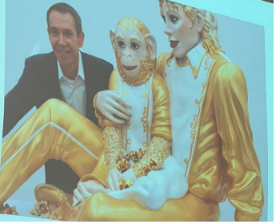
It blends celebrity culture, sentimentality, and glossy porcelain aesthetics, creating a decorative, exaggerated tribute
How does this connect to architecture?
Architecture similarly uses celebrity, nostalgia, and spectacle to attract attention from themed hotels to monumental statues
What’s the main theme?
Kitsch merges pop culture and ornament into a spectacle that challenges traditional taste
what’s in common for all of them?
In my opinion, they all share a common thread (they use popular icons and sentimental imagery, exaggerated through repetition or scale, to blur the line between high art and kitsch.)
What ties them together is that they all rely on recognition and emotional appeal. Whether it’s a cartoon, a celebrity, or a balloon animal, the subject is familiar, comforting, or nostalgic — but exaggerated until it becomes kitsch
In architectural terms, the connection is clear: just as these artworks enlarge or repeat familiar icons, kitsch architecture enlarges everyday objects (like baskets, bottles, or animals) into buildings. Both art and architecture use kitsch to communicate directly with the public, prioritizing instant recognition, spectacle, and emotional impact over abstract purity
Ornamentalism
What is the main idea of Adolf Loos’s “Ornament and Crime”?
Loos argued that ornamentation in architecture is unnecessary and even harmful. He saw it as wasteful labor and material, believing that true modern architecture should be functional, rational, and stripped of decoration
How does this idea relate to architecture?
It marks a turning point in modernist design. By rejecting ornament, Loos pushed architects to focus on proportion, material honesty, and spatial clarity. This influenced the rise of minimalist and functionalist movements, where buildings express their purpose without decorative excess
I see Loos’s stance as radical but necessary for its time. Ornament was deeply tied to tradition, and rejecting it forced architecture to evolve toward modernity. Yet, I think ornament still has value when it carries cultural meaning the challenge is balancing functional clarity with expressive identity
Is there a comparison or common thread with other architectural theories?
Yes. Loos’s critique aligns with later modernist principles (like Bauhaus or International Style) that emphasize “form follows function.” The common trade is the pursuit of efficiency and clarity — architecture as a reflection of social progress rather than historical ornament. In contrast, ornamentalist traditions (like Baroque or Art Nouveau) valued symbolic richness and cultural storytelling. The tension between these approaches highlights architecture’s dual role: practical shelter vs. cultural expression.
What does “ornamentalism” mean in architecture?
It refers to the traditional practice of decoration, often seen as an excess of ornament applied to furniture, interiors, and building exteriors. Historically, it was considered the natural embellishment of surfaces, drawing inspiration from nature and geometry.
How does this relate to architecture?
Ornament was central to how ancient cultures expressed identity and meaning in their built environment. Mesopotamia, Egypt, and other civilizations used ornament to symbolize power, spirituality, and cultural values. In architecture, it wasn’t just decoration — it was a language of symbols that gave buildings social and cultural resonance.
Is there a comparison with modern architectural theories?
Yes. Compared to Adolf Loos’s critique (“Ornament is crime”), ornamentalism represents the opposite pole: ornament as essential cultural expression. The common trade between them is the search for meaning in architecture — whether through pure function (Loos) or symbolic decoration (ornamentalism). Both approaches ask: How should architecture communicate with society?
I think ornamentalism shows how deeply architecture is tied to human culture. While Loos’s modernist rejection was important for efficiency and clarity, ornament still carries emotional and symbolic weight. For me, the balance lies in using ornament thoughtfully — not as excess, but as a way to connect buildings to their cultural and natural context.
Who was Otto Wagner and why is he important in architecture?
Wagner was an Austrian architect and urban planner, a leading figure in the Vienna Secession (1897) and Art Nouveau movements. His works in Vienna illustrate the rapid evolution of architecture from classical traditions to modernist experimentation.
How did his style evolve over time?
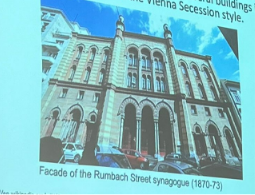
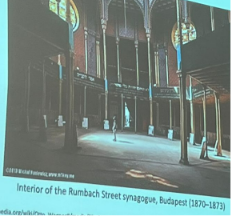
Early works (1870s): Inspired by classical architecture, e.g., the Rumbach Street Synagogue with richly decorated interiors.
Mid-1890s: Transitioned into Vienna Secession style, blending tradition with innovation.
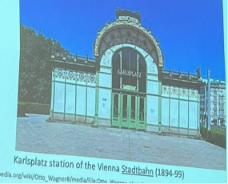
Late 1890s onward: Embraced Art Nouveau, seen in projects like the Vienna Metro stations (Karlsplatz), with floral motifs and decorative collaboration with Koloman Moser.
What is the relation of Wagner’s work to architecture as a discipline?
Wagner embodies the shift from historicist ornamentation to modernist clarity. His career shows how architecture negotiates between cultural tradition (ornament, symbolism) and modern functionality (urban planning, transport infrastructure). He bridges the ornamental past with the rational future.
Is there a comparison with other theories or architects?
Compared to (Adolf Loos), Wagner still embraced ornament (especially in Art Nouveau), but in a controlled, modern way. Loos rejected ornament entirely, while Wagner reinterpreted it.
The common trade between them: both sought to modernize architecture, but through different strategies — Loos by stripping decoration, Wagner by transforming it into stylized, geometric, nature-inspired motifs.
Compared to (ornamentalism in antiquity), Wagner’s Art Nouveau shows continuity: ornament as cultural expression. Yet, unlike ancient excess, his ornament was integrated with modern materials and urban infrastructure.
I see Wagner as a transitional figure he respected tradition but wasn’t trapped by it. His ability to adapt ornament into modern contexts makes him more flexible than Loos. For me, Wagner proves that ornament doesn’t have to be “crime”; it can evolve into a modern language that enriches architecture without overwhelming it
How did Otto Wagner’s architectural style evolve?
Early phase (1870s): Classical inspiration, e.g., Rumbach Street Synagogue with richly decorated interiors
Secession phase (1890s): Transition into Vienna Secession style, blending tradition with innovation
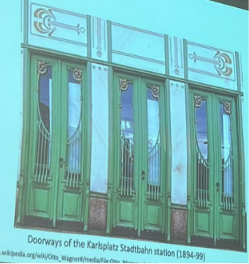
Art Nouveau phase (1898–1900s): Floral motifs and decorative collaboration (Karlsplatz Stadtbahn station, ornate doorways)
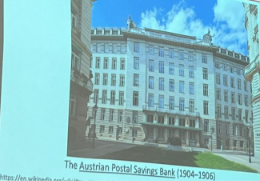
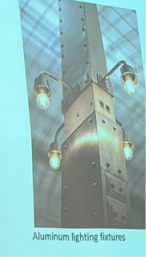
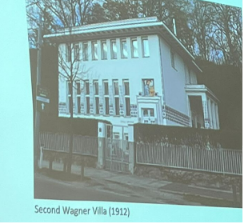
Later works (1906–1918): Geometric forms, minimal ornament, functional clarity (Austrian Postal Savings Bank, aluminum fixtures, Second Wagner Villa)
What is the relation of Wagner’s work to architecture?
Wagner’s career illustrates architecture’s negotiation between tradition and modernity. He began with ornament-heavy classical designs, embraced Art Nouveau’s decorative language, and ultimately moved toward functional modernism. His works show how architecture adapts to cultural shifts while anticipating future needs like urban infrastructure and material innovation.
Is there a comparison with other theories or architects?
They all treat ornament as a language of architecture — but each interprets its role differently.
Ancient ornamentalism: Ornament was symbolic, drawn from nature and geometry, used to communicate cultural identity.
Otto Wagner (Art Nouveau): Ornament was reinterpreted into stylized, geometric motifs, balancing tradition with modern urban needs.
Adolf Loos: Ornament was rejected as wasteful, pushing architecture toward pure function and material honesty.
Modernist successors (Bauhaus, International Style): Ornament was stripped away entirely, but the idea of communication persisted — now through clarity, proportion, and efficiency rather than decoration.
The debate over how architecture should communicate meaning. Ornament is the pivot point:
For some, it’s visual storytelling (ancient, Wagner).
For others, it’s functional silence (Loos, Bauhaus).
But in all cases, ornament — whether embraced, transformed, or rejected — is the measure of how architecture reflects society’s values at a given time
What is Art Nouveau and how does it relate to architecture?
Art Nouveau (1890–1910) was an ornamental style across Europe and the U.S., characterized by flowing, organic lines. In architecture, it appeared in facades, interiors, and urban design, blending nature-inspired motifs with geometry. It was a reaction against industrial uniformity, aiming to restore beauty and individuality to everyday spaces.
How did Art Nouveau manifest in different countries?
Germany: Jugendstil
Austria: Sezessionstil
Italy: Stile Floreale / Liberty
Spain: Modernismo
The common trade is the reinterpretation of ornament into a modern language, adapted to local culture but unified by organic, flowing design.
What role did Gustav Klimt play in this movement?
Klimt was a symbolist painter and a leading member of the Vienna Secession. His early career involved architectural decoration, which shows how painting and architecture were intertwined in this movement. His works (like The Kiss) embody ornamental richness, merging symbolic meaning with decorative surface.
How do Egon Schiele and Oskar Kokoschka connect to Klimt?
The common trade: both inherited Klimt’s ornamental sensibility but transformed it into expressive, emotional intensity — ornament became psychological rather than decorative.
What ties Art Nouveau, Klimt, Schiele, and Kokoschka together in terms of ornamentalism?
They all share a fascination with ornament as a carrier of emotion and meaning. Instead of treating decoration as superficial, they use it to intensify the expressive power of their work. The common thread is that ornament becomes a language — whether through line, pattern, or surface — that bridges art and architecture by shaping how viewers experience form and feeling.
The shared trait is ornament as expression. Whether stylized (Art Nouveau, Klimt) or raw (Schiele, Kokoschka), they reject the idea that ornament is unnecessary. Instead, they prove that decoration can embody cultural identity, psychological depth, and emotional resonance — qualities that architecture also seeks when it moves beyond pure function.
How is this tie shown in each of their work?
Art Nouveau: Ornament is structural. Flowing lines, floral motifs, and organic curves are not just decoration but define the architecture itself. Buildings and objects become living organisms.
Klimt: His paintings fuse figures with ornamental surfaces. Gold leaf, mosaic‑like patterns, and decorative abstraction blur the boundary between body and ornament, echoing architectural façades that merge structure with embellishment.
Schiele: Though more raw and expressionist, his use of angular lines and patterned backgrounds still treats ornament as a psychological frame. His figures are surrounded by decorative tension, showing ornament as emotional intensity rather than prettiness.
Kokoschka: Ornament appears in his brushwork and expressive surfaces. Instead of geometric or floral motifs, his “ornament” is the turbulence of paint itself — decoration transformed into emotional atmosphere, much like architecture that uses texture and rhythm to convey feeling.
Where do we see Floral and Art Nouveau buildings in Istanbul?
We see them mainly in Beyoğlu where late‑19th and early‑20th century urban expansion brought European influence. Apartment blocks, embassies, and cultural venues adopted Art Nouveau’s flowing floral motifs, ironwork balconies, and curving façades
Casa Botter (Botter Apartment, 1901, Beyoğlu)
Frej Apartment (1905, Galata/Beyoğlu)
Markiz Pastanesi (Beyoğlu)
Hidiv Palace (Bebek)
Şeyh Zafir Mausoleum (Besiktas)