animal diversity
Exam 3 Study Guide
§ Sketch the physiological processes telling the story of how it works from beginning to end. Think of the dynamics as a narrative describing the setting, the actors, and the action as the story unfolds. Do this over and over until you are nimble with the information.
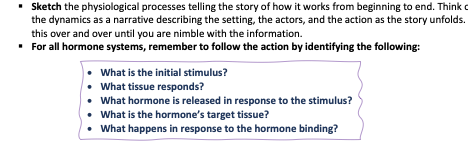
§ For all hormone systems, remember to follow the action by identifying the following:

Animal Diversity
· Know and interpret the phylogenetic tree and what each trait on it is.
· Draw the tree with all the character states as developed in lecture (I won’t ask you to draw it, but if you can, you will be prepared for any questions about the tree).
· If shown a picture, identify the phylum of the animal using diagnostic traits to figure it out.
Animal structures you should know (know what it is, what it does, who has it)
Spongocoel | Osculum | Choanocyte |
Spicule | Cnidocyte | Nematocyst |
Parenchyma | Gastrovascular cavity | Complete gut |
Medusa | Polyp | Radula |
Tube feet | Parapodia | Head-foot |
Mantle & mantle cavity | Visceral mass | Tagmatization |
Chelicerae | Mandibles | Dorsal hollow nerve tube |
Pentaradial body plan | Water-vascular system | Notochord |
Notochord | Pharyngeal gill arches | Post-anal tail |
When you have put in the work to learn the above information, you should also be able to fully discuss the following …
· Define an animal
· What were the first animals to appear on earth? That is, which group has the most ancient lineage?
· Describe the Cnidarian life cycle.
· Describe what a cuticle is and how it relates to ecdysis. Which phyla have this?
· Give some examples of tagma in arthropods.
· Having an exoskeleton means the animal must molt in order to grow. Explain what molting and ecdysis are.
In what ways are incomplete and complete metamorphosis different? (Describe each)
· List and describe the major groups of arthropods – be able to identify them based on the number of legs and the tagma they have.
· The echinoderms exhibit pentaradial body plans. So, why are they included in the Bilateria?
· List the three subgroups of Chordata (both scientific and common names). What does each use the pharyngeal arches for?
· Which are the “invertebrate” chordates?
Digestion & Nutrition (I recommend drawing out the digestive tract and writing in what happens at each place, where each digestive enzyme is located – tell the story of what happens as food moves through. Then answer these questions.)
· Identify the components of diet and what the body uses each for [LBL].
· Label the parts of the digestive system.
· Describe each step of the digestive process, where it occurs, and how it contributes to the process of digesting food and extracting nutrients.
· Layer in the information about the hormones that control release of digestive enzymes.
· Identify the macromolecules associated with various types of diets (lab)
· Diagnose results of the macromolecule tests (lab)
When you have put in the work to learn the above information, you should be able to fully discuss the following …
· Why are “essential amino acids” called “essential”?
· What is chemical energy used for?
· Describe which macromolecules (protein, sugar, fat, starch) comprise the major components of carnivore, herbivore (foliage, seeds, fruit), omnivore diets. (Lab)
· Relate each macromolecule to what it is needed for in the body.
· Compare and contrast a complete gut vs a gastrovascular cavity (and who has a gastrovascular cavity?).
· Compare and contrast “intracellular” digestion with “extracellular” digestion. Who uses each of these methods?
· Describe the journey of food through the vertebrate digestive tract, starting with ingestion. Name the parts; describe which enzymes are active in each stop along the way; explain what each enzyme digests and what produces it; Give the appropriate name to the mix of food in different places along the journey;
· Explain how the body prevents the gastric juice from digesting the stomach itself.
· Explain the general principle of surface area to volume ratio as it relates to movement of molecules across surfaces and increasing surface area for digestive enzymes to react with food (mouth).
§ How is surface area increased in …the food entering the mouth? … the structure of the small intestine?
· Describe the skull, tooth, intestine adaptations associated with herbivores … carnivores … omnivores
§ Correlate tooth structure, length of the digestive tract, size of the cecum to type of diet. [lecture & lab]
Hormones
· Describe the key characteristics of polypeptide (protein) vs steroid hormones, including where the receptors are located for each. Describe the dynamics that are triggered when a hormone binds to its receptor.
· Discuss the role of a second messenger and which hormone system you find it in.
· Is the response by the target cell faster or slower for a steroid hormone when compared to a protein hormone? Explain why.
· Describe the endocrine system and name the various organs associated with it [LBL&Lecture].
· What is the effect of “negative feedback”? Give examples of systems that utilize a negative feedback system.
· What are antagonistic hormones and how do they maintain homeostasis? Give examples of systems that utilize antagonistic hormones to maintain homeostasis
· How does a cascade system of hormones work? Give examples of systems that are regulated by a sequential cascade of hormones.
· Describe (sketch)step-by-step, the process by which each of the following regulatory systems we covered in lecture. Identify the trigger for secretion, the organ that secretes it, the target tissue and the response of the target tissue to the hormone for each:
o Blood sugar regulation
o Calcium regulation
o Digestive enzyme regulation
o Sperm production
o Ovum production
· Describe the differences between Type I and Type II diabetes. Explain under what circumstances giving insulin injections would be an effective treatment and when it would not.
Animal Reproduction
· Describe different modes of asexual reproduction seen in animals.
· What is parthenogenesis?
· Describe the factors that make external fertilization a successful mode of reproduction and those that make internal fertilization a successful mode of reproduction.
· Explain how internal fertilization is an adaptation to life on land.
· Outline [sketch] the steps for making sperm and for making eggs
· What are the end-products of spermatogenesis? … oogenesis? (LBL)
· Name / label the parts of a sperm and ovum.
· What diagnosis would you make if a woman’s progesterone levels were low? What if they were high? (refer to the in-class worksheet)
· Birth control pills taken orally by women typically contain a synthetic progesterone. Explain how this would this prevent pregnancy (refer to the in-class worksheet)
Animal Development
· Describe the processes involved in fertilization
Q. What happens during the acrosomal reaction?
Q. What happens during the cortical reaction?
Q. What is the zona pellucida? What is its function?
Q. What happens during the “fast block to polyspermy”?
Q. What happens during the slow block to polyspermy?
Q. Why is polyspermy a problem?
· Walk through the steps of cleavage and gastrulation using technical terms.
· Describe how the three germ layers are created by the process of gastrulation.
· List the organs derived from each germ layer
· Describe how is the mesoderm formed. What organ systems are derived from this germ layer?
· What happens during neurulation?
· What germ layer gives rise to the nervous system?
· What are somites? Which structures do they give rise to?
· Describe the structure of the amniotic egg –
§ Name the four the membranes and describe the function of each compartment.
§ List which vertebrates are included in the “amniotes”