bio notes
mod 8
Module 8: Non-Infectious Diseases
IQ1: How is an organism’s internal environment maintained in response to a changing external environment?
construct and interpret negative feedback loops that show homeostasis by using a range of sources, including but not limited to: (ACSBL101, ACSBL110, ACSBL111)
temperature (ACSBL098)
glucose
investigate the various mechanisms used by organisms to maintain their internal environment within tolerance limits, including:
trends and patterns in behavioural, structural and physiological adaptations in endotherms that assist in maintaining homeostasis (ACSBL099, ACSBL114)
internal coordination systems that allow homeostasis to be maintained, including hormones and neural pathways (ACSBL112, ACSBL113, ACSBL114)
mechanisms in plants that allow water balance to be maintained (ACSBL115)
Homeostasis
Homeostasis: the capacity of the body to maintain the stability of diverse internal variables. Helps regulate blood pressure, body temp, glucose levels, ph level.
Both the nervous system (uses nerve impulses) and the endocrine system (uses hormones secreted by glands) are involved in maintaining homeostasis.
Negative feedback loops: Occurs when a variable throws the body out of balance causing the body to counteract in response in order to maintain homeostasis.
1. A change occurs, also known as a stimulus.
2. The change is detected by an appropriate receptor
3. Receptor sends a signal to the control centre
4. Control centre sends a signal to an appropriate effector
5. Effector causes a response to the signal
Temperature: In order to keep the body’s temperature at a constant level, there is a negative feedback loop. Recognised by thermoreceptor (receptor), nerves transmit information to hypothalamus (control center), effectors trigger action to increase/decrease temperature → temperature respond by increasing/decreasing.
Increased temp: sweat glands, vasodilation, evaporative cooling.
Decreased temp: shivering, vasoconstriction, goosebumps.
Glucose: In order to keep the body’s blood glucose level maintained, there is a negative feedback loop. Blood glucose sugar level increases/decreases based on foods being eaten and physical activity. More carbs= more insulin. Less carbs = more glucagon.
Hyperglycaemia: BGL too high, detected in pancreas by beta cells, releases insulin, causing liver to convert glucose to glycogen= cells become more permeable=decreases.
Hypoglycaemia: BGL too low, detected in pancreas by alpha cells, releases glucagon, causing liver to convert glycogen back to glucose= increasing BGL levels.
Adaptations
Adaptation: features which increase an organism's chance of survival in its environment.
Structural adaptations: physical feature of an organism
Behavioural adaptations: the way an orgasm acts
Physiological adaptations: internal processes that maintain homeostasis
Larger SA:V = lose heat more effectively, Small SA:V = retain heat more effectively
Endotherms (warm blooded): Organisms that use internal processes to regulate body temperature in a narrow range, regardless of the external temperature. They use the heat produced from their metabolism to help maintain their body temperatures. E.g. mammals and birds.
Ectotherms are unable to do this and must change their behaviour based on the external environment to maintain a stable body temperature (often called “cold-blooded” – e.g. reptiles, fish, invertebrates)
Kangaroo:
Structure: high density of feathers to trap heat, no muscles in feet only tendons, bone, keratin, limits exposure of muscle to cold environment as the proteins would freeze.
Behavioural: huddle together and rotate as the middle gets too hot to maintain internal temperature, they can also fluff their feathers up which can trap warmth, and can pull them down to keep cool.
Physiological: counter current exchange, blood flow to the feet but its so cold that if it travelled to the heart it would cause damage, so the capillaries traveling up and down are placed side by side to exchange heat, which warms up cool blood, increases temperature of blood
Internal coordination systems
Nervous systems and endocrine systems are internal coordination systems in our body to achieve and maintain homeostasis.
Nervous system: Consists of nerves that are extended all over the body and pass messages through electrical impulses.
Neural pathways: Internal coordination of the body in order to maintain homeostasis requires messages to be sent around the body, to and from the control centre. Consists of the brain and spinal cord and peripheral nerves.
Sensory neurons: Receive information from our senses and send it to the CNS. They have special sections called receptors that detect the stimulus such as thermoreceptors, chemoreceptors, osmoreceptors. Nerve cells can be sensory, motor,interneurons.
Sensory organs: Have ears, eyes, nose, skin and tongue detect various stimuli.
Hypothalamus: Control centre for regulation. Directs effectors to carry out a response via neural pathways or by chemical messages (hormones).
Endocrine system: Hormones are signalling molecules that regulate the activity of specific target cells, interacting with specific receptors.
Hormones: Chemical messenger molecules, transported by the bloodstream.
Homeostasis mechanism in plants
Maintaining water balance is crucial as plants cannot move to find water. Much of Australia is arid (dry) with very little rainfall, and so plants must minimise water loss to store as much as possible.
Regulating stomata opening: Prevents dehydration and allows photosynthesis to occur through necessary CO2. Can also control water stress by closing guard cells helping to control water loss through transpiration.
Thick waxy cuticle: Prevents excessive evaporation (waterproof) and protection of UV.
Shedding leaves: reduces water loss during drought, eliminates primary source of transpiration during unfavourable conditions.
IQ2: Do non-infectious diseases cause more deaths than infectious diseases?
investigate the causes and effects of non-infectious diseases in humans, including but not limited to: genetic diseases, diseases caused by environmental exposure, nutritional diseases, cancer
collect and represent data to show the incidence, prevalence and mortality rates of non-infectious diseases, for example: nutritional diseases, diseases caused by environmental exposure
Non-Infectious Diseases
Non-infectious diseases: Not caused by pathogens, and therefore not transmitted between hosts.
Genetic diseases: when a mutation affects your genes or when you have the wrong amount of genetic material. This includes autism, hemophilia.
E.g Down syndrome is the result of having additional 3-chromosome 21. This causes mild to moderate retardation and poor muscle tone; higher risk of disorders such as congenital heart defects.
Nutritional diseases: Undernutrition or overnutrition. Can be influenced by lifestyle and genetic factors. This includes scurvy, diabetes, lactose intolerance.
E.g Anemia is the result of iron deficiency. This causes tiredness and muscle weakness, pale skin, headache, dizziness, light headedness.
Environmental exposure: Can be triggered by exposure to substances in the environment (e.g. mesothelioma from asbestos, lead poisoning). Can also be caused by lifestyle factors (e.g. stress, sleep).
E.g Melanoma is the result of UV radiation from the sun. Interferes with the correct functioning of the body. Discoloured area of skin, yellow discolouration. Dilation of blood vessels. Destruction of elastic tissue.
Cancer: A disease caused by an uncontrolled division of abnormal cells in a part of body.
Benign tumours cells remain within the boundary of the tumour and do not spread to other body tissues whereas Malignant tumours contain abnormal cancerous cells that are not confined by the boundary of the initial tumour.
Bowel cancer is the result of a growth (tumor) on the inner lining of the large intestine and/or rectum. Symptoms include diarrhoea, constipation, blood in the faeces, weight loss, a lump in the anus or rectum and abdominal pain.
Incidence, Prevalence, and Mortality rates
Incidence: the number of new cases diagnosed.
Prevalence: the total number of cases in the population.
Mortality: the number of deaths due to a condition.
IQ3: How can technologies be used to assist people who experience disorders?
analyse patterns of non-infectious diseases in populations, including their incidence and prevalence, including but not limited to nutritional disease, diseases caused by environmental exposure.
investigate the treatment/management, and possible future directions for further research, of a non-infectious disease using an example from one of the non-infectious diseases categories listed above
evaluate the method used in an example of an epidemiological study
evaluate, using examples, the benefits of engaging in an epidemiological study
Non-infectious diseases in populations
Disease Caused by Environmental Exposure: Melanoma
Incidence: In Australia, there were an estimated 14320 cases diagnosed in 2018 Prevalence: In Australia, Melanoma has high reported rates 37 per 100000.
Mortality rates: 1905 deaths in 2018.
Disease Caused by Environmental Exposure: Cancer
One in two Australian men and women are diagnosed with cancer by the age of 85.
Leading cause of death, 50000 deaths from cancer est. in 2019.
25000 more people died from cancer in comparison to 1982. In 2016, 679 Australians died from non-melanoma skin cancer.
Nutritional disease: Obesity
Incidence: The Australian Bureau of Statistics' National Health Survey revealed that 12.5 million Australians were obese in 2018.
Prevalence: Obesity affects over 60 out of every 100 000 Australians Mortality rates: A total of at 140 premature deaths due to obesity
In 2016, 650 million adults were obese (13% of these over the age of 18) . 41 million children over 5 were obese or overweight. 340 million children/adolescents within the age bracket of 5-19 were overweight or obese.
Treatment and Management
Treatment: People with non-small cell lung cancer can be treated with surgery, People with small cell lung cancer are usually treated with radiation therapy and chemotherapy. Surgery can be used to remove cancerous cells.
Radiation: exposing cells to radiation kills cancerous cells, normal cells repair. It is administered externally or by placing radioactive sources near cancer cells. Chemotherapy: can slow the growth of cancer cells (not so useful for melanoma, so used less)
Targeted therapy: taking drugs that affect molecules that allow the growth of tumour cells e.g. disrupting pathways for mitosis/cell division)
Future directions: NCI-funded researchers are working to advance our understanding of how to prevent, detect, and treat lung cancer. There has been a great deal of progress made, for scientists are identifying many different genetic alterations that can drive lung cancer growth.
Types of studies
Descriptive studies: The first of study, providing information about the frequency of the disease, which section of the population is affected (age, gender, SES ect), geographic location and timeframe. Allows early hypotheses on cause of disease.
Analytical studies: Used to collect more data to statistically analyse hypotheses to find likely causes of disease. Uses mortality, morbidity, incidence and prevalence. Divided into 2 ; cohort studies and case control.
Cohort studies: studying two or more similar groups of people who are free of the disease and exposing one to the possible cause. They are then followed for some time to compare incidence.
Case control: comparing people with the disease (case) to people without (control) and comparing differences to find the cause.
Intervention studies: Testing the effectiveness of a treatment or public health campaign e.g. experiment study allowing testing of new drugs by giving one group the trial drug and the other placebo. Testing effectiveness of medication and comparing it to what is already on the market.
Random: Ensuring a large number of people in each group will reduce random error. Systematic: Bias in selecting subjects to study, or in the measuring or recording of data.
Evaluating epidemiological studies:
Conducted over a long period of time
Study a large sample size (thousands)
Collect relevant data from affected and unaffected people
Participants need to represent the wider population (e.g. age, gender, diet)
Controls should have similar aspects to the case cohort (e.g. similar ages if that isn’t being tested)
Collect data on incidence, prevalence, mortality and morbidity -> use this for statistical analysis
Identify causes of disease and risk factors
Benefits of epidemiological studies: Identify causes of disease e.g. smoking and lung cancer. Allows public health authorities to manage, evaluate and plan to control diseases governments then allocate resources, develop policies and health promotion strategies to improve health e.g. National Tobacco Strategy Identify treatments and/or cures for diseases e.g. HIV and PrEP allow us to predict possible future outbreaks.
Be conducted over a long period of time
Study very large sample sizes (thousands) – this will depend on what is being studied
Collect a range of relevant data from a large group of both affected and unaffected people (only in some circumstances e.g. drug for arthritis won’t be tested on people who don’t have symptoms)
Included participants that represent the wider population
Use control groups who are not exposed to the potential cause of the disease
Collect data on the incidence, prevalence, mortality and morbidity rates of the disease
Statistically analyse the data to identify patterns and trends
Develop a management plan with strategies to control or eliminate the disease and educate the public
Evaluate the effectiveness of control and treatment programs
Inquiry question: How can non-infectious diseases be prevented?
use secondary sources to evaluate the effectiveness of current disease-prevention methods and develop strategies for the prevention of a non-infectious disease, including but not limited to: educational programs and campaigns, genetic engineering
Preventions: Governments and health agencies use a range of strategies to educate the public, actively prevent diseases and minimise the factors that cause these diseases. These can include public health campaigns (such as advertising, vaccination programs and education initiatives) or utilising biotechnology such as genetic engineering.
Educational programs/campaigns: provides information and educates the population about effects of a disease and its risk factors (and therefore protective behaviours).
Need to be diverse to reach the many different groups within a population, may require change to policy and legislation and real time monitoring, evaluation and program improvements.
Slip, slop, slap, seek, slide (for skin cancer e.g. melanoma): Involved television advertisement, sunscreen vans, catch phrase, jingle/song, free bottles on sunscreen and more gov. funded research → Led to a decline in melanoma, and thought to have prevented 43,000 cancers.
QUIT campaign (for smoking) QUIT was developed to reduce prevalence of smoking-related disease in the population. QUIT has a multifaceted approach and includes strategies such as: use of slogans, graphic images on tobacco packets to show dangers of smoking, national helpline, legislation -> requires plain packaging, increased tax, legislation to restrict advertising, banning smoking in certain areas.
Genetic engineering: transgenic species to prevent nutritional diseases ➔ vitamins deficiencies and poor diet are issue in developing countries; transgenic species can supplement certain nutrient (e.g. Golden rice). Can be used to develop vaccines (e.g. Gardasil for HPV, which causes cervical cancer
IQ5: How can technologies be used to assist people who experience disorders?
explain a range of causes of disorders by investigating the structures and functions of the relevant organs, for example: hearing loss, visual disorders, loss of kidney function
investigate technologies that are used to assist with the effects of a disorder, including
hearing loss: cochlear implants, bone conduction implants, hearing aids
visual disorders: spectacles, laser surgery
loss of kidney function: dialysis
evaluate the effectiveness of a technology that is used to manage and assist with the effects of a disorder
Structure of Eyes, Disorder of Eyes, Technology of Eyes
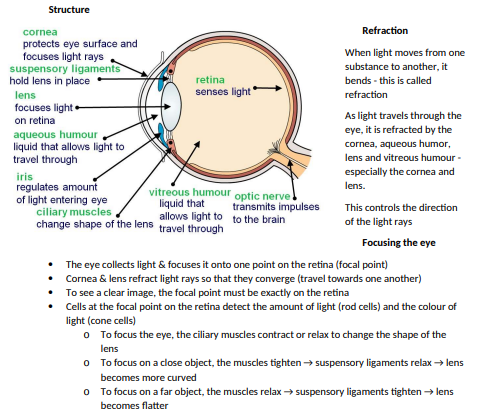
Myopia (short-sightness): eye can focus on near objects, but the focal length when viewing distant objects is too short. Caused by, concave glasses help light rays to diverge slightly before entering the eye so that the image is then focused on the retina.
Hyeropia: eye can focus on distant objects, but the focal length when viewing near objects is too long. Caused by, convex glasses help light rays to converge slightly before entering the eye so that the image is then focused on the retina.
Cataracts: Any loss of transparency of the lens, causing blindness if untreated. Caused by aging, uv, disease or damage. Phacoemulsification (Surgery) probe emits EM waves that break up the lens, debris is removed and a new artificial lens is inserted.
Sample Answer: The lens of the eye refracts light from the environment on the retina. Cataracts are a visual disorder caused by the clouding of the lens which is normally clear. Clouding stops light passing through the lens leading to blurry vision.
Treatment: A technology that assists with the effects of a visual disorder is laser surgery. One type of laser surgery is LASIK. It is used to correct myopia, hyperopia and astigmatism which are caused by refraction errors in the eye which can be caused by problems with the shape of the cornea. In LASIK surgery a thin flap is opened on the surface of the cornea, a laser then reshapes the cornea to provide the correct refraction and the flap is laid back into place.
Structure of Ear, Disorder of Ear, Technology of Ear

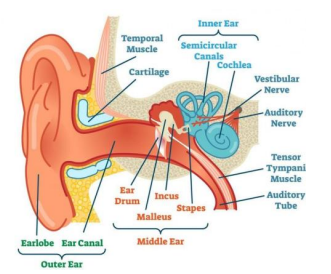
Outer ear - sound waves travel through air. Middle ear - sound waves travel through membrane & bone Inner ear - sound waves travel through fluid, then are converted to electrical signals by organ of Corti Auditory nerves - electrical signals carried to brain
Conductive hearing loss: Caused by blockage or damage in the outer and/or middle ear. This includes blockages of the ear canal e.g. wax or foreign objects ,perforated eardrum e.g. trauma (pencil) or otosclerosis (bone grows around stirrup bones).
Sensorineural hearing loss: caused by damage to, or malformation of, the inner ear, including parts of the cochlea, hair cells or auditory nerve. The causes include excessive noise exposure, heredity, birth defects, infections, tumours, medication and ageing.
Damage to the inner ear (including the receptor hair cells) prevents the kinetic energy of the vibrations being transformed into electrical impulses to be sent to the brain for interpretation.
Hearing aids: electronic devices that can amplify sounds entering the external ear.Can help with conductive or mild sensorineural hearing loss e.g. in the elderly. Consist of microphone, amplifier, receiver, speaker. Doesn’t require surgery, increase quality of sound however all part of the ear must be functioning (to an extent) to work.
Microphone: detects sound and converts it to electrical signal.
Amplifier - magnifies/increases strength of sound.
Receiver - converts electrical signal back into sound.
Speaker - transmits the sound into the ear.
Bone cochlear implants: External processors that send sound as vibrations through bone directly to the inner ear. Can help with more severe hearing loss, bypassing both the outer and middle ear. Requires surgery.
Processor - detects and amplifies sound waves, then converts them to vibrations.
Implant - transmits vibrations directly through bone to the cochlea.
Cochlear implants: 'bionic ear' sends sound as electrical impulses directly to the auditory nerve. Can help to treat severe to profoundly deaf people with missing/damaged hair cells . Help improve QOL, facilitate hearing in deaf people however very expensive, doesn't work if auditory nerve damage, have to be trained to interpret sounds.
Processor - detects sound and converts into digital code.
Implant - converts digital code into electrical impulses and transmits to electrodes in the cochlea.
Electrodes - stimulate auditory nerve, signals then recognised by the brain
Structure of Kidney, Disorder of Kidney, Technology of Kidney
Purpose of kidneys: Help regulate concentrations of soluble substances in the blood, maintain a healthy water-salt balance(osmoregulation) and remove unwanted products/waste from the blood to be excreted in urine via the bladder.


Loss of kidney function (kidney failure): Occurs when kidneys are no longer able to filter blood effectively. Usually involves damage to the nephrons. This prevents the nephrons from carrying out its function properly: filtering, reabsorption and secretion of wastes not being removed efficiently and an inability to balance water and salt levels in blood. Genetic or chronic conditions (e.g. kidney dysplasia - malformed kidneys), other illnesses (e.g. diabetes), damage to kidney (drugs/injury).
Glomerulonephritis can damage your kidneys so that they lose their filtering ability. As a result, dangerous levels of fluid, electrolytes and waste build up in your body. Conditions leading to the inflammation of kidney filters include infection and immune diseases.
Kidney dialysis: Dialysis is a treatment that filters waste and excess fluid from your blood when your kidneys are failing through the diffusion of small solute molecules through a partially permeable membrane in a dialysis machine.
Peritoneal dialysis: Occurs inside the body and insertion of catheter tube. Doesn’t interrupt time (patient can still work), can occur during sleep however need to set up and attach machine, risk of infection at injection site.
Haemodialysis: Specialised equipment and machine acts as the artificial kidney to clean the patient’s blood. Can occur in hospitals/ homes and done during sleep. However, a very time consuming, limited amount of blood can be removed from waste, side effects.
Kidney transplant: surgically inserting a healthy donated kidney (can be from a living donor). Requires matching cell markers (best chance is from a relative), allow for prolonged active life as no dialysis is needed, no restriction on dietary intake however wait lists are long, limited kidneys available, must take immunosuppressants until death.