4.3: Comparative Genomics, Genetic Variation and Natural Selection
%%Comparative Genomics:%% provides evidence for evolution and helps establish the likely evolutionary relationship between different species. it is a field of molecular biology that enables scientists to use a variety of research tools to compare whole genomes, part sequences or targeted sequences of different species to determine how much genetic material species share or differentiate between each other.
The genetic code, aka “language of life” is the same for all living things. this code uses 3 bases called codons at a time from the sequence of nucleotide bases to direct the assembling of proteins from amino acids.
==Mutations== are a permanent change to the nucleotide base sequence within the DNA molecule and are the ultimate source of genetic variation.
Over time, researchers and scientists found certain genes that have been highly conserved over time in many different species. these genes produce gene products involved in cellular processes that are essential for life across many species. The assumption made in the analysis of this data is that m mutations accumulate over time at a rate that can be calculated, therefore organisms with less mutations in their DNA are closer to the common ancestor than those that have accumulated more.
%%Sequencing of common proteins:%%
each protein produced by a cell has a primary structure, which is its linear amino acid sequence.
the sequencing of the amino acids can be directly obtained by sequencing techniques or can be determined to some degree from the DNA encoding the protein.
- ==Cytochrome C.:== 104 amino acid protein is involved in aerobic respiration and is a highly conserved protein that is found in most organisms.
- ==Haemoglobin====:== protein that transports oxygen around the body in red blood cells.
%%DNA-DNA hybridisation%%%%:%%
enables the degree of similarity between the different genomes to be determined. The amount of similarity is determined through the number of basis both species share in common. is used mainly in study of relationships between species of bacteria
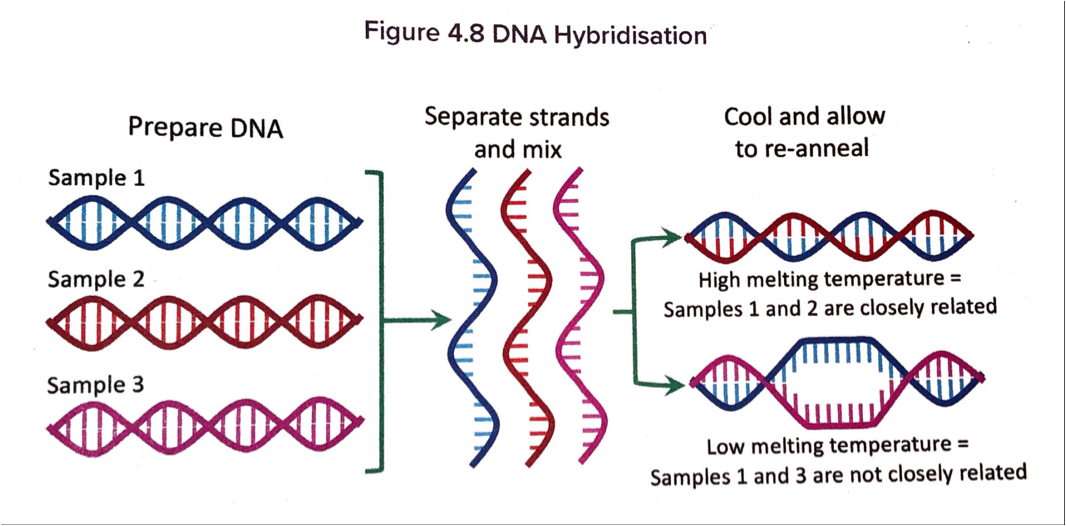
This measurement is achieved through:
- Heating (above 90°C) the strands of the double helix of DNA from one species to separate the complimentary strands.heating breaks the hydrogen bonds between the complimentary nucleotide bases.
- Single stranded DNA from the other species is then mixed with the separated strands and then the mixture is cooled (between 50°-60°C).
- closely matched strands bond more tightly than those that are not well matched.
- the newly formed hybrid double helix is reheated to see how readily the strands separate.
poorly matched strands separate more easily, at a lower temperature than well matched ones.
The DNA strands from closely related species should match well, unlike distantly related species.
%%DNA Sequencing:%%
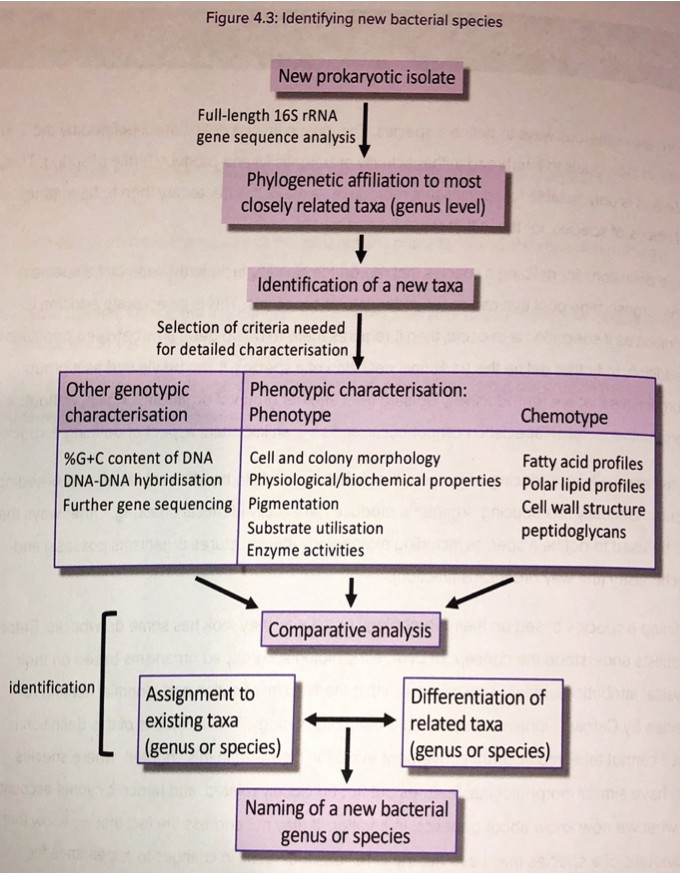
involves the determination of the base sequence of a segment of DNA. the sequences from 2 different species can then be compared directly either manually by scientists or through software such as Genbank, Clustal and BLAST). It can be used to sequence genomic DNA, plasmid DNA and mitochondrial DNA. this can be used to determine evolutionary differences based on the number of nucleotide base differences.
%%rRNA Sequencing:%%
is used in prokaryotic organisms (bacteria) to compare 16S component to distinguished species.
%%Genetic Variation:%%
Mutations are the ultimate source of genetic variation for most organisms and accounts for some of the changes seen in common genes between species. genetic variation in a population is critical as individual organisms cannot adapt to changes in their environment, however a species or population can.
%%Gene Pool:%%
A gene pool is the sum of all alleles (genes and characteristics) of all the individuals in the population. it provides genetic raw material for future generations. it is all the genetic information in an inbreeding population.
A larger gene pool indicates increased diversity and is more likely to survive a new selection pressure, due to a change in the environment. A selection pressure may be either a ==biotic== factor or an ==abiotic== factor.
%%Natural Selection:%%
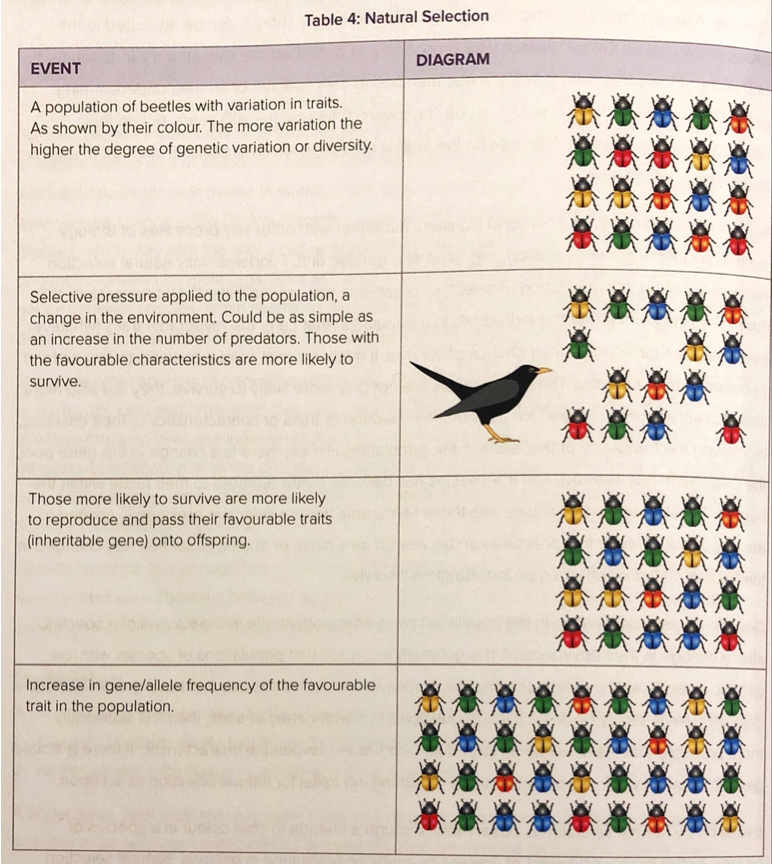
A process in which organisms that are better adapted to their environment are more likely to survive and produce offspring. Charles Darwin was the founder of Natural selection as well as the modern understanding of the process of organic evolution.
@@He used the following ideas to explain the theory of evolution:@@
- within a population there is genetic variation between individuals.
- some individuals are therefore better suited (adapted) than others to the biotic and abiotic factors in the environment.
- these individuals are more likely to survive longer and produce more offspring than less adapted ones.
- they will tend to pass genes for their favourable characteristics on to their offspring.
Over many generations the proportion of individuals in the populations with the favourable genes will increase.
Natural selection can operate with other key processes in biology such as genetic drift, mutation, genetic variation and migration. Fundamentally natural selection requires variation in a population to select an organism that is the fittest also known as
Gradually the genetic makeup of the population will change as the proportion of favourable genes in the population increases, thus changing the gene pool. Natural selection changes the frequency of alleles for favourable traits in a population. It does not always lead to the formation of new species or speciation.
 %%Genetic Drift:%%
Refers to changes in the frequencies of alleles in a population due to chance events such as catastrophes. it is usually confined to small populations as it is more likely that an allele can be completely removed from the gene pool by the death of a small number of individuals which could be due to immigration, disease or the impact of human activity. This decreases the gene pool and results in evolution as the remaining individuals provide the gene pool for the next generation, therefore only choosing specific traits.
%%Speciation:%%
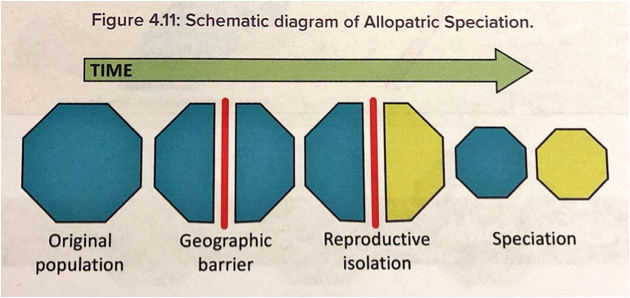
==Allopatric Speciation==: it occurs when the original population is divided into at least 2 distinct populations. the original population will become the common ancestor to the new species.
- they are usually geographically separated with a barrier (mountain range, river, road, ocean desert etc.) this prevents interbreeding within the separate populations along with separating their gene pools further.
- the separated populations are experiencing different environmental conditions and are therefore subject to different selective pressures. the population through natural selection adapt to their unique environments and habitats.
- Over a number of generations, the populations become so genetically different, with no gene flow they can become so reproductively isolated, that new species form.
==Adaptive radiation==: refers to a special case of divergent evolution where organisms rapidly evolve from a common ancestor to fill new available niches (new food source, change in aibiotic factors etc.) throughout the new ecosystem. it is a form of colonisation that over time due to the accumulation of different mutation in the population, selective pressure and natural selection the organisms become adapted to their niches which ultimately leads to speciation.