Sensory Receptors
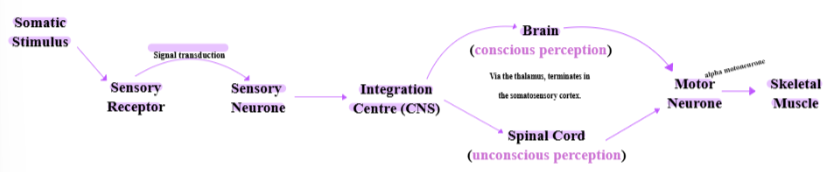
Somatic Nervous Pathway:
Types of Sensory Receptor:
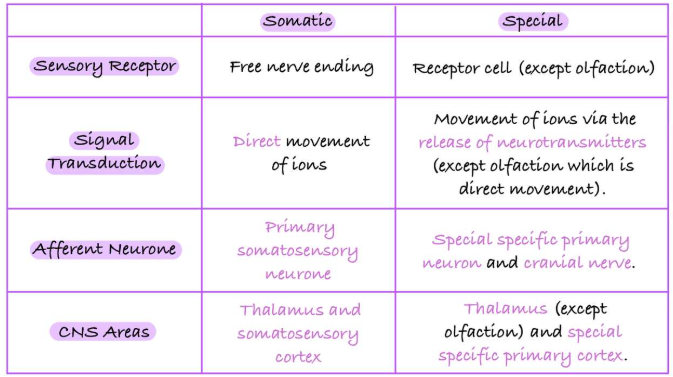
Somatic Sensory Receptors - modified or free nerve endings of sensory neurones.
Special Sense Receptors - receptor cells which synapse with the sensory neurone; they release neurotransmitters to stimulate an AP.
Sensory receptors are located throughout the body, and are activated by specific stimuli.
Mechanoreceptors:
Mechanoreceptors are found mostly in the skin and some visceral organs, such as the heart. They react to physical distortion (e.g. touching the skin).
Meissner’s Corpuscles - glabrous (smooth), with a low threshold for touch.
Merkel’s Disk - glabrous, with a low threshold for static touch.
Ruffini’s Corpuscles - glabrous and hairy, with a high threshold for stretching.
Pacinian Corpuscles - largest and deepest.
Free Nerve Endings - glabrous and hairy, with a very high threshold for touch.
Meissner’s and Pacinian Corpuscles are rapidly adapting; action potentials fire at the onset and offset of the stimulus only.
Merkel’s disks and Ruffini’s endings are slowly adapting; action potentials fire throughout the presence of the stimulus.
Types of Receptor:
Thermoreceptors - found primarily in the skin, and respond to changes in temperature. They use two main free nerve ending ion channels: TRPV1, which detects temperature increase, and TRPM8, which detects temperature decrease.
Nociceptors - found primarily in the skin, and respond to tissue-damaging stimuli. There are a few types of free nerve ending nociceptors: mechanical, chemical, and thermal.
Proprioceptors - found in the muscles, tendons, ligaments, and joints. They respond to muscle tension and have three main types:
Muscle Spindles, such as stretch receptors.
Golgi Tendon Organs, which are responsible for muscle tension.
Proprioceptors in Joints - responsible for angle, direction, and velocity of movement in joints.
Types of Sensory Neurone:
Aa - proprioception.
AB - touch.
AY - temperature and pain.
C - temperature and pain.
Receptive Fields:
The receptive field is the area in which the specific stimulus will activate the sensory receptor.
There is a high density of smaller receptive fields, which means that there is a higher spatial resolution of the stimulus.
For example, fingers and lips are highly discriminative, whereas the back, legs and arms are less discriminative.
Sensory Transduction:
Sensory transduction is the process of converting stimulus energy into electrical signals.
The activation of receptors causes the movement of ions, which leads to a change in membrane potential.
Primary Afferent Neurones:
Axons of neurones which bring in information from the somatic sensory receptors are known as primary afferent neurons, and they transmit sensory information to the central nervous system for processing.
Primary afferent neurones have their cell body in the dorsal root ganglia.
Their axons project into the dorsal horn of the spinal cord, through the dorsal roots.