sociology class 8
control and deviance
Deviance is the violation of cultural norms
→ criminal (violate legal norms), insane (not sane), sick (not healthy), perverts (violate sexual norms), heretics (violate religious norms)
definition of deviance: not because of the people violating the norms, but because of the society
normality of deviance: we need deviance in a way to keep the majority of society to follow the norms
social control involves formal and informal processes that minimise deviance
moral rules (Durkheim):
analytical (consequence that follows automatically) vs synthetical (sanction, a consequence involving social intervention
social control
informal control: significant others, we tell each other what to do
formal control: system of social control, planned and programmed, society has specialised people do the control
societal evolution: from informal to formal, bureaucratisation and proffesionalisation
Power and surveillance (Foucault)
public, physical punishment to discipline in the past
now we punish the self, surveillance (regulation of space and time)
the Panopticon (Bentham): a round room with cells in the wall and a guard tower in the middle; the inmates never know if the guard is looking at them or not so they behave = constant threat of surveillance, only one guard needed
discourse
bodies of ideas and definitions
everything about social control is about definitions
we define what’s normal and abnormal
we make some people abnormal and with that powerless (= define to dominate)
social control theory (Hirschi)
why would we conform?
human nature: inherently deviant
impeding factor
social bond (social bond not working = we take the deviant route
different dimensions
attachment: linked to significant others and you value their judgement
commitment: rational element; if caught, we might lose some things we worked hard to get
involvement: time; we’re so busy conforming there’s no time for deviance
belief: we believe in value of norms
deviance
the classical school
crime is rational choice
gain/punishment ratio (cost-benefit)
best decision in that situation
punishment and deterrence (= scaring away, make sure costs outweigh benefits) (Beccaria)
good punishment
legally standardised: no place for exceptions
particular, proportional and not indefinite (second chance)
public and prompt: don’t wait to punish
punishment in function of act, not future: in function of act, not in function of chance they do it again
critique:
rationality of choice: people aren’t always rational
freedom of choice: sometimes no choice
structural determinants
fair societies
law and power (society isn’t always fair)
the positivist school
establishing a criminal type
phrenology (Lambroso): criminal atavism; people that didn’t adapt to society
body type: most/all criminals are muscular boys ⇒ common cause
human genome project: genes connected to personality disorders, aggression…
profiling
positivistic criminology
the positivist stance
a type of person
particularity of criminals
criminals not in control, they can’t help it
critique
applicable to very small segment
most criminals are normal
neglect of the social influence on people
social foundations of deviance
society and crime definition
norms
labelling: you fit in a type and get a label, you will likely do deviant behavior
power
→ social inequality
functionalism
deviance is ‘normal’
functions of deviance (Durkheim)
affirms norms and clarifies boundaries
reaction strengthens unity (by showing deviance you show conformity)
collective conscioussness
encourages social change
anomy (absence of rules) according to durkheim (reprise)
cultural desires are insatiable
societal limitations for cultural needs
anomie → deviance
rapid societal change
regulation not adequate
context
19th c France (revolution, instable times)
strain theories (turn to deviance because you miss something)
anomy theory (Merton)
context: US, mid 20th c; American dream
society has
cultural goals → society tells us what to strive for
institutionalised means
anomy → not everyone has access to the means
discrepancy (verschil, tegenstrijdigheid) between goals and means
especially among disadvantaged
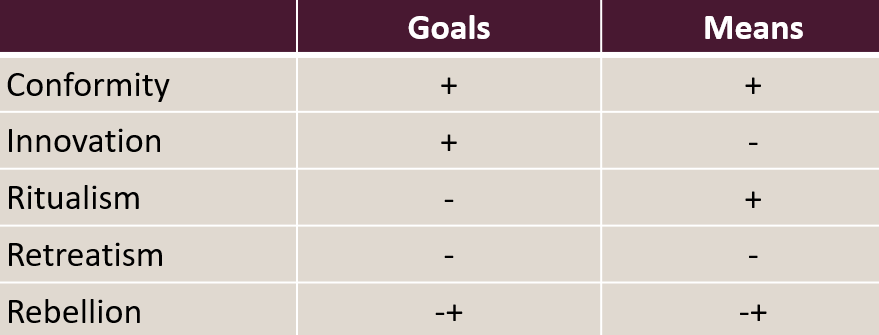
innovators: same goals, illegal means
ritualism: give up but still use means
retreatism: give up entirely
rebellion: retreat then new goals and means
critique
non-instrumental (no gain), white-collar (rich people) crimes
universal cultural goals (people aren’t universally socialized)
availability of illegitimate means?
relative opportunity structure (Cloward & Ohlin)
ratio legitimate and illegitimate means
The delinquent subculture (Cohen)
focus on lower-class boys
problem
status frustration: middle-class education but lower-class culture
do their best in school, but see that it’s easier for others
problem-solving
change situation → work harder to get into middle-class themselves, but might alienate from lower-class family
change frame of reference → set yourself aside from society, easier in group
opposes middle-class society
works when in group → culture
differential association theory (Sutherland & Cressey)
social learning theory (every behavior learned by others, we learn how and why to do it)
people we associate with determine what we’ll do by what we hear the most - (anti-)social definitions
techniques and motivations
social definitions
antisocial definitions
in small, cohesive groups
differential association
ecological view
labelling theory
response to deviance (Becker)
applying definitions creates deviants by labelling them, inciting (encouraging, stirring up) more deviance
symbolic interactionism
primary vs secondary deviance (Lemert)
primary: the first time someone does a deviant act
secondary: the label causes more deviant behavior
reaction → deviant identity
stigma, master status and criminal career
degradation ceremony: society puts the label on
retrospective labelling: start to look at past acts of someone through that label they have on
medicalisation of deviance
from bad to sick
labels
affect who responds
affect the response
affect personal competence of deviant
deviance by reasons of insanity
deviance by irresistable urge
critiques
relativity of harsh crime
consequences: creativity of reaction to labelling