L5 - Mantle Cumulates, Partial Melting and Geochemical Signatures
Magmatic Processes: Mantle Cumulates, Partial Melting, and Geochemical Signatures
Introduction
The lecture focuses on magmatic processes, specifically mantle cumulates, partial melting, and geochemical signatures.
Two key questions are addressed:
What controls the composition and mineralogy of mantle cumulates?
How does partial melting influence the mineralogy and chemistry of the resulting solid and melt?
Ophiolites and Mantle Structure
Ophiolites: Sections of oceanic crust obducted onto continental crust, providing a window into the Earth's mantle.
Structure of Oceanic Lithosphere (from top to bottom):
Pillow basalts (layers 1 and 2)
Sheeted dykes (layer 3)
Plagiogranite (layer 4)
Massive gabbros (layer 5)
Layered cumulates (layer 6)
Wehrlite intrusion (layer 7)
Dunite (layer 8)
Chromitite (layers 9 and 10)
Harzburgites (layers 11 and 12)
Lherzolites
Types of Mantle Cumulates: Troctolite, wehrlite, dunite.
Involved in Partial Melting: Depleted harzburgite, fertile lherzolite.
Partial Melting
Partial melting occurs in the upper mantle, leading to the formation of oceanic crust.
The mantle only partially melts to form basaltic melt at mid-ocean ridges - slow spreading ridges have less melting and less material removed, fast spreading ridges have much more melting.
The degree of melting is controlled by the mantle temperature and the spreading rate of the tectonic plates.
The upper mantle is referred to as the depleted mantle because lots of basaltic melt has been extracted from it, while the lower mantle has experienced less melting and is referred to as the primitive mantle.
Silica Content and Temperature
The relative silica content of magma is influenced by temperature; higher temperatures typically result in less silica by percentage volume.
Mantle Peridotite
Fertile Lherzolite: Lherzolite that hasn't melted but can produce a partial melt.
Depleted Harzburgite: Harzburgite that has been partially melted to produce a basaltic melt.
Major Element Chemistry
The major element chemistry (e.g., and ) reflects the partial melting process.
Mineral Composition and Structure
Different silicate minerals have different structures and cation compositions:
Feldspars: Framework silicate
Quartz: Framework silicate
Biotite: Sheet silicates
Amphibole: Double chain
Pyroxene: Single chain
Olivine: Isolated tetrahedra
Major Elements in Magma
Major oxides in magma include , , , , , , , , and .
They are in order of crystallising phase, so MgO and FeO are part of the early crystallising phases while K2O is part of the later crystallising phases.
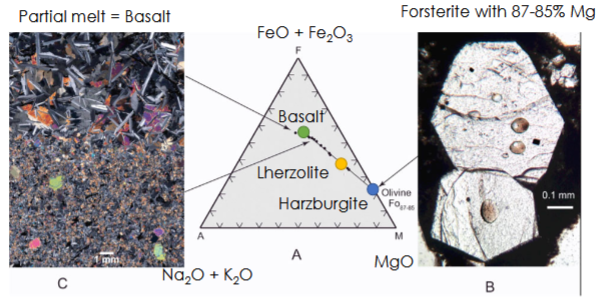
AFM Diagram
The AFM diagram plots the relative proportions of + , , and + .
Examples shown: Basalt, Harzburgite, Lherzolite
Differentiation Indexes
Mg Number ( ) is calculated as: . It indicates the relative proportion of magnesium to iron in a rock or mineral.
Increased degrees of partial melting decrease content and approach a primitive melt, while increasing fractional crystallisation increases content, forming a more evolved melt.
Magmatic Differentiation
Magmatic differentiation is the evolution of different igneous rocks via varying degrees of melting or crystallization of a common parental source.
Harker Diagrams
Harker diagrams show major element oxides vs. .
Partial melting decreases content, while fractional crystallization increases content.
Bowen's Reaction Series
Bowen's Reaction Series details the sequence in which minerals crystallize from magma as it cools.
Olivine crystallizes at high temperatures (approximately 1200°C), forming ultramafic rocks (peridotite/komatiite)
As the magma cools:
Mafic (gabbro/basalt)
Intermediate (diorite/andesite)
Felsic (granite/rhyolite) at low temperatures (approximately 750°C).
Partial Melting Percentages
Partial melting of the mantle:
0-33% melting produces Basalt ( = 0.55 – 0.64)
50% melting produces Komatiite ( = 0.6 – 0.85)
From Archaean, as geotherm was much higher, meaning much higher degrees of partial melting.
100% melting produces Peridotite ( = 0.9)
Komatiites
Komatiites are associated with high degrees of partial melting.
They have spinifex textures.
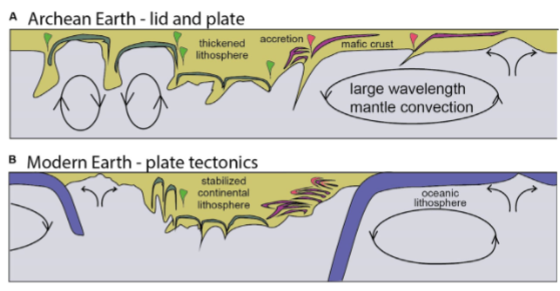
The setting in which they formed was likely different to modern, lacking large scale plate tectonics and instead having a lid and plate model.
Mantle Cumulates and Processes
Mantle cumulates are formed through various processes including water circulation, magma lens formation, and compaction.
Mantle Cumulate Compositions
Dunite: Composed of olivine (ol).
Wehrlite: Composed of olivine (ol) and clinopyroxene (cpx).
Troctolite: Composed of olivine (ol) and plagioclase (plag).
Influence of Pressure
Decreasing pressure as basaltic melt extracted from the mantle rises causes the Fo + L field to expand, causing incongruent melting rather than congruent melting.
High pressures allow for a thermal divide to exist between enstatite and crystobalite, but lower pressures form a peritectic.
Olivine preferentially crystallizes over orthopyroxene.
Influence of Melt Composition
The next phase to crystallize after olivine is either orthopyroxene or clinopyroxene, depending on melt composition.
Typical crystallization orders in mafic melts:
ol -> opx -> plag -> cpx
ol -> cpx -> plag -> opx
ol -> opx -> cpx -> plag
Crystal Settling
Olivine and pyroxene sink, while plagioclase floats.
Plag-rich deposits form at the top of the sequence.
Lunar Crust Example:
Features a Ferroan Anorthosite Crust with Plagioclase (floats) and Olivine + Low Ca-pyroxene.