Forces and Matter (EdExcel)
Introduction
Definition of Force
A push or pull exerted on an object due to interaction with another object.
It can cause an object to:
Change speed
Change direction
Change shape
Types of Forces
Contact Forces
Forces that require physical interaction (e.g., friction, tension, normal force).
Examples of Contact Forces:
Friction
Tension
Normal force
Air resistance
Non-Contact Forces
Forces that act at a distance (e.g., gravity, magnetism, electrostatic force).
Examples of Non-Contact Forces:
Gravity
Magnetic force
Electrostatic force
Matter and Its Properties
Matter is anything that has mass and occupies space.
Properties of Matter:
Mass (amount of substance in an object)
Volume (amount of space it occupies)
Density (mass per unit volume, ρ=m/V)
Forces Affecting Matter
Gravity
Pulls matter towards Earth (e.g., objects falling).
Elasticity
Matter can stretch and return to its shape (e.g., rubber bands).
Pressure
Force applied over an area (e.g., fluid pressure).
Scalars and Vectors
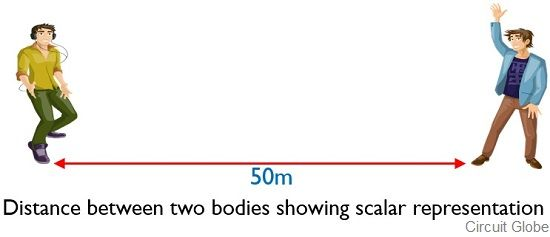
Scalars
Quantities with only magnitude (e.g., mass, distance, speed, energy).
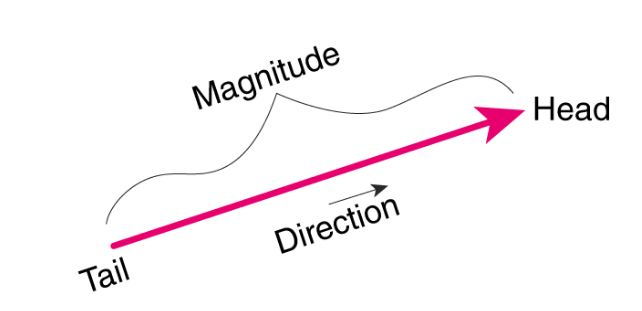
Vectors
Quantities with both magnitude and direction (e.g., force, displacement, velocity, acceleration).
Examples of Scalar and Vector quantities:
Scalar | Vector |
|---|---|
Distance | Displacement |
Speed | Velocity |
Mass | Force |
Time | Acceleration |
Distance and Displacement
Distance
A scalar quantity (total path traveled).
Displacement
A vector quantity (straight-line distance from start to end).
**Velocity
Displacement per unit time (speed in a given direction).
Friction Force
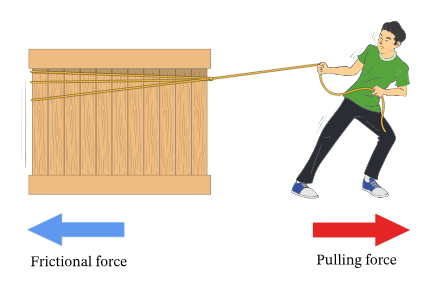
A resistive force that opposes motion between two surfaces in contact.
Acts opposite to the direction of motion.
Application (Advantages) of Friction Force:
Helps in lighting a matchstick.
Prevents vehicles from sliding on roads (grip between tires and road).
Disadvantages of Friction Force:
Causes wear and tear of machines.
Leads to tire wear in vehicles.
Newton’s Laws of Motion
Newton’s First Law (Law of Inertia)
An object remains at rest or moves with constant velocity unless acted upon by an external force.
Newton’s Second Law (Force & Acceleration)
Force = Mass × Acceleration (F = ma)
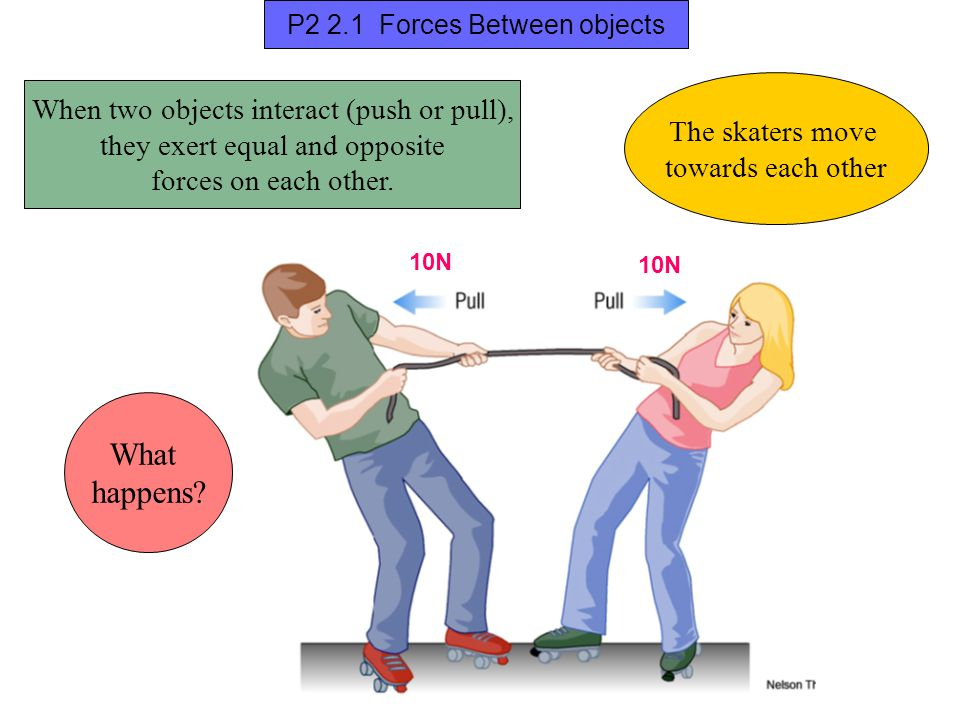
Newton’s Third Law (Action-Reaction)
For every action, there is an equal and opposite reaction.
Resultant Forces
Net Force = 0 N (Balanced Forces)
An object remains at rest or moves at a constant speed.
Net Force ≠ 0 N (Unbalanced Forces):
The object moves in the direction of the resultant force.
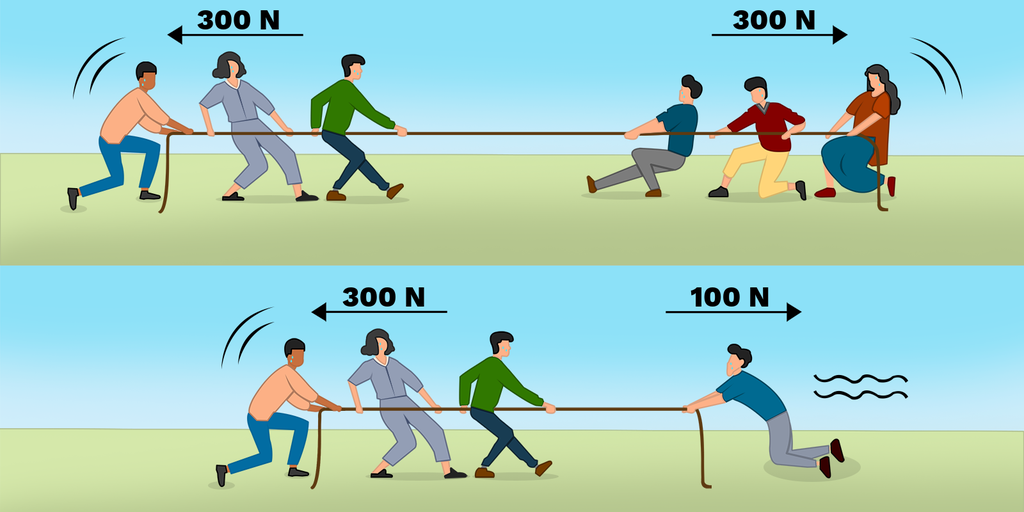
Balanced Forces | Unbalanced Forces |
|---|---|
No change in motion | An object accelerates in the force’s direction |
Object at rest stays at rest | Speed or direction changes |
Momentum & Conservation of Momentum
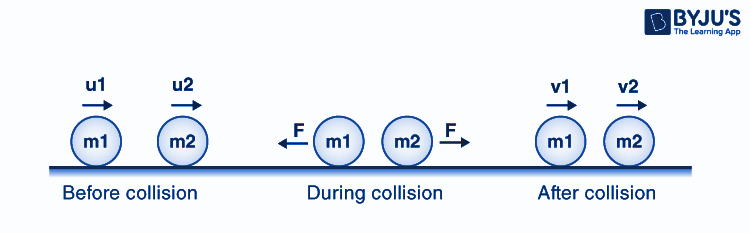
Momentum (p) = Mass × Velocity
Law of Conservation of Momentum:
Total momentum before collision = Total momentum after collision (if no external force acts).