Upper Limb - Bones and Joints
What bones make up the shoulder girdle? Which make up the different portions of the upper limb?
Shoulder Girdle: Clavicle and Scapula
Arm: Humerus
Forearm: Radius and Ulna
Wrist: Carpals (8)
Hand: Metacarpals and Phalanges
Know each bone, its general information, what joints it interacts with, what features go with which bone, and any information listed for each feature. Specific questions are listed below (not comprehensive):
Where is the only point of contact between the upper limb and axial skeleton?
Clavicle
Occurs at the sternoclavicular joint.
Which end of the clavicle articulates medially? Laterally?
Sternal end (rounded) Medial
Articulates with manubrium of sternum at sternoclavicular joint.
Acromial End (Flattened) Lateral
Articulates with acromion of scapula at acromioclavicular joint.
Which bone typically breaks in a FOOSH fracture? What is a FOOSH fracture?
Fallen on an outstretched hand, and the clavicle normally gets fractured.
What are the attachments for the Trapezoid Line, Conoid Tubercle and Costal Tuberosity?
Trapezoid Line: Attachment for trapezoid ligament
Conoid Tubercle: Attachment for conoid ligament
Costal Tuberosity: Attachment for costoclavicular ligament
Which bone is also known as the shoulder blade?
Scapula
Which borders make up the superior angle of the scapula? Inferior angle?
Superior Angle: Medial Border and Superior border
Inferior Angle: Medial Border and Lateral Border
Which feature of the scapula articulates with the clavicle? With the humerus?
Acromion Process (clavicle)
Coracoid Process (Muscle attachment)
How is the posterior scapula split?
Due to the spine
What muscle associate with the various places on the scapula?
Supraspinous fossa: Supraspinatus m.
Infraspinous Fossa: Infraspinatus m.
Subscapular Fossa: Subscapularis m.
Glenoid Fossa: Articulation w/ humerus
Which bone(s) is/are found in the arm? Forearm?
Humerus (Arm):
Head: Smooth rounded superior end
Articulates with glenoid fossa at glenohumeral joint.
Anatomical Neck: Just distal to head
Surgical Neck: Where tubular shaft begins; common area of fracture.
Greater tubercle/ Lesser tubercle: Anchoring sites for mm. of the rotator cuff
Intertubercular groove: Long head of biceps brachii tendon
Deltoid Tuberosity: Lateral attachment of deltoid m.
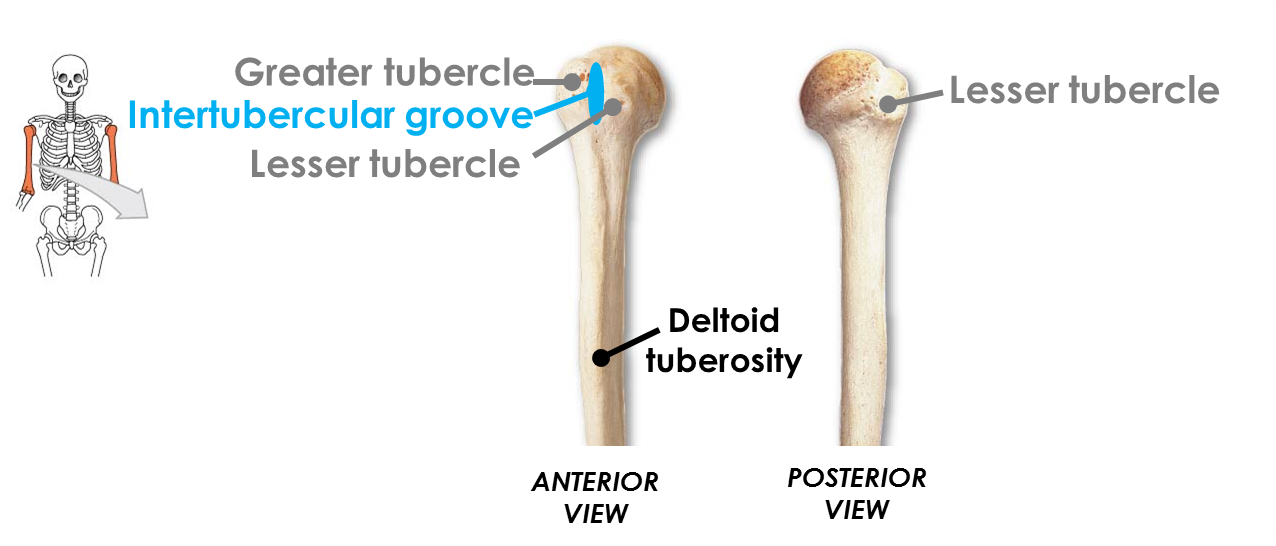
What structure travels in the intertubercular groove?
Bicep brachii tendon
Which epicondyle of the humerus is more prominent?
Greater Tubercle
What are the names of the two condyles at the distal end of the humerus? Which is medial/lateral?
Medial/ Lateral epicondyles: Attachment for forearm mm.
Medial epicondyle fore prominent
Which features of the humerus, ulna, and radius articulate at the elbow joint?
Capitulum: Articulates with head of radius (lateral)
Trochlea: Articulates with trochlear notch of ulna (medial)
Olecranon Fossa: Posterior depression for olecranon process of ulna
Coronoid Fossa: Anterior depression for coronoid process of ulna
Is the ulna medial or lateral? Is the radius medial or lateral?
Radius: Lateral (thumb)
Ulna: Medial (Pinky)
Radius and Ulna – Proximal End
Ulna:
Olecranon Process: Forms point of elbow.
Trochlear notch: Deep fossa that articulates with trochlea of humerus.
Coronoid Process: Anterior “lip” of the proximal ulna
Radial notch: indent where head of radius articulates
Ulnar/Brachialis tuberosity: attachment for brachialis m.
Radius:
Head: Articulates with capitulum of humerus & radial notch of ulna
Radial/ Bicipital tuberosity: attachment site of biceps brachii m.
Is the head of the radius proximal or distal? Is the head of the ulna proximal or distal?
Head of radius –
Head of ulna – distal end
Is the styloid process of the radius proximal or distal? What about the styloid process of the ulna?
Styloid process of radius and ulna – distal end
How many carpals are there?
8
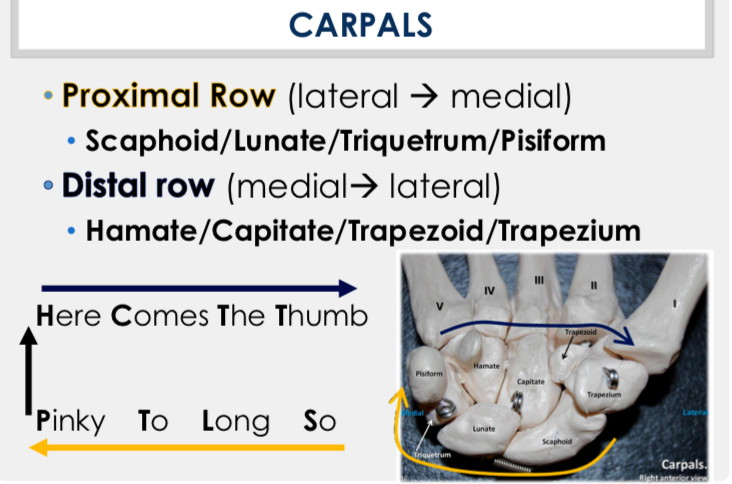
Which three carpal bones help make the carpal tunnel?
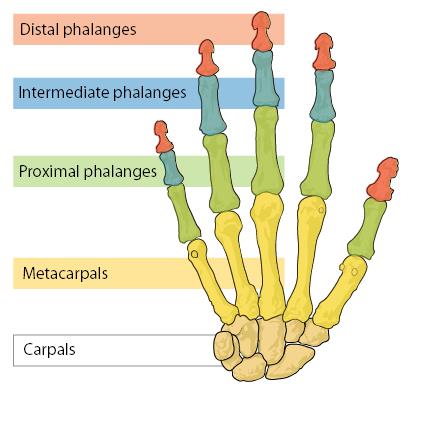 What are the names of the bones in the palm of the hand? How are they numbered?
Metacarpals
5 total
Numbered I-V
Lateral to medial
Thumb to pinky
Knuckles
What are the names of the bones in the fingers? How many does the thumb have and what are their names? How many do the remaining fingers have and what are their names?
Phalanges
Singular: phalanx
Plural: Phalanges
14 total
5 proximal
4 middle
5 distal
Know the different joints of the upper limb. Know which bones/features articulate at each and any additional information mentioned for each.
Proximal
Sternoclavicular
Only point of bony connection b/w upper limb and axial skeleton
Sternal end of clavicle and manubrium
Strengthened by costoclavicular ligament
Acromioclavicular
Limited movement
Acromial end of clavicle and acromion
process
• Strengthened by:
Acromioclavicular ligament
Trapezoid ligament
Conoid ligament
Glenohumeral
A.k.a. shoulder joint
Ball-and-socket joint between head of humerus and glenoid fossa
Greatest freedom of movement of any joint in the body
Unstable: shallow glenoid fossa/large humeral head
Strengthened and stabilized by:
Glenoid labrum: cartilaginous lip attached to margin of glenoid fossa
What does this help do?
Strengthened and stabilized by:
Rotator cuff mm.: 4 muscles that surround shoulder joint
Pull head of humerus into glenoid fossa
Consists of:
Subscapularis m.
Supraspinatus m.
Infraspinatus m.
Teres minor m.
Elbow (humeroradial, humeroulnar, proximal radioulnar)
Humeroradial
Between head of radius and capitulum of humerus
Strengthened by lateral/radial collateral ligament
Humeroulnar Joint
Between trochlear notch of ulna and trochlea of humerus
Strengthened by medial/ulnar collateral ligament
Proximal radioulnar joint
Between head of radius and radial notch of ulna
Strengthened by annular ligament which wraps around head of radius
Why stabilize radial head?
Distal radioulnar
Produces movement of supination and pronation
Between head of ulna and ulnar notch of radius
Radiocarpal
A.k.a. wrist joint
Between distal end of radius and scaphoid/ lunate
Midcarpal
Between proximal and distal rows of carpals
 Distal
Carpometacarpal
Between carpals and metacarpals
Little movement except for thumb • Wide range of motion
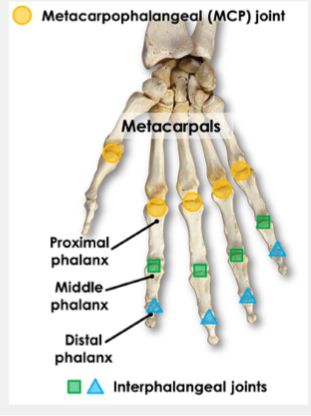
Metacarpophalangeal (MCP)
A.k.a. MCP joint
Between metacarpals and proximal phalanges
Interphalangeal (IP)
More commonly referred to as IP joint
Between phalanges
PIP joint
Between proximal/middle phalanges
DIP joint
Between middle/distal phalanges