Untitled
WJEC (Wales) Biology GCSE Topic 2.6: Role of Kidney in Homeostasis Notes (‘Higher Tier only’ in bold)
Functions of the Kidney
The kidney performs a variety of critical roles, including:
Removal of Toxic Waste Substances:
Eliminates waste products from metabolism to maintain homeostasis.
Osmoregulation:
Regulates the water balance in the body to ensure stable internal conditions.
Control of Urine Volume and Concentration:
Manages the concentration and volume of urine produced, adapting to body needs.
Osmoregulation
Osmoregulation is defined as the maintenance of constant water levels in the body fluids of an organism. This process is essential because:
It prevents cells from bursting or shrinking which can occur when water enters or leaves through osmosis.
Since cellular reactions occur in an aqueous solution, water levels significantly impact the concentrations of substances and the rate of biochemical reactions within the cells.
Structure of the Human Excretory System
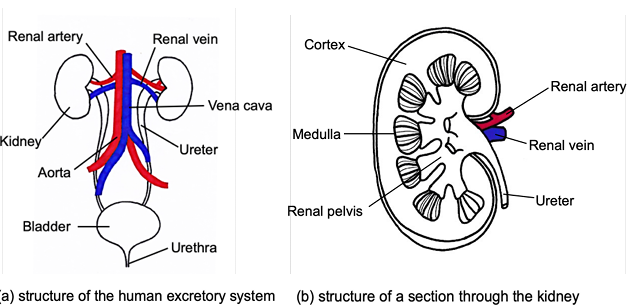
The human excretory system includes various structures, each with distinct functions:
Renal Artery:
Supplies blood to the kidneys for filtration.
Renal Vein:
Drains blood from the kidneys after filtration.
Ureter:
Transports urine from the kidneys to the bladder.
Urethra:
Conducts urine from the bladder to the exterior of the body.
Nephrons
Nephrons are the functional units of the kidney responsible for urine formation. The main processes that occur in the nephron include:
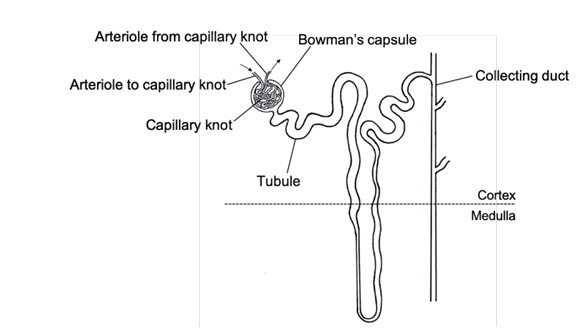
Filtration:
Removes waste products and excess substances from the blood to form filtrate.
Selective Reabsorption:
Reabsorbs essential substances back into the bloodstream.
Osmoregulation:
Adjusts water and solute balance in the body.
The Process of Excretion
The formation of urine involves three key stages:
Filtration:
Blood enters the nephron through a capillary knot at high pressure.
The afferent arteriole (leading into the capillary knot) is wider compared to the efferent arteriole (leading out), generating pressure buildup.
Small molecules (e.g., urea, glucose), water, and salts are filtered into Bowman’s capsule.
Large molecules (e.g., red blood cells, proteins) remain in the bloodstream due to their size, unable to pass through capillary pores.
Selective Reabsorption:
Glucose, some water, and various salts are reabsorbed back into the bloodstream.
Molecules not reabsorbed are forwarded down the kidney tubule as urine, ultimately stored in the bladder and excreted.
Osmoregulation:
The water content of blood is dynamically adjusted based on hydration status:
High blood water levels leads to the production of more dilute urine.
Low blood water levels leads to the production of more concentrated urine.
The hormone anti-diuretic hormone (ADH) plays a critical role in this process:
Secreted by the pituitary gland, ADH promotes increased reabsorption of water in the nephron, resulting in concentrated urine production.
Composition of Blood, Filtrate, and Urine
Component | Blood | Filtrate | Urine |
|---|---|---|---|
Water | ✔ | ✔ | ✔ |
Salts | ✔ | ✔ | ✔ |
Urea | ✔ | ✔ | ✔ |
Glucose | ✔ | ✔ | ✘ |
Proteins | ✔ | ✘ | ✘ |
Cells | ✔ | ✘ | ✘ |
Presence of Glucose in Urine:
May indicate diabetes.
Presence of Blood or Cells in Urine:
May suggest kidney disease.
Treating Kidney Disease
Two primary methods are employed to manage kidney disease:
Kidney Dialysis:
A machine used to artificially filter the patient’s blood:
Utilizes a selectively permeable barrier that separates the patient’s blood from dialysis fluid.
Materials exchange across this barrier, where waste products like urea, excess ions, and water exit the blood and are collected in the dialysis fluid.
Large cells and proteins remain in the blood due to their size.
Advantages:
Does not require surgical intervention.
Patients can undergo dialysis while awaiting a kidney transplant.
Disadvantages:
Patients must be connected to a dialysis machine for extended hours multiple times a week.
Regular travel to a hospital is necessary.
Patients must adhere to dietary restrictions (e.g., controlling fluid and salt intake).
This treatment is not a permanent solution.
Kidney Transplant:
Involves the surgical implantation of a kidney from either a living donor or a recently deceased individual.
To minimize rejection of the transplanted kidney:
Tissue typing is performed to ensure compatibility between the donor kidney and recipient.
Immunosuppressant drugs are administered to prevent immune rejection of the organ.
Advantages:
This provides a more permanent solution compared to dialysis.
Can significantly enhance the patient’s quality of life.
Disadvantages:
Finding a suitable donor can be challenging.
The procedure involves major surgery.
Transplanted kidneys have a limited life span.
There is a risk of organ rejection.
Long-term use of immunosuppressants may increase susceptibility to other infections.