Unit 2 US GOV
The first permanent English settlement in what would become America was Jamestown, which was established in 1607. These settlers would be followed by other colonists who, by necessity, had to set up methods of self-government. Britain was too far removed to govern these new colonies directly. In Virginia, the colonists established the House of Burgesses in 1619. The Pilgrims in Plymouth Colony authored the Mayflower Compact, pledging to govern themselves according to laws they created themselves. The colonists were proud of their tradition of self-governance.
This tradition came under threat following the Seven Years' War. Britain had gained control of territory in North America formerly belonging to the French. Britain had also spent a great deal of money to defeat the French. Parliament passed numerous regulations aimed at increasing revenue from the colonies. These taxes, combined with a lack of parliamentary representation for the colonists, became the source of the American Revolution. Parliament first passed the Stamp Acts, and then the Townshend Acts, generating increased resistance to British rule in the colonies. It was at this moment that the Revolution began.
By July 1776, the colonists decided to declare independence formally. Thomas Jefferson drafted the Declaration of Independence, which officially proclaimed the colonies free and independent states. The document charged the king with multiple invasions on the colonists' unalienable rights and committed the signers to the creation of a whole new kind of government the world had not yet seen.
During the Revolution, the Articles of Confederation were written to govern the newly-formed United States of America. The Articles were in place from 1777 until 1789. It quickly became apparent to Americans that the Articles, while sufficient in wartime, were insufficient and ineffective for governing the young nation. The Articles created a very weak central government without the ability to tax citizens, regulate foreign trade or interstate commerce, or even raise an army.
Beginning in 1786, delegates gathered to revise the Articles. The purpose of these initial meetings quickly changed to focus on creating an entirely new government under a Constitution. These delegates, along with the signers of the Declaration of Independence, are known as the Founding Fathers
John Adams – Adams was a very influential Founder, later becoming vice-president under George Washington and serving one term as president himself. Early in the Revolution, he pushed for formal independence and helped Thomas Jefferson author the Declaration of Independence. During the debates on proper forms of government, Adams advocated for a republic ruled by laws, a bicameral (two-house) legislature, and encouraged separation of powers into executive, legislative, and judicial branches.
Alexander Hamilton – Hamilton was very involved in the foundation of American democracy. He was an outspoken critic of a weak central government and authored the Federalist Papers to advocate for a stronger central government (more on this in Unit 2). He founded the Federalist Party and the First National Bank of the United States.
Thomas Jefferson – Jefferson is a well-known Founder, having authored the Declaration of Independence and served as the third president of the United States. During the debate over the form that the United States government should take, he was a critic of Alexander Hamilton, founding the Democratic-Republican party to oppose the Federalists. Jefferson believed that the states should retain more power and advocated for a weaker central government.
James Madison – Madison is known as the “Father of the Constitution” because of his pivotal role in drafting that document and the Bill of Rights. He was also the fourth president of the United States. While he initially favored a strong central government, during the adoption of the Constitution he changed his views, coming to believe that states should retain greater power. He helped Jefferson found the Democratic-Republican party.
John Jay – Jay helped to champion the Constitution and was instrumental in its eventual ratification. He was a vocal supporter of a strong central government, working frequently with Alexander Hamilton on the Federalist Papers. He was the first leader of the Federalist Party, the first Chief Justice of the United States, and an outspoken critic of slavery. He was pivotal in ending slavery in New York in 1799.
George Mason – While Mason was a delegate to the Constitutional Convention, he is noted because he refused to sign the Constitution. He refused to sign primarily because the original document lacked a bill of rights. He was instrumental in adding the Bill of Rights to the Virginia Constitution and inspired Madison to propose adding one to the U.S. Constitution. He also supported an immediate end to the slave trade.
Roger Sherman – Sherman signed the Declaration of Independence, Articles of Confederation, and the Constitution. He was a supporter of the Articles, favoring the unicameral (one house) legislature, believing that the large (more populous) states would suffer if the smaller states had equal voting power. Although he was a firm believer in this idea, he still helped negotiate the Great Compromise between his side (those favoring proportional representation based on population) and those favoring equal representation from each state.
George Washington – Washington was a noted leader of the Revolution and early republic periods of American history, serving as the commander-in-chief of the Continental Army and the first president of the United States. He also presided over the convention that created the Constitution. He was critical of the weak central government created by the Articles, partly due to his frustrations with the army – the central government retained no power to raise or manage a military. Washington avoided becoming a member of political parties and famously warned against them in his presidential Farewell Address. As the first president of the nation, he established many traditions that continue to this day, such as choosing a cabinet of advisors.
James Wilson – Wilson was one of the original six justices Washington appointed to the Supreme Court. During the Constitutional Convention, he argued for the direct election of senators and the president by the general population. He also proposed the Three-Fifths Compromise, allowing each state from the south to count three-fifths of its slave population for purposes of taxation and representation in the House of Representatives.
Debates and Compromises
Writing the Constitution was not easy. As the brief biographies on the previous pages reveal, the founders were divided on a great many issues and engaged in vigorous debate. Most of these debates ended in compromises that were written into the Constitution itself. The structure of our government is based on these debates and discussions between the founders. There are a few critical debates and compromises to be aware of:
Representation and the Great Compromise
One of the earliest conflicts was over how representation in the legislature would be divided among the states. Would it be equal, or would it be based on population? The more populous states favored models based on population while the less-populated states favored equal representation. The Articles of Confederation had created a system based on equal representation and the larger states (Virginia, New York, and Pennsylvania) pushed hard at the Constitutional Convention to revise this set-up. What resulted were two plans:
New Jersey Plan | Virginia Plan |
|
|
The Great Compromise was the result of merging the two plans:
| |
Slavery and the Three-Fifths Compromise
The text of the Constitution remained silent on the legality of slavery, but it was a very hotly debated issue, particularly with regard to representation:
Southern States | Northern States |
|
|
The Three-Fifths Compromise settled the issue:
| |
Election of the President
Many delegates were afraid to give the president too much power (remember, they had just escaped from a monarch), while others felt the president needed to be a powerful figure, elected for life.
States' Rights Supporters | Federal Power Supporters |
|
|
The Electoral College Compromise resolved the issue:
| |
As mentioned earlier, in creating a new nation, the founders of American democracy were relying on very old traditions. The colonies were heavily influenced by the history of British political thought. For many years, the British monarch had ruled according to the divine right of kings, a belief that monarchs derived their right to rule directly from God. This right had been limited several times in English history, most notably with the Magna Carta in 1215 and the English Bill of Rights in 1689. Both of these documents limited the power of the king by granting greater rights to his subjects. By the time that the English Bill of Rights was signed, a new way of thinking had emerged that would prove very influential on not only the British system of government but also on the colonies across the Atlantic.
Beginning in the late 17th century, many philosophers across Europe began to question divine right of kings, as well as many other political and social realities, in an intellectual movement known as the Enlightenment. Above all, Enlightenment thinkers believed in applying logic and reason to solve social problems, rather than in relying on tradition.
One of the great political thinkers of the Enlightenment was John Locke. Locke’s most influential contribution to western political philosophy was his belief that people were born with certain God-given, natural rights – namely, the rights to life, liberty, and property (note the similarity to the unalienable rights listed in the Declaration of Independence – life, liberty, and the pursuit of happiness). This was a major departure from political thought at the time. Many rulers stated that people only had rights because those rights were given by the ruler himself. The English Bill of Rights was heavily influenced by Locke’s beliefs – it listed the guaranteed rights of life, liberty, and property.
Another of Locke’s ideas that became influential at the time was related to the divine right of kings. Locke believed that human beings were the source of the government's authority, not God. He stated that people sacrificed a small portion of their rights when they decided to create a government, but that this small sacrifice ensured their rights to life, liberty, and property through government protection. This agreement between the people and their government is called the social contract. A government can only exist with the consent of the governed, and should that government fail to protect the rights of the people, it was the people's right to withdraw their consent and form a whole new government. In other words, the people have a right to resist illegitimate government.
Another influential Enlightenment thinker was Charles de Montesquieu, from France. Montesquieu was a political philosopher who investigated the various forms of government that existed in late-17th-century Europe. The most influential portion of his work was his belief that, in order to prevent abuse of power within a government, power must be divided into separate branches. Each branch (executive, legislative, or judicial) must have the ability to limit the powers of the other branches in order to prevent despotism.
In addition to political philosophy, the concepts of constitutionalism and republicanism were exported from Britain to the colonies. The famous British legal scholar, William Blackstone, and his work organizing British common law was very influential – much of American law is derived from his thought. Finally, colonists were also influenced by Judeo-Christian beliefs. Many of the founders were Protestants and several of the colonies had been founded in order to escape religious persecution in Great Britain. The teachings of the Bible, including those of Moses and the Ten Commandments, were influential on the founders.
Slavery and the Three-Fifths Compromise
The text of the Constitution remained silent on the legality of slavery, but it was a very hotly debated issue, particularly with regard to representation:
Southern States | Northern States |
|
|
The Three-Fifths Compromise settled the issue:
| |
Election of the President
Many delegates were afraid to give the president too much power (remember, they had just escaped from a monarch), while others felt the president needed to be a powerful figure, elected for life.
States' Rights Supporters | Federal Power Supporters |
|
|
The Electoral College Compromise resolved the issue:
| |
New Jersey Plan | Virginia Plan |
|
|
The Great Compromise was the result of merging the two plans:
| |
Slavery and the Three-Fifths Compromise
The text of the Constitution remained silent on the legality of slavery, but it was a very hotly debated issue, particularly with regard to representation:
Southern States | Northern States |
|
|
The Three-Fifths Compromise settled the issue:
| |
Election of the President
Many delegates were afraid to give the president too much power (remember, they had just escaped from a monarch), while others felt the president needed to be a powerful figure, elected for life.
States' Rights Supporters | Federal Power Supporters |
|
|
The Electoral College Compromise resolved the issue:
| |
Governments can place power within various geographic divisions. The central government can hold power, the regional or state governments can hold power, or they can share power. A unitary form of government is one in which all the powers are held by a single, central agency. In a unitary system, there is only a central government calling all the shots. An advantage of this system is that decisions are made easily and can be applied uniformly throughout the nation. A disadvantage, however, is that regional differences in culture or traditions can easily be disregarded – many times the policies in these governments are “one size fits all.” Another form of government is a confederation. A confederation is a system where several regional or state governments are loosely organized together, but they each reserve a great amount of power to determine their own policies. An advantage of this is that regional or state governments have complete control of law-making and therefore are very reflective of local culture and traditions. A disadvantage of this is that there is no real national policy and the state governments can frequently come into conflict with one another. The government created under the Articles of Confederation was a confederation. A federal system is one in which the powers are shared equally between the central and regional/state governments. An advantage of this is that there is a balance between central and local power. A disadvantage of this system is that there can still be conflicts among states, and also between the central and state governments. The government created under the Constitution is a federal system.
Throughout the world, many systems of government include both an executive and a legislative branch. The relationship between these two branches is how we draw our next distinction. In a presidential system, voters elect both the members of the legislature and the president through an election. An advantage of this is that the legislative and executive branches are co-equal and independent. A disadvantage of this system is that sometimes the majority of members of the legislature and the executive can come from opposing political parties, making consensus very difficult to achieve. Another system is the parliamentary system, in which voters select the members of the legislature through the electoral process. The executive is then chosen from among the legislators elected by the people. An advantage of this system is that frequently the executive reflects the will of the legislature because they are of the same party, meaning new laws are easily passed and implemented. A disadvantage of this system is that the executive branch is very dependent on the legislature, which in some ways violates the separation of powers, as well as checks and balances.
Source of Authority
There are many sources of authority in governments throughout the world. The United States has a constitutional republic because the structure of the government is defined by a constitution, but the power of that government is derived from the people, who elect representatives to serve them (this is the definition of a republic).
Type of Government | Source of Power | Example |
Monarchy | The monarch, or queen/king |
|
Republic | The people, who elect their representatives |
|
Authoritarian (Dictatorship) | The Dictator |
|
Socialist | Under true socialism, the people hold all the power |
|
Direct democracy | The people, who directly vote on all the issues |
|
Theocracy | The priest/religious figure |
|
Tribal | Varies widely – could be based on egalitarian concepts where all members are equal, on kinship ties and social rank, on chieftainships, and even on constitutions |
Principle | Definition of the Principle (in your own words) | |||||||||||||||||||||||||||
Limited Government | This principle is a feature of most democracies and states that the power of the government is not absolute. In a limited government, there are limits placed upon the power of the national and regional governments so that the government is prohibited from taking certain actions. | |||||||||||||||||||||||||||
Republicanism | The principle of republicanism is founded upon the practice of the people electing representatives to rule on their behalf. This principle is closely related to another principle, popular sovereignty. | |||||||||||||||||||||||||||
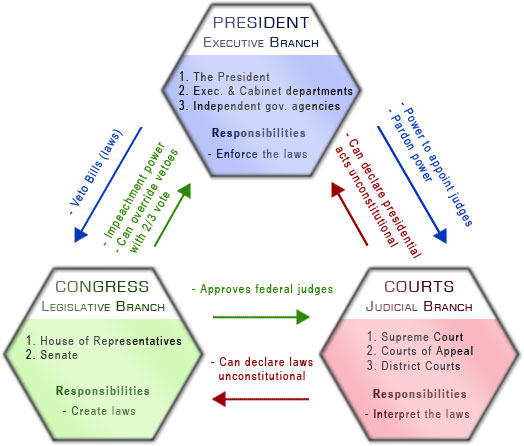
Separation of Powers | The Constitution limits the power of the national government by creating a structure based on separation of powers. Under separation of powers, the national government is split into three branches: legislative, judicial, and executive. Each branch has different duties, roles, and responsibilities to the people. This system prevents the national government from becoming too powerful. | |||||||||||||||||||||||||||
Checks and Balances | Checks and balances is closely related to separation of powers. Under the Constitution, each one of the branches has methods by which it can limit the power of the other two branches. For example, the legislative branch (Congress) has the power to create and pass legislation but the executive branch (namely, the President) can veto that legislation, preventing it from becoming law. The Congress, in return, can override the presidential veto with a two-thirds vote. This is just one example of checks and balances; there are many more. | |||||||||||||||||||||||||||
Popular Sovereignty | Popular sovereignty is one of the most basic concepts in our government. The term itself simply means “rule by the people.” The government is based on the will of the people and can only derive its power from the consent of those governed people. This fundamental concept is very much the basis of the Declaration of Independence. | |||||||||||||||||||||||||||
Individual Rights | Under the Constitution, the power of the government is limited but there is also a built in mechanism to protect the rights of all individual citizens—the Bill of Rights. The Bill of Rights sets out the most fundamental rights of individuals that the government cannot take away, including freedom of speech and worship, the ability to protest and bear arms, freedom from unjustified government searches, and the right to a trial by jury. | |||||||||||||||||||||||||||
Federalism | The final principle of the Constitution is federalism. Federalism is a term that describes the structure of the government. A federal government is one in which the power is divided between the federal, or national, government and the state governments. Within each state, there is also a division of power between the state government and the local (city, county, etc.) governments. Under the federal system, certain powers are reserved to the national government, some powers are reserved to the state governments, and still other powers are shared. We will cover this concept in greater depth in lesson 3 of unit 2.The U.S. Constitution was a revolutionary document in the history of governance. The government that was created with this document was fundamentally different from that of England. First of all, the Founding Fathers created a federal system instead of a unitary system, dividing power between the national government and the state governments instead of just creating one unitary, central government. In addition, the founders also created a government based on separation of powers and checks and balances. The structure of Constitution reflects these two chief concerns of the founders. This structure is the framework for the actual government. The U.S. Constitution is comparatively brief but contains all the information necessary to establish our government. There are three main sections: the Preamble, the Articles, and the Amendments. Preamble The Preamble is the introduction to the Constitution. It explains the purpose of the document and more broadly, the purpose of government. Articles There are seven main sections to the Constitution, called Articles. Each Article covers a different aspect on how the government is structured and addresses either federalism or separation of powers. In addition, two articles outline the steps by which the Constitution must be ratified and amended.
| |||||||||||||||||||||||||||
Amendments
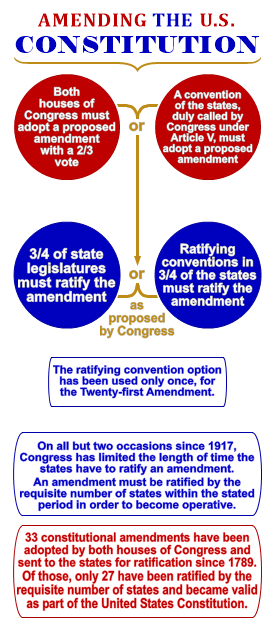
The Constitution has been amended 27 times since it was ratified and this final section of the document contains all of those amendments. The first ten amendments are considered the Bill of Rights and were added shortly after ratification. These first amendments set limitations on the power of the federal government, reflecting the Founders’ commitment to the principle of limited government. For example, the 5th Amendment protects the individual right to own private property from government seizure for public use. In other words, the federal government cannot take your property in order to build a road, “without just compensation” which is a process known as eminent domain.
Some amendments that were added after the Bill of Rights modified the rules or structure of the government and several others have been added to expand rights and privileges to new groups of people, such as the right to vote to former slaves, women, and to anyone over the age of 18. There has only ever been one amendment that was repealed: the 21st amendment repealed the 18th amendment, which had made it illegal to manufacture, transport, or consume alcohol.
Article V of the Constitution sets out the process by which it can be amended. There are two ways to propose amendments and two ways to approve them. Look at the graphic below to understand these processes:
It is important to note that when the U.S. Constitution was initially ratified, the first ten amendments only applied to the federal government, not to the states. Following the passage of the 14th amendment following the Civil War, the Supreme Court, using the power of judicial review, has used the amendment’s ‘due process’ clause to selectively apply individual amendments from the Bill of Rights to the states—a process known as selective incorporation. These court decisions impact the balance of power between national and state governments, known as federalism, which is explored in more depth in the next lesson.
More than 11,000 amendments have been proposed throughout U.S. history, but only 27 have actually made it into the Constitution. Why is that? Well, the process to amend is very complicated and the adoption of the amendment only occurs if there is an overwhelming support for it. This was intentional on the part of the founders. They did not want to make this process too easy because they believed that most issues could be resolved through normal political processes; changing the Constitution should not be done for trivial reasons or causes.
One of the greatest accomplishments of the U.S. Constitution is the establishment of a federal system. This has allowed various levels of government to develop and interact in the U.S.—the central, state, and local governments.
Structure and Function of National, State, and Local Governments
We have briefly covered the structure and function of the national government in earlier lessons. We now turn to an examination of state and local governments. Every state in the country has its own constitution, which means all Americans actually live under two constitutions: the national constitution and their state’s constitution. Every state constitution has separation of powers into three branches along with the power to check and balance each other. Much like Congress at the federal level, legislatures at the state level can pass state laws, tax citizens, and control the budget. Almost every state has a bicameral legislature—Nebraska is the only state that has a unicameral state legislature. Unlike Congress, however, state legislatures have quite a bit of freedom in which laws they can create, especially in the areas of public welfare and safety. Every state also has an executive branch, headed by the state governor. The power of the governor varies widely by state but all have the power to carry out, or execute, the state laws. Finally, states also have established judicial systems to resolve conflicts. These courts handle civil disagreements (having to do with injuries/accidents, fraud, or money damages) as well as criminal prosecutions.
State constitutions will also establish smaller, local governments, usually based on size and population. Many of these local governments are located in major cities and counties throughout the state. State constitutions regulate the duties and responsibilities of local governments, including how they raise and spend money. A charter is a document that a state government issues to a local government in which powers and responsibilities are outlined. Many local governments can also pass regulations and ordinances, further increasing the number of laws a citizen is subject to. It is important to remember, however, that under the federal Constitution, none of these local laws, or state laws for that matter, can conflict with national laws or the U.S. Constitution.
Division of Government Power
When you think about how the national and state government interact today, you may not realize that this has been a source of conflict in the past. Even from the beginning, there were some doubts about the federal system—the purpose of The Federalist Papers was actually to defend this new system from its critics. The controversy did not end with the ratification of the Constitution; in fact, the Tenth Amendment had to be added to appease those critics. The Tenth Amendment states that “the powers not delegated to the United States by the Constitutions, nor prohibited by it to the states are reserved to the states respectively, or to the people.” This amendment essentially gives states authority over matters that are not found in the Constitution and gives rise to a division of power between the national and state governments. This includes expressed or implied national powers, reserved state powers, and concurrent powers.
Division of Power between National and State Governments | |
Expressed Powers (Enumerated Powers) | powers that the Constitution explicitly states are to be held by the national government. These include most everything in the first three Articles, such as the power to raise taxes, to coin money, declare war, and regulate commerce between states. |
Implied Powers | Powers that are not stated specifically in the Constitution but have been inferred from those expressed powers in the Constitution. For example, the Constitution does not state anything about developing nuclear weapons, but this power has been implied by the national government under the express power of protecting the country. |
Reserved powers | Powers that were discussed in the tenth amendment. These are the powers reserved for the state governments, including regulating business within the state and establishing local school systems. |
Concurrent Powers | Powers that are shared by the national and the state governments. These include the power to tax, maintain a court system, and take private property for public use. |
Expressed and Implied Federal Powers | Concurrent Powers
| Reserved State Powers
|
|
|
|