Short-Term Memory
History
William James - 1890, father of two-part memory system
Primary memory - memories that never leave consciousness, part of the psychological present
Secondary memory - a memory absent from the consciousness and belongs in the psychological past
Short-term memory - memory that is limited in duration and capacity
Long-term memory - typically any memory more than a few minutes old; can last a few minutes to a lifetime
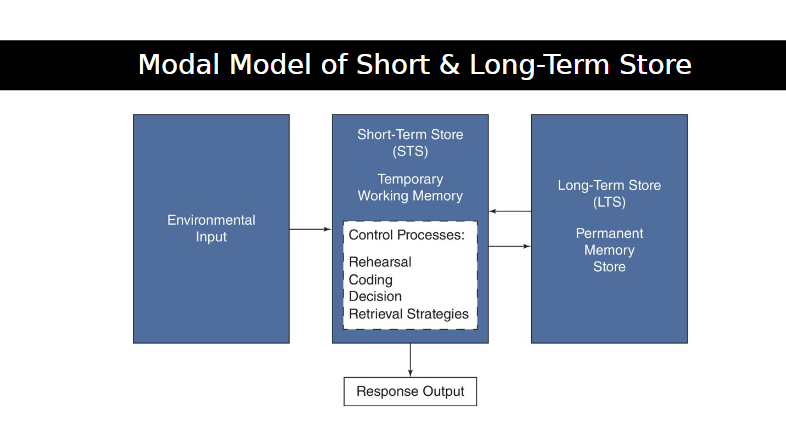
Atkinson and Schiffrin (1968) - multistore system of memory; the “modal” model of memory
Proposed there are separate short-term and long-term memory stores
Baddeley and Hitch (1974) - proposed the evolution of a single short-term memory into working memory
Short-Term Memory Tasks
Distractor task - attempts to quantify the duration of immediate memory over brief delay intervals while rehearsal is prevented
Do something opposite that interrupts cognitive process, checks to see how much we can interrupt potential short-term input
We find that short-term memory can be highly manipulable
By and large, outlines what happens to us on a daily basis when we’re studying, learning, engaging
Brown-Peterson task - items are presented for retention, usually three letters or words; typically, items can be recalled accurately if tested immediately
Caveat to distract task: What happens if the lapse in memory is due not to memory loss but due to interference from earlier trials?
Proactive interference - items presented on earlier trials interfere with recall of the current list of to-be-remembered items
Items with similarity to the to-be-remembered can also interfere with memory
Forgetting occurs more rapidly across trials; however, shifting the category of the target items can dramatically increase recall, a phenomenon called release from proactive interference
If we’re showing pictures of faces then switch to pictures of buildings, it violates proactive interference
If you study the same material for a long time, it can start to morph and create poor understanding (why cramming doesn’t work)
Memory Span
Second measure of STM is related to its capacity
Memory Span - the longest sequence of items that can be remembered in correct order after a single presentation
Recall is immediate; without delay or distractor
Often consists of five to nine items (think plus/minus 7 rule) that can be recalled correctly
World-length effect - more items can be remembered when short words are the to-be-remembered items
Characteristics of Verbal Short-Term Memory
Recent memories (STM) are rich in sensory quality such as color, sound, and texture
Objective features have been attributed to STM:
Acoustic encoding
Limited capacity
Limited duration
Susceptibility to forgetting
Transfer to long-term memory
Control Processes
Acoustic Encoding - It is what is “sounds like”; words are remembered as they sound as though they are being verbally rehearsed
LTM usually remembers the meaning of a word via semantic encoding
We remember meaning rather than sound
Man, Can, Mad, Cap, Map - all sound similar and can be confused, but when encoded and recalled by meaning, the words are more easily remembered
Man is not the same as ball cap, it is not the same a map, etc.
Verbal-semantic encoding - instantaneous recall of a phrase is close to verbatim, later recall is done in paraphrases
Limited Capacity & Duration - The average person can remember seven items in a memory span test
This doesn’t mean the STM is only seven items
What is an “item”?
A letter, word, idea, picture, etc.
Items are proposed as a unity already existing in LTM
Memory span can be enlarged by increasing the amount of information within each item.
Chunking - the parsing and encoding of material in meaningful units
Forgetting
STM is sensitive to disruption
Forgetting from STM is due to displacement of old items by new items
The capacity limit means the addition of new items requires dropping some items already in STM
STM retention often takes place in the context of divided attention
More interference occurs if speech is in the background as compared to white noise
Transfer to LTM
STM functions as a mode to transfer info into the LTM
Maintenance occurring in the STM is the process of rehearsing, forming images, or mnemonics to aid the development of permanent memories of information
Caveat: STM is not required for LTM development
Individuals with brain injuries can still learn and encode memories into their LTM
KF had a poor STM but a high functioning LTM
Inverse: HM had a good STM but could not encode new memories into LTM
Control Processes
Humans can, to a degree, control how to STM
Control where to direct attention
How to code new inputs
When to rehease
Which retrieval cues to use
Control processes define the STM as an active rather than passive information store
Other Modalities of STM
Visual STM - images are presented, participants are asked to recognize if the picture is known or unknown
Spatial STM - spatial positions are shown on a grid and participants are asked to point to locations in the order they had appeared
STM for Actions - body movement mirroring following an example by instructor
STM for Odors - single or multiple smells offered, participants must choose if smell is same or new
STM for Hearing Impaired - similarity in signs can cause memory error
Working Memory - the proposed advancement and elaboration of STM
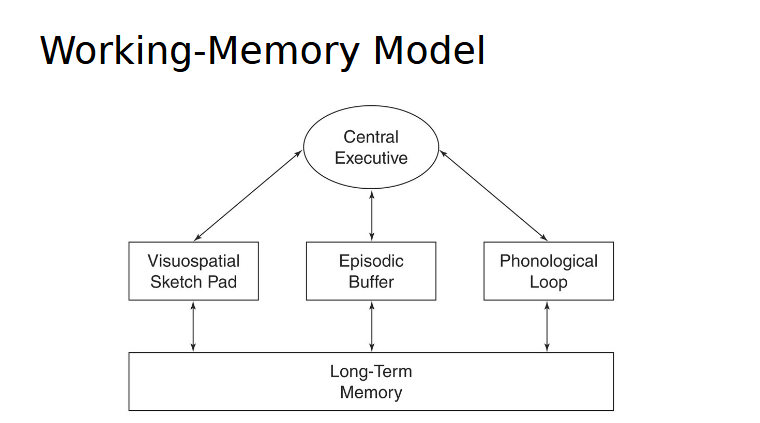
Working-memory model consists of four components (multicomponent model)
Phonological Loop
Visuospatial Sketchpad
Central Executive
Episodic Memory
Phonological Loop - similar to verbal short-term memory
Represents our brief storage of verbal material we use in rehearsal, verbal problem solving, and arithmetic
Brief, limited capacity, easily disrupted
Testing could be conducted with a digit or word span; working memory adds in a second processing task to be conducted simultaneously
To-be-remembered words are intermixed with true-false arithmetic problems
Visuospatial Sketchpad
Retains visual images
Pictures, imaged versions of words, mental representations
Spatial information
Locations of squares or pieces on a game board
A test would ask to remember a sequence on a checkerboard; working memory would ask to assess symmetry or patterns
Can be referred to as: visual-spatial; visual-spatial intelligence, visual-spatial memory; these terms are all used interchangeably
Central Executive - in control of attention
Focuses attention, allocates attention, or distributes attention across multiple tasks
Difficulty experiences when attempting two things at once can be due to our inability to focus full attention on each
Attention is a limited resource
Central executive acts as a “manager” between the STM and LTM
Episodic Buffer
Integrates information across:
Phonological and visual stores
Central executive
Encoding and retrieval from LTM
STM interacts with LTM to accomplish processing tasks
Episodic buffer acts like a bridge between the two, retrieving memories from the LTM to help assist in accomplishing more complex thinking tasks
Measuring Working Memory
Typically measured by the capacity to do two things at once, referred to as dual tasks
Example: 2+3=?; 4 × 2 = ?; 9 - 3 = ? While remembering all the answers
Or phonological & visuospatial stores, remembering a string of words while judging if object pairs are the same or different
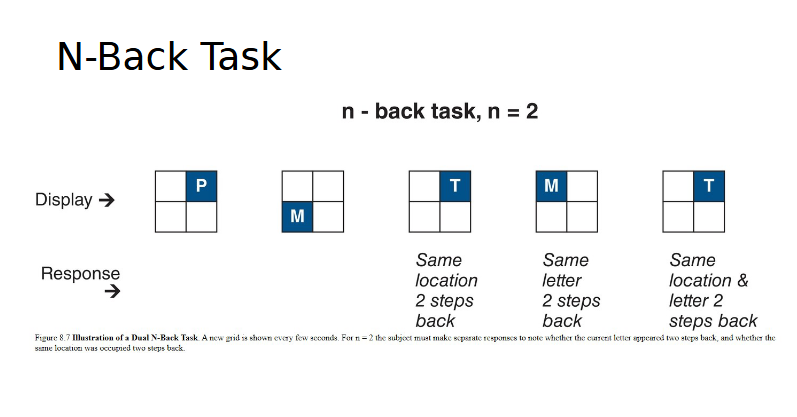
N-back task - remembering a location or letter “n-steps back”
Participants must push a button to indicated whether the n position is the same letter, in the same position, etc.
Executive Functions - higher-level cognitive skills used to control and coordinate other cognitive abilities and behaviors
Directs mental processes such as short-term remembering, problem solving, language production and comprehension, decision-making
Example: preparing a meal for one’s family - all the steps for completion
Food prep, cook time, quantities, portions, etc.
Updating: updating the contents of working memory by adding or dropping information
Inhibition: overriding a dominant, automatic, habitual response
Stroop test: Red, Black, Blue, etc.
Shifting: ease of switching rules or strategies
Sorting blocks by color to sorting by shape
Flexibility: readiness to response to changed goals or priorities
Attention control: the ability to focus attention, avoid distraction, and switch attention readily
Consciousness & Working Memory
Is there a difference between the two? What is mind and what is consciousness?
The CE is the control of attention, suggesting something (or someone) directs and chooses what to attend to
Rehearsing words in the phonological store is essentially “talking to oneself”
Visual & verbal information originate in different sensory modalities and coded differently in the brain, yet the mind translates one to the other and combines them
Individual Differences
Aging and WM - slower response time and difficulty inhibiting distracting thoughts
Dementia and WM - AD can range from mild to profound, dual tasks come with impairment as compared to single task problems
Anxiety and WM - attention is diverted to preoccupation, self-criticism, and other forms of negative thinking
Negative self-talk engages the phonological store, negative self-image engages the visuospatial, etc.
Can contribute to stereotype threats - stereotype reinforcers for beliefs can inhibit memories
Multitasking - Several separate tasks being attempted simultaneously
At any one moment, only one task or step can be performed due to physical or cognitive limitations
Steps involved are interleaved (one task is stopped to start a second task)
Interruptions and unexpected outcomes lead to delays
Remembering to return to a task that has not yet been completed
Basically, multitasking occurs whether we like it or not
High stress positions require multiple actions to be taken throughout a process (medical, legal, business, etc.)
Supertaskers - two cooccurring processes with high stakes outcomes
Driving while texting or talking on the phone