23: Species Community
Tophat
You are studying a plant species that has a fungus growing in its roots. You remove the fungus and evaluate what happens to the plant. Which outcome indicates a mutualistic relationship?
The plant becomes less toxic to herbivores.
How does an ecologist determine the presence of an ecotone?
Measure the abundance of plant species over space and abrupt changes in species composition.
The mathematical models for competition between species are based on the _____ equation.
logistic population growth
Species abundance and diversity
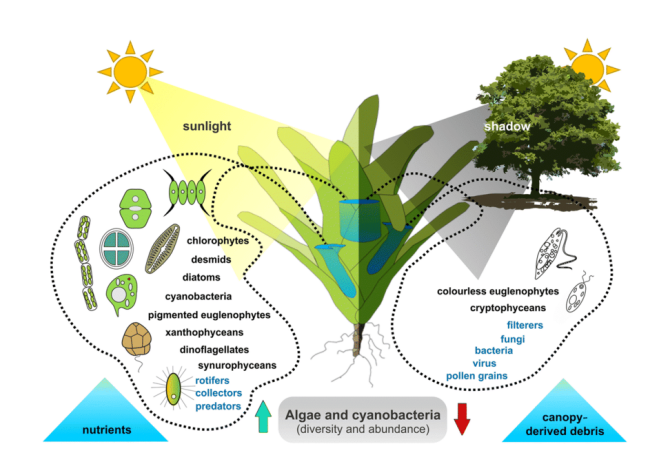
Community: all populations of species living together in a particular area
Definitions
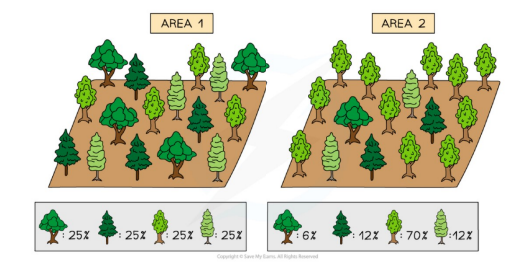
Species richness: the number of species in a community
Relative abundance: the proportion of individuals in a community represented by each species
Diversity: the number of different species in a particular area and their relative abundance
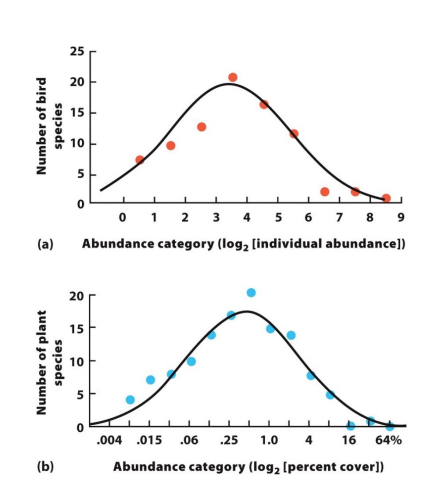
Log-normal distribution: a normal, or bell-shaped, distribution that uses a logarithmic scale on the x-axis
Rank-abundance curve: a curve that plots the relative abundance of each species in a community in rank order from the most abundant species to the least abundant species
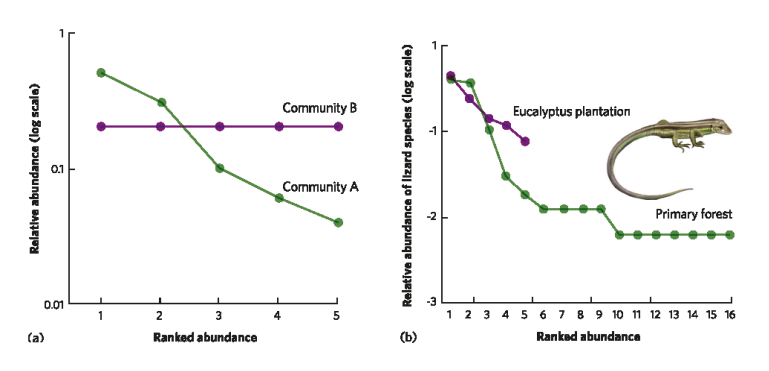
Species evenness: A comparison of the relative abundance of each species in a community.
The use of indices to characterize communities
Diversity Index: a quantitative measure of the number of species in a community
useful to compare communities
account for: richness, evenness, dominance
Taxonomic diversity index:
Simpson index, Shannon-Wiener index
Scale (landscape ecology)
Alpha diversity
diversity within a particular area
Beta diversity
diversity between ecosystems or sites
Gamma diversity
overall diversity within a region
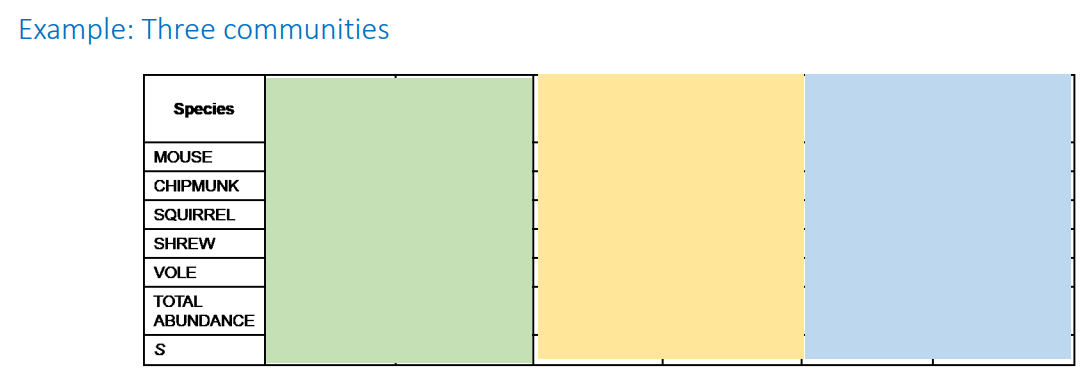
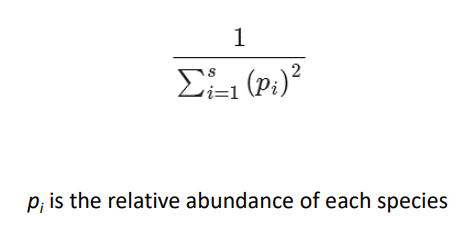
Simpson Diversity Index
Developed by Simpson (1949)
It is a measure of probability: the less diversity, the greater the probability that two randomly selected individuals will be the same species
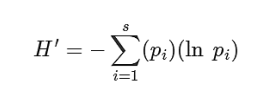
Shannon-Wiener Diversity Index
Shannon (1948)
Shannon’s diversity index
Based on uncertainty
In a community with low diversity, we can be fairly certain of the identity of an organism we might choose by random (high certainty or low uncertainty)
If a community is highly diverse and we choose an organism by random, we have a greater uncertainty of which species we will choose (low certainty or high uncertainty)
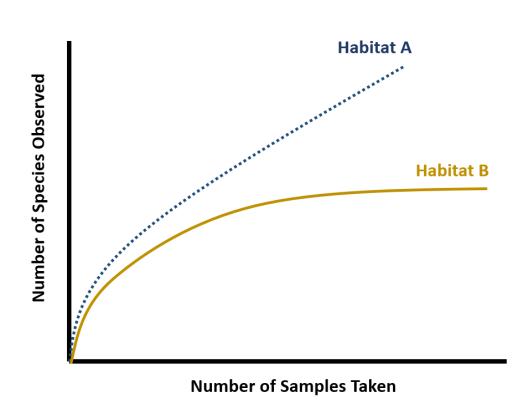
Rarefaction Curves
A technique to assess species richness from the results of sampling
The larger the number of samples, the greater number of species that will be found
Rarefaction allows the calculation of species richness for a given number of individual samples, based on the construction of so-called rarefaction curbes
Rarefaction curves are necessary for estimating species richness
If a curve hasn’t yet reached its aymptote, there are additional species in that habitat still to discover