Molecular and Cellular Biology
1.1: Introduction to Chemical Composition of Organisms
1.1.1: Reactions & Bonds
Matter: Any substance that occupies space and has mass, and is made of elements
Elements: Cannot be broken down to other substances
Carbon
Oxygen
Hydrogen
The four elements common to all living organisms are oxygen, carbon, hydrogen, and nitrogen
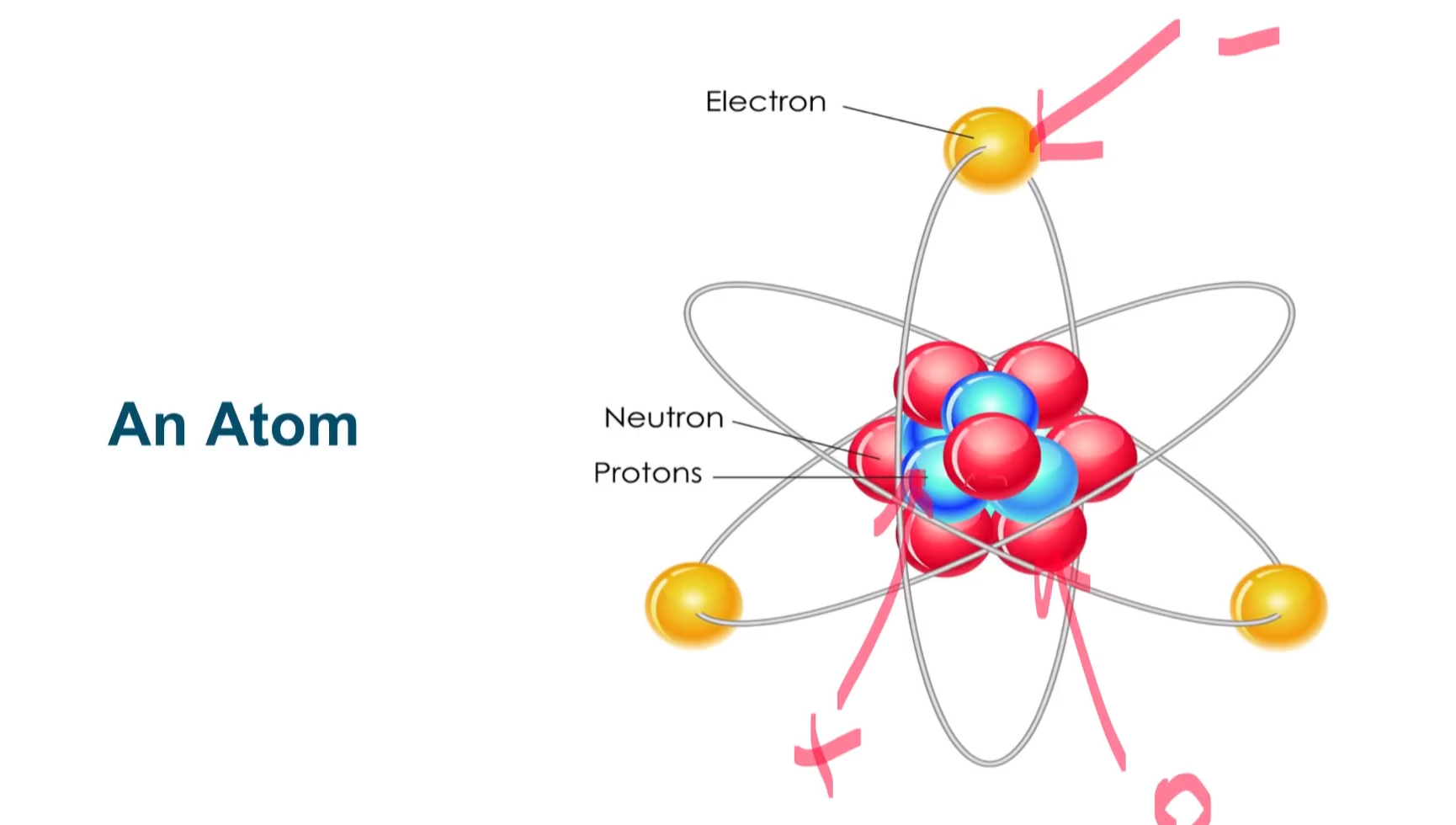
Atom: Smallest unit of matter w/ element’s properties
Each element has unique atoms composed of three types of subatomic particles
neutrons (in nucleus)
protons (in nucleus)
electrons (orbitals surrounding the nucleus)
Compound: 2+ different elements combined in a fixed ratio
Molecule: 2+ Same or different elements combined in a fixed ratio
Oxygen gas for example
Electrons: Found orbiting in shells
valence shell: Outermost shell, electrons here called valence electrons
only valence electrons interact w/ other atoms
Chemical bonds: attractions that keep atoms close together
protons and electrons attract like magnets
Chemical Bonds - Covalent
Sharing pair of electrons, strong bonds
nonpolar: Sharing is equal
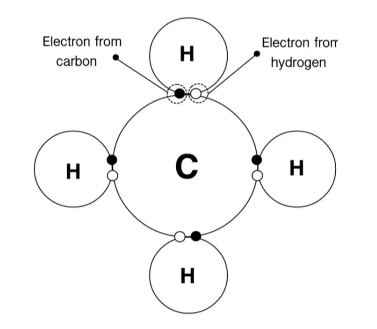
polar: Sharing is unequal, creates partial charges (poles)
Chemical bonds - Ionic
One atom (anion) steals electron, other atom (cation) loses electron, strong bonds
Chemical Bonds - Hydrogen
Form between poles of H and O in water molecules, weak bonds
Chemical reactions
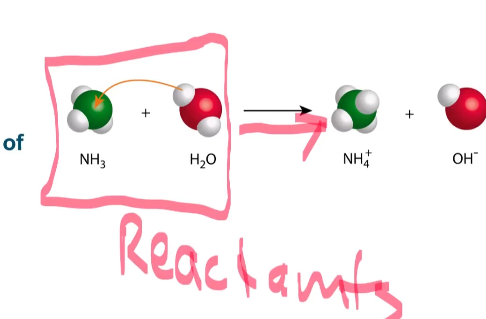
Make and break chemical bonds
Reactants react together, start of reaction
Products are produced, end of reaction
Energy:
1st Law of thermodynamics: Energy cannot be created or destroyed
2nd law of thermodynamics: reactions tend to increase disorder (make energy less available for cells)
Endothermic reactions take energy
Exothermic reactions release energy
1.1.2: Properties of Water
Solid less dense than liquid
Water has adhesion, cohesion and surface tension
Adhesion: molecules will stick to molecules other than water molecules well
Cohesion: Molecules will stick to molecules of the same type well
Surface tension: It’s difficult to break the surface of water
All of these characteristics are due to hydrogen bonds
Universal solvent
High specific heat
Evaporative cooling
Acids and Bases
Acids: dissolve in water and increase relative H+ ion concentration in the solution
HCl ←> H+ Cl-
Bases: Dissolve in water and decrease the H+ ion concentration in the solution
NH3 + H+ ←> NH4+
pH scale shows relative amount of H+ ion concentration
smaller + means more acidic
acidic
larger # means more basic
alkaline
7 is neutrals
substances called buffers can help bring something to neutral
1.1.3 Chemical Structure of Carbohydrates, Lipids, Proteins, Nucleic Acids
Any molecule containing carbon is called “organic”
Can contain other molecules - oxygen, hydrogen, nitrogen
Made of building blocks called monomers
Many monomers linked together form polymer (whole molecule)
4 Types of Organic Molecules
Carbohydrates
carbon, oxygen, and hydrogen
Monomer name: monosaccharide
ex: glucose
Polymer name: polysaccharide
ex: starch
lipids
grouped together because of their hydrophobic properties
ex: waxes (water barriers), fats (energy storage), phospholipids (cell membranes), steroids (hormones)
proteins
Monomer name: amino acids
Polymer name: polypeptide (protein)
Peptide bond: holds amino acids together
function:
most enzymes
defense - antibodies
muscle - fibers
nucleic acids
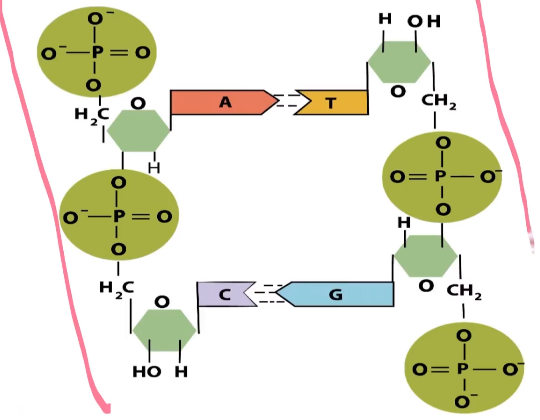
monomer name: nucleotide
two types:
deoxyribonucleic acid (DNA)
ribonucleic acid (RNA)
Primary function: information storage]
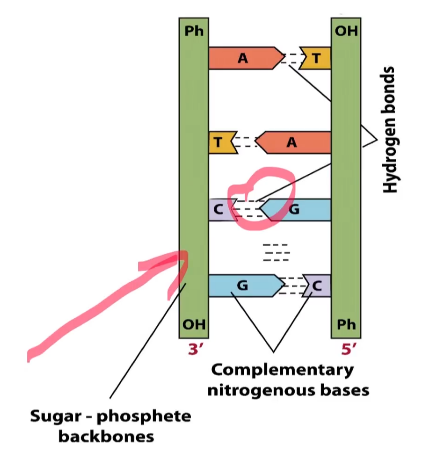
Sugar-phosphate “backbone” forms
Nucleotides paired (called a base pair) so that DNA or RNA strands are complimentary
A-T or A-U
C-G
Base pairs joined in center by hydrogen bonds
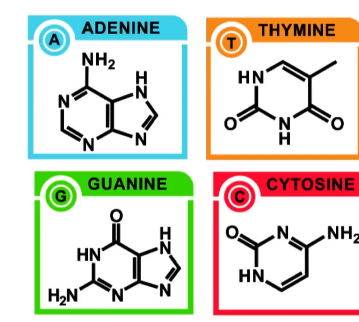
nucleotides are made of:
1. Nitrogen base
Adenine
thymine (only in DNA)
uracil (only in RNA)
cytosine
guanine
1 Sugar (deoxyribose or ribose)
1 Phosphate group
1.2: Introduction to Cells
1.2.1 Structure and Function of Cell Organelles
Membrane: Boundary between inside of a cell and surroundings
selectively permeable
phospholipid bilayer with proteins, other lipids, hybrid molecules
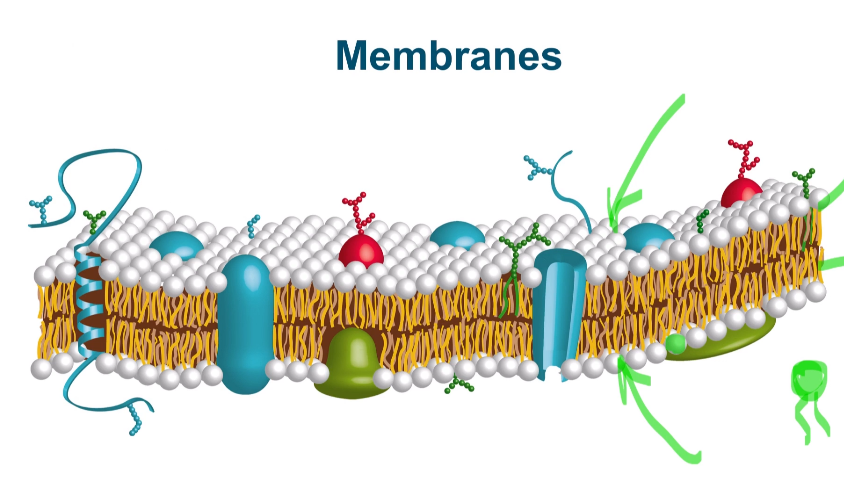
Selective Permeability: Membranes regulate cell traffic by only allowing some things to pass freely, transporting others, preventing still others
Membrane Transport
Passive transport: Diffusion across membrane; no energy required; sometimes need “doorway” protein (which is in membrane)
Diffusion: Movement of molecules from high to lower concentrations
each molecule moves randomly
no energy required; spontaneous
Osmosis: Diffusion of water across membrane from higher to lower concentrations
Facilitated diffusion: Diffusion with the help of doorway
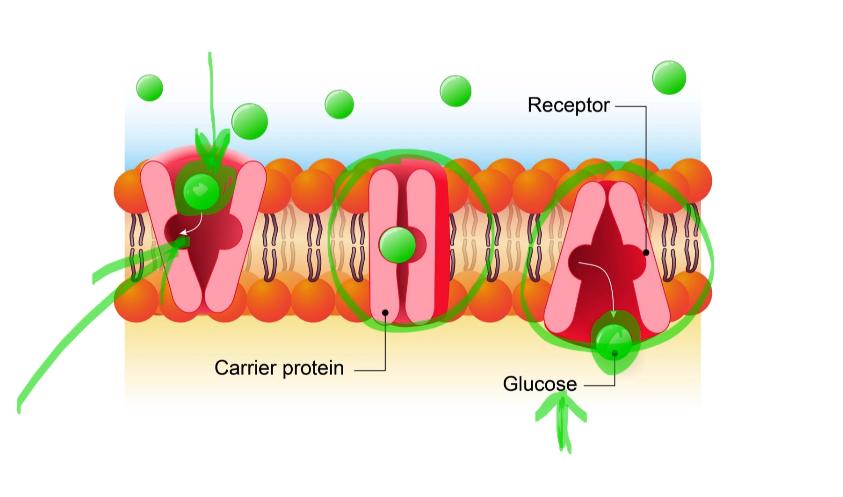
Active transport: Movement across membrane requiring energy and doorway protein
Useful for moving molecules against their concentration gradients