The Working Model Of Memory
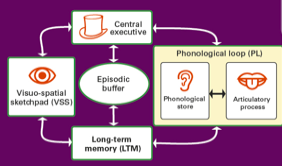
The Central Executive → ‘supervisory role”
monitors incoming info
assigns other systems to tasks
coordinates info from any sensory modality
capacity : limited
does not store information
Phonological Loop
deals w auditory information + preserves order which information is given
subdivided into
phonological store → stores the words u hear (inner ear)
articulatory process → allows maintenance rehearsal (vocal repetition) → (inner voice)
The capacity of this loop is 2 seconds worth of what you can say
coding : acoustic
Visuo-spatial sketchpad
stores visual and spacial info
eg when u r asked to visualise something
has capacity 3-4 objects according to Baddley
coding : visual
Episodic buffer → introduced by baddley in 2000
temporary store for information
integrates the visual, spatial and verbal information from the phonological loop + visuospatial sketchpad
links all the information together to create episodes of memory - maintains time sequencing
links working memory to the LTM
capacity : around 4 chunks
Strengths
Clinical evidence → support from Shallice and Warrington's case study of patient KF
After brain injury, KF had poor STM ability for auditory information but could process visual information normally.
→ his immediate recall of letters and digits was better when he read them (visual) than when they were read to him (acoustic)
→ KF's phonological loop was damaged but his visuo-spatial sketchpad was normal.
supports the existence of separate visual and acoustic stores
Counterpoint
case study → not generalisable.
Dual-task performance → support there must be separate components in working memory model → visuo-spatial sketchpad + phonological loop
The participants in Baddeley’s study (1975) carried out a visual + verbal task at same time (dual task)
→ their performance was similar to when they carried out the tasks separately
→ but when both tasks visual or both tasks verbal, performance on both declined
Bc both visual tasks compete for the same visuo-spatial sketchpad subsystem, whereas there is no competition when performing a verbal and visual task together.
shows there must be separate subsystem that processes visual info (visuo-spatial sketchpad) and one that processes verbal info (Phonological Loop)
Counterpoint
These studies use tasks that are not typically performed in everyday life → reduces their ecological validity → makes the findings less applicable to real-world situations
also carried out in highly-controlled lab conditions → demand characteristics as participants know they r taking part in psychological research so try to perform really well, furthering weakening evidence for WMM
Weakness
Lack of clarity of nature of the central executive
→ The CE needs to be more clearly specified than just being 'attention’→ vague + harder to test
Eg some psychologists believe the CE may consist of separate subcomponents.
role of Central executive being unclear challenges the integrity of the working memory model
Wolbers et al 2011
research compared spatial awareness with people blind from birth and sighted volunteers
brain scans of participants show that they could use other senses like touch to help them with spatial awarenesss
showing spatial awareness is not depended on vision and is separate
suggest baddley and hitch idea on visuospatial sketchpad should be separated into different components → one for visual memory and one for spatial memory
A weakness of the Working Memory Model is that the central executive cannot be tested empirically. The central executive, proposed by Alan Baddeley, is said to control attention and coordinate the other components, but there is no direct way to measure or observe it. Most evidence for it is indirect, meaning psychologists infer its existence rather than test it directly. This makes it difficult to produce objective, scientific evidence for how it actually works. As a result, the central executive may be seen as an overly vague concept, which reduces the scientific credibility of the model.