History and Evolution of Marine Biology
What is marine biology?
- ==Marine biology is the study of marine organisms, their behaviors, and interactions with the environment.== The study of marine biology requires an examination of functional biology, biodiversity, and ecology. During this course, we will spend time on all three topics.
We'll start with an examination of functional biology by looking at how marine organisms carry out basic biological functions such as locomotion and reproduction in the ocean. This will require us to review some basic oceanography.
Then we'll survey some of the biodiversity of the ocean from microscopic organisms to the largest of all, whales.
From there we will move on to the ecology of specific marine habitats. To prepare us for those lessons, we'll also need to review some basic ecology.
Humans and the Sea
Archaeological evidence suggests that humans have relied on the sea for food for tens of thousands of years. The oldest fish hooks discovered so far were made from sea snail shells and were discovered in Sakitari Cave in Okinawa Island. Archaeologists date them as between 22,380 and 22,770 years old.
Archeological evidence:
- Rely on the ocean for food
- Fish hooks Okinawa Island
- ~22,000 years old
- Made from snail shells
Spearfishing with barbed poles (harpoons) was widespread in paleolithic times. Cosquer Cave in Southern France contains cave art over 16,000 years old, including drawings of seals that appear to have been harpooned. The Phoenicians began ocean voyages using celestial navigation as early as 1200 BCE.
- Cave art in S. France
- 16,000 years old
- Harpooned seals
References to the sea and its mysteries abound in Greek mythology, particularly the Homeric poems “The Iliad” and “The Odyssey”. However, these two sources of ancient history mostly refer to the sea as a means of transportation and food source and not a science.
Ocean voyages - transport
- Phoenicians celestial navigation
- 1200 BCE
- Homer’s The Iliad & The Odyssey
The Father of Marine Biology
It wasn’t until the writings of Aristotle from 384-327 BC that ==specific references to marine life were recorded in a systematic way==. Aristotle identified a variety of species including crustaceans, echinoderms, mollusks, and fish. He also recognized that cetaceans are mammals and that marine vertebrates are either oviparous (producing eggs that hatch outside the body) or viviparous (producing eggs that hatch within the body). Because he is the first to record observations on marine life, Aristotle is often referred to as the father of marine biology.
Aristotle is also recognized as giving the earliest systematic treatise on the nature of scientific inquiry in the Western tradition, one which embraced observation and reasoning about the natural world. In the Prior and Posterior Analytics, Aristotle reflects first on the aims and then the methods of inquiry into nature. Careful observation was his starting point but he also stressed the ordering and display of facts were required for successful scientific inquiry.
The Aristotelian framework for correctly seeking knowledge through careful observation of nature followed by a search for rules or principles which explain or predict it continued throughout the medieval period as evident in the works of Thomas Aquinas and many others.
- Aristotle’s writings from 384-327 BC make specific references to marine life in a systematic way
- Identified a variety of species including crustaceans, echinoderms, mollusks, and fish
- Noted that cetaceans are mammals
- Recognized marine vertebrates are either
- oviparous (producing eggs that hatch outside the body)
- viviparous (producing eggs that hatch within the body)
- Prior and Posterior Analytics
- Treatise on the nature of scientific inquiry
- Seek knowledge through observation and explanatory principles
The Scientific Revolution
The 16th–17th centuries were a period of not only dramatic advance in knowledge about the operation of the natural world but also of intense reflection on the source and method by which the advances were made. Many people refer to this period as the Scientific Revolution.
By the end of the 17th century, many of the disciplines of modern science had emerged. A quantitative view of nature and common sense had usurped abstract reasoning and a qualitative view of nature. The method of science sought definite answers to limited questions couched in the framework of specific theories. Intellectuals were now stressing how things worked rather than contemplating why things were the way they were as Aristotle had in his search for final causes.
The shift in the approach to understanding our natural world would launch the field of marine biology into a new era of exploration and unprecedented description of life in the ocean.
- 16th–17th centuries
- Intense reflection on the source and method of scientific discovery
- A quantitative view of nature and common sense usurped abstract reasoning and qualitative views
- Method of science sought definite answers to limited questions within a framework of theories
- How do things work? No longer why are things this way
- Dramatic advance in knowledge about the operation of the natural world
- Many modern scientific disciplines emerged
18th Century Ocean Explorers
The 18th century was an important era of oceanic exploration. Maritime exploration had become safer and more efficient with technical innovations that vastly improved navigation and cartography. Scientific missions mapped the continents and oceans. During the voyages, they collected animals and plants and made hydrological and meteorological observations.
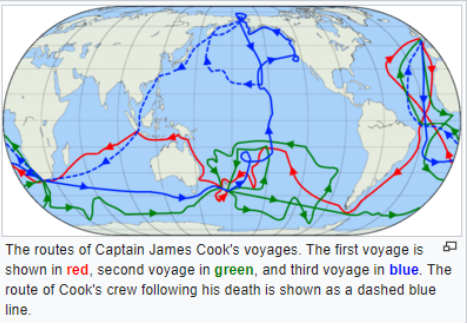
The modern-day study of marine biology began with the exploration by Captain James Cook (1728- 1779). Captain Cook sailed for the British Navy, mapping much of the world’s uncharted waters during that time. He led three great voyages, circumnavigating the world twice during his lifetime. He collected biological specimens from all over the Pacific basin which needed to be cataloged and classified.
- Technical innovation = safer ocean exploration
- More exploration
- Improved maps
- Expanded animal and plant collections
- Cataloged hydrological and meteorological observations
- Modern Marine Biology marked by Captain James Cook’s 3 voyages
- https://www.youtube.com/watch?v=2yXNrLTddME
Classification of Organisms
The 18th century also marked the development of modern classification systems for organisms. Huge number of plants and animals were being brought back to Europe from Asia, Africa, and the Americas. At the time species naming practices varied. Many biologists gave the species they described long, unwieldy Latin names, which could be altered at will; a scientist comparing two descriptions of species might not be able to tell to which organisms were being referred. The need for a workable naming system was great.
Carl Linnaeus, also known as Carl von Linné or Carolus Linnaeus, is often called the Father of Taxonomy. His system for naming, ranking, and classifying organisms is still in wide use today. Linnaeus simplified naming by designating one Latin name to indicate the genus and one as a shorthand name for the species. The two names make up the binomial species name.
- Collections of biological specimens brought back to Europe
- Naming practices varied and did not work well
- Carolus Linnaeus
- Developed basis of modern classification of organisms
- Binomial system uses genus and species
- Taxonomy – systematic classification of organisms
- Physical characteristics
- Genetic information
Linking Organisms with the Environment
In the 19th century, the descriptive nature of marine biology shifted to one focused more on the ==reciprocal relations between organisms, their adaptations, and the environment.==
A number of scientists began a closer study of marine life including Charles Darwin who is best known for his Theory of Evolution (which we will get to next). His expeditions as the resident naturalist aboard the HMS Beagle from 1831 to 1836 were spent collecting and studying specimens of marine organisms. His interest in geology gave rise to his study of coral reefs and theories on their formation.
- 19th century - descriptive nature of marine biology shifts to a focus on the reciprocal relations between organisms, their adaptations, and the environment
- HMS Beagle (1830s) with Darwin aboard
- Theory of Natural Selection
- Studied coral reefs and generated theories on formation of atolls
The voyages of the HMS Beagle were followed by a 3-year voyage by the British ship HMS Challenger led by Sir Charles Wyville Thomson. The expedition visited all the major ocean basins of the world and collected thousands of marine specimens. This voyage is often referred to as ==the birth of oceanography.==
The Challenger was well equipped to explore deeper than previous expeditions with laboratories aboard stocked with tools and materials, microscopes, chemistry supplies, trawls and dredges, thermometers, devices to collect specimens from the deep sea, and miles of rope and hemp used to reach the ocean depths. The end product of the Challenger’s voyage was almost ==30,000 pages of oceanographic information== compiled by a number of scientists from a wide range of disciplines.
The “Report of the Scientific Results of the Exploring Voyage of H.M.S. Challenger during the years 1873-76” reported findings such as:
- 4,717 new species;
- The first systematic plot of currents and temperatures in the ocean;
- A map of bottom deposits much of which has remained current to the present;
- An outline of the main contours of the ocean basins; and
- The discovery of the mid-Atlantic Ridge.
Azoic Theory
Edward Forbes was a naturalist on a survey ship commandeered by Captain Thomas Graves. They set sail in 1841 aboard HMS Beacon. As they left Malta, Forbes dredged the Aegean seafloor. Samples from greater depths displayed a narrower diversity of creatures which were generally smaller in size than samples collected in shallower waters.
Forbes reported his findings in a 1843 report entitled Report on the Mollusca and Radiata of the Aegean Sea. He posed the Azoic Hypothesis stating that ==the abundance and variety of marine life decreased with increasing depth== and, by extrapolation of his own measurements, Forbes calculated that marine life would cease to exist below 300 fathoms (550 m).
The theory was not disproven until the late 1860s when biologist Michael Sars discovered and listed 427 animal species collected along the Norwegian coast at a depth of 450 fathoms. In 1869, the Challenger expedition led by Thomson dredged marine life from a depth of 2,345 fathoms (4,289 m), finally ==dispelling Forbes' azoic theory for good.==
- 1840s HMS Beacon explored the Aegean
- Most creatures collected in shallow water
- Abundances and sizes reduced in deep water
- Edward Forbes published Azoic Hypothesis
- The abundance and variety of marine life decreased with increasing depth
- By extrapolation, Forbes calculated that marine life would cease to exist below 300 fathoms (550 m)
- Theory persisted until the late 1860s
- Collections along the Norwegian coast collected animals at 450 fathoms
- Challenger expedition dredged life from 2,345 fathoms (4,289M)
Modern Marine Biology
Technology has changed marine biology in the past century. Ocean exploration extended from the surface of the ocean into the depths as submersibles were built and improved. In 1934 William Beebe and Otis Barton descended 923m below the surface off the coast of Bermuda in a bathysphere designed and funded by Barton. In 1960, a descent was made to 10,916m in the Challenger Deep of the Marianna Trench—the deepest known point in the oceans. The dive was made in the bathyscape Trieste. The descent took almost five hours.
Submersibles
- 1934 William Beebe and Otis Barton descended 923m off Bermuda in a bathysphere
- 1960, bathyscape Trieste descended to 10,916m in the Challenger Deep of the Marianna Trench
Expeditions were soon followed by marine laboratories established to study marine life. In 1871, a collection station was built in Woods Hole, Massachusetts because of the abundant marine life there and to investigate declining fish stocks. This laboratory still exists now known as the Northeast Fisheries Science Center and is the ==oldest fisheries research facility in the world==.
Land-based marine laboratories in Woods Hole, MA
- 1871, a collection station was built
- Investigate declining fish stocks.
- Now the Northeast Fisheries Science Center.
Also at Woods Hole, the Marine Biological Laboratory (MBL) was established in 1888. MBL was designed as a summer program for the study of the biology of marine life for the purpose of basic research and education.
- 1888, Marine Biological Laboratory (MBL) was established in Woods Hole
- basic research in biology of marine life.
The Woods Hole Oceanographic Institute was created in 1930 in response to the National Academy of Science’s call for “the share of the United States of America in a worldwide program of oceanographic research” and was funded by a $3 million grant by the Rockefeller Foundation.
- 1930 WHOI created
- Response to the National Academy of Science’s call for oceanographic research
- Initially funded by a $3 million grant by the Rockefeller Foundation.
To expand greatly the efficiency of deep-sea observation, remotely operated vehicles (ROVs) have been developed. These vehicles are unmanned but can make precise surveys and even take samples.
Remotely operating vehicles are tethered to a ship by a cable, but a great deal of data are now collected by autonomous underwater vehicles (AUVs), which are robots not connected to the ship.
Gliders are a variant of AUVs, which use simple balancing devices to allow the vehicle to rise and fall through the water column or be moved by vanes in a constant direction by wave action.
Modern Scientific Method
The scientific method is often presented in textbooks and educational web pages as a fixed four-step procedure starting from observations and description of a phenomenon and progressing over the formulation of a hypothesis which explains the phenomenon, designing and conducting experiments to test the hypothesis, analyzing the results, and ending with drawing a conclusion.
In reality, this is an oversimplification and does not reflect the reality of practice. For the purpose of this class, we will consider the scientific method to be a systematic means of observation and reasoning. It is not linear nor is it one method. It is a process that focuses exclusively on the natural world, and does not deal with supernatural explanations. ==Science is a way of learning about what is in the natural world, how the natural world works, and how the natural world got to be the way it is.== Accepted scientific ideas are reliable because they have been subjected to rigorous testing, but as new evidence is acquired and new perspectives emerge, these ideas can be revised.
- Systematic means for observation and reasoning
- Not linear
- Not one method
- Does not deal with supernatural explanations
- Revised as more evidence is accumulates
Scientific Reasoning
Scientists work in many different ways, but all science relies on testing ideas by deductive reasoning - figuring out what expectations are generated by an idea and making observations to find out whether those expectations hold true. In other words, scientists deductively go from the general (the theory) to the specific (the observations).
But how do scientists develop theories? They use inductive reasoning to go from observations to a hypothesis. In other words, they make broad generalizations from specific observations.
The accumulation of specific observations to make a generalization is called induction. By contrast, we might take some premise and use logic to make a prediction.
Such an inference, predicated on logical associations of conclusions with facts and premises, is a deduction.
Statistics and probability theory are used for the analysis of inductive inference. Developments in the theory of statistics itself, meanwhile, have had a direct and immense influence on the experimental method, including methods for measuring the uncertainty of observations, criteria for the rejection of outliers, and significance tests.
- Deductive: General → Specific; predict observations based on a hypothesis/theory; syllogisms
- Inductive: Specific → General; make broad generalizations (hypothesis/theory) from specific observations
- Abductive: Sort of like a best guess or an educated guess; incomplete observations to formulate hypothesis
Exploratory Studies
Not all modern science is narrowly directed at hypothesis testing. Some theory-driven experiments are directed at fact-gathering, such as determining numerical parameters. Exploratory experiments are usually informed by theory but are investigated without first limiting the possible outcomes of the experiment on the basis of extant theory about the phenomena.
In recent years, the development of high throughput instrumentation in molecular biology has given rise to a special type of exploratory experimentation that ==collects and analyses very large amounts of data==. These new ‘omics’ disciplines are often said to represent a break with the idea of hypothesis-driven science and instead are described as data-driven research or as convenience experimentation in which many experiments are done simply because they are convenient to perform.
- Not all modern science is narrowly directed at hypothesis testing
- Exploratory experiments informed by theory but investigated without limiting possible outcomes on the basis of extant theory
- High throughput instrumentation in molecular biology has given rise to a special type of exploratory experimentation
- Omics disciplines collect and analyze very large amounts of data because it is convenient
- Use statistics and computing techniques to mine the data
Definitions
Plankton: organisms that live suspended in the water, may have some locomotory power but not enough to counteract major ocean currents or turbulence (protists, animals, plants, and bacteria that are at most a few centimeters long)
Neuston: organisms associated with the sea surface and microorganisms that are bound to the surface slick of the sea.
Nekton: usually larger animals that swim in the water column, but they can move against a current or through turbulent water (small shrimp, crabs, fish, whales)
Benthos: animals and plants associated with the seafloor.
- infaunal: animals that can burrow within the soft seabed (clams)
- epifaunal: animals that live on the seabed surface (oysters and barnacles)
- demersal: mobile organisms associated with the seabed that can swim (e.g., bottom fish)
Intertidal zone: the range of depths between the highest and lowest extent of the tides.
Subtidal zone: the entire remainder of the seabed from the low-water tidemark to the greatest depth of the ocean.
Continental shelf (or neritic) habitats: all seafloor and open-water habitats between the high-water mark and the edge of the continental shelf.
Oceanic or pelagic habitats: habitats seaward of the shelf
Epipelagic zone: the upper 200 m of water
Mesopelagic zone: 200-1,000 of depth
Bathypelagic zone: 1,000 to 4,000 m depth
Abyssopelagic zone: 4,000 to 6,000 m depth
Bathyal benthic bottoms: 1,000 to 4,000 m depth
Abyssobenthic bottoms: 4,000 to 6,000 m depth.
Hadal environments: the seabed and the waters at the bottoms of the trenches, often far deeper than 6,000 m depth.