Psychopharmacology
Psychopharmacology:
the study of the effects of drugs on the NS and behavior
Site of action:
A location at which molecules of drugs interact with molecules located on or in cells of the body, thus affecting some biochemical processes of the cell
Pharmacokinetics:
The process by which drugs are absorbed, distributed within the body, metabolized, and excreted
Neurotransmitter:
Chemical released into synapse
Has excitatory or inhibitory effect on another neuron
Neuromodulator:
Most are peptides that acts like NTs
Not limited to synapse- diffuse through extracellular fluid
Peptide
Two or more amino acids linked together
Lock and key mechanism
Ligand:
chemical that attaches to a receptor
Receptor is the lock, ligand is the key
NT are natural ligands
Drugs can also serve as ligands
Other natural chemicals
Man-made chemicals
NTs you’ll hear about the most…
Acetylcholine (ACh)
Movement, REM sleep, memory
Amino acid NT
GABA
Primary inhibitory NT
Glutamate
Primary excitatory NT
Monoamines
Dopamine (DA)
Movement (L-DOPA is a precursor), problem solving, reward
Norepinephrine (NE)
Fight-or-flight responses, arousal
Serotonin (5-HT)
Regulation of mood, dreaming
Postsynaptic potentials
EPSP - excitatory post-synaptic potential = depolarization (AP more likely)
IPSP - inhibitory post-synaptic potential = hyperpolarization (AP less likely)
The NT doesn’t directly determine type of postsynaptic potential
It is which type of ion channel is opened on the post-synaptic receptor
How are chemicals (NTs/ligands) removed from the synapse?
Degredation
The destruction of an NT by an enzyme
Ex. acetylcholinesterase
Breaks down acetylcholine
Reuptake
The neurotransmitter is cleared by being taken back in by the presynaptic cell
E.g. SSRIs block reuptake
Ways drugs affect synaptic transmission
Agonists
drugs that facilitate a response
Antagonists
drugs that block or dampen a response
Agonistic effects
Drug causes increase in NT synthesis (creation)
Drug increases release of NT
Drug acts as ligand and binds to receptor
Antagonist effects
Drug blocks release of NT
Drug blocks receptors
Drug causes NT to leak from vesicles
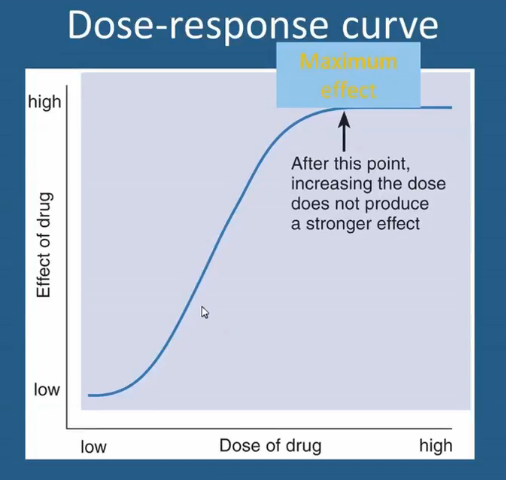
Dose-response curve
Plots the magnitude of the effect of a drug as a function of the amount of the drug that is administered
Maximum effect = the point at which increasing dose does not produce a stronger effect
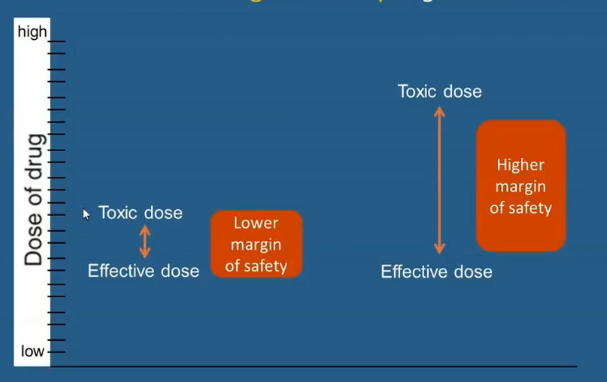
Therapeutic index
Also called the margin of safety. HIGHER IS BETTER!
Tolerance
A decrease in the effectiveness of a drug that is administered repeatedly
e.g. cocaine, decreased euphoric effects
The placebo effect
Placebo
An inert substance given to an organism in lieu of a physiologically active drug
Used in researched studies and also medicine