1.3.2 Externalities
Private costs (MPC)
Private costs are the costs to economic agents involved directly in an economic transaction
Producers are concerned with the private costs of production for example, the rent, the cost of machinery and labour. Determines how much the producer will supply
Social costs (MSC)
Calculated by private costs plus external costs
Cost to society as a whole.
Marginal social costs (MSC) and marginal private costs (MPC) diverge from each other. External costs increase disproportionately with increased output.
External costs
An external cost occurs when producing or consuming a good or service imposes a cost (negative effect) upon a third party.
Private benefit (MPB)
Consumers are concerned with the private benefit derived from the consumption of a good. The price the consumer is prepared to pay determines this .
Private benefits could also be a firms revenue from selling a good.
Social benefit (MSB)
Social benefits are private benefits plus external benefits
Similarly to external costs, external benefits increase disproportionately as output increases
External benefits
The benefit received from those who are not directly involved in the economic transaction. (e.g opening an airport increases jobs for unemployed in the local area)
External costs of production using marginal analysis
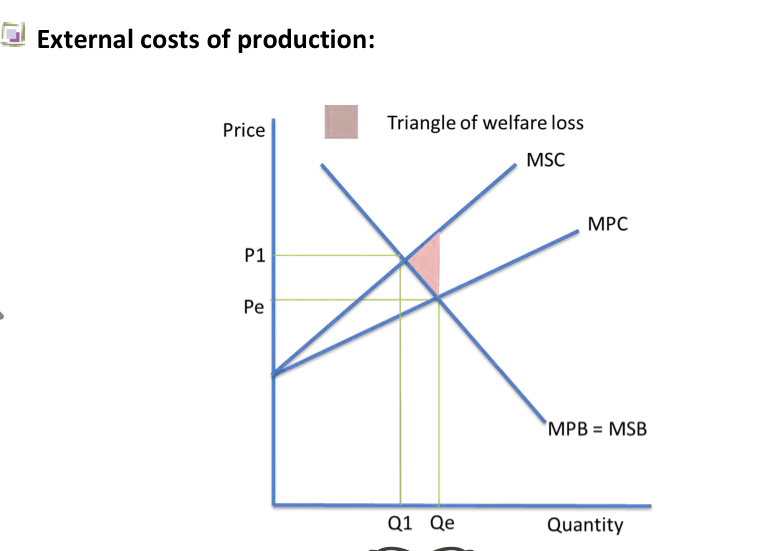
External costs occur when a good is being produced or consumed such as pollution - vertical distance between MSC and MPC
Market equilibrium, ignores these negative externalities which leads to over-provision and under-pricing
With negative externalities, MSC>MPC of supply. At the free market equilibrium, there are an excess of social costs over benefits at the output
output where social costs > private benefits is known as the area of deadweight welfare loss
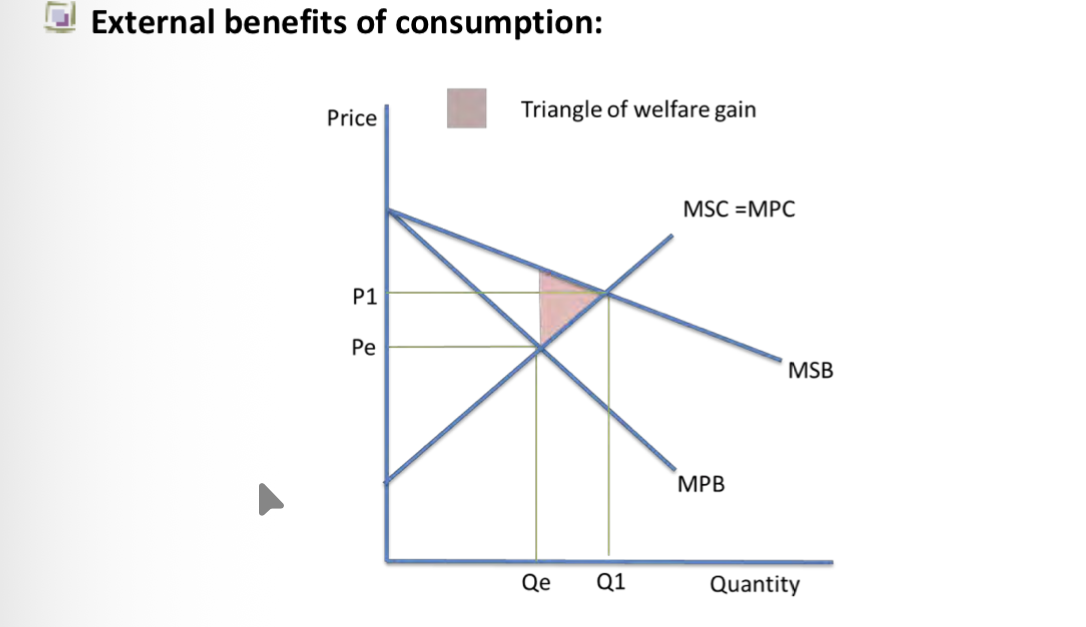
External benefit of consumption of a good or service could be the decline of diseases and the healthier lives of consumers through vaccination programmes
As consumers do not account for them, they are under consumed in the free market where MSB>MPB. This leads to market failure
Triangle in the diagram shows the excess of social benefits over costs. It is the area of welfare gain.x
Number of ways government can intervene to ensure the market considers the external costs and benefits.
Indirect taxes and subsidies - Taxes can be put on goods with negative externalities and subsidies on goods with positive externalities. These help to internalise the externalities, moving production closer to the social optimum position.
Tradable pollution permits- These allow firms to produce up to a certain amount of pollution and can be traded amongst firms so give them choice whilst reducing total level of pollution
Provision of the good- When social benefits are very high, the government may decide to provide the good through taxation. They do this with healthcare and education.
Provision of information- Since some externalities are associated with information gaps, the government can provide information to help people make informed decisions and acknowledge external costs
Regulation- Could limit consumption of goods with negative externalities for example, banning advertising of smoking