MOD 2 - Xray Production
ELECTROMAGNETIC RADIATION
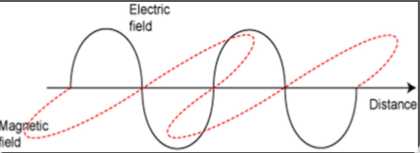
two parts in electromagnetic radiation
electric field
magnetic field
considered a transverse wave → both fields oscillate sinusoidally
WAVES
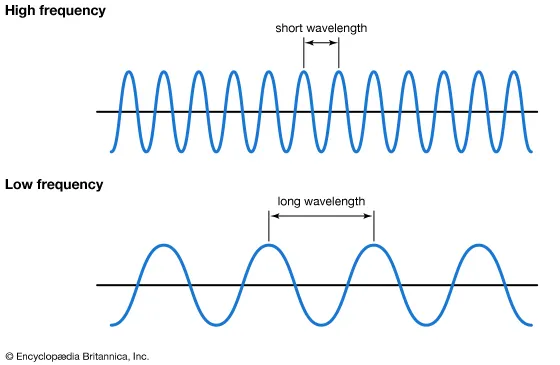
two important properties of waves
wavelength: longer wavelength = decreased wave energy = decreased x-ray photon energy
frequency: higher frequencies = higher energies
X-RAYS
form of electromagnetic energy
categorized as ionizing radiation = photons (have no mass nor charge)
ionization = the acquisition or loss of an electron by an atom, occurs as x-rays have sufficient energy to eject those orbiting -e
X-RAY PRODUCTION = look MOD 1 Notes
TYPE OF X-RAYS
CHARACTERISTIC:
interact with orbital electron
only the inner shell (K-shell orbital) -e loss creates diagnostic level x-rays
projectile -e knocks an inner shell -e out of orbit
which creates an -e vacancy in the atom → atom is unstable
to balance this instability, an -e from an outer/higher energy state/valence will drop down into the vacant space
now to stabilize the atoms energy changes, atom releases the differential energy as a x-ray photon
x-ray photon = (-electron energy) + (-electron energy) THEREFORE the energy is back in balance
BREMS:
interact with the atom’s nucleus
most common
the direction change causes a release of energy in the form of an x-ray photon
a projectile -e passes near to the positive nucleus as it’s attracted to it
this course alternation slows down the -e
this KE potential is released in the x-ray photon form
this -e is either fully stopped (absorbed) or slowed and diverted
resulting in a wide variety of x-ray photon energies
THE 0.5% OF PROJECTED -E
only ~0.5% of the energy deposited by the -e into the anode is converted to x-rays
THE 99.5% OF PROJECTED -E
projectile electrons are absorbed by atoms at the anode which LEADS to the production of infrared radiation or heat
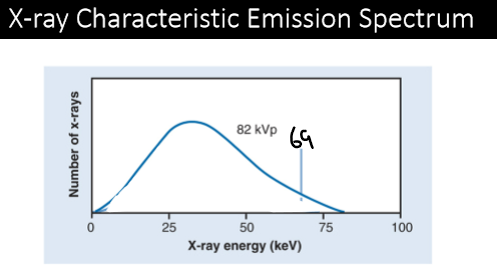
quantity vs. quality and influenced by the following factors
FACTORS AFFECTING X-RAY BEAM
KVP
increasing kVp = increasing penetration quality of x-ray beam
affects how -e will interact with atoms
affects x-ray beam energy and higher kVp = higher energy = travels thru body more easily
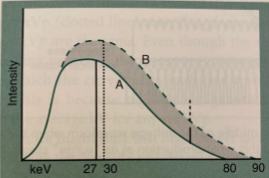
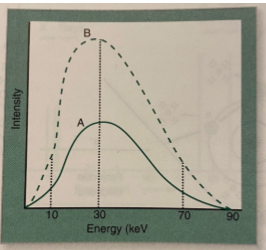
kV only needs a 15% increase to double the amount of photons
MAS
double mAs = double the number of x-rays
impacts beam quantity ONLY
TARGET MATERIAL
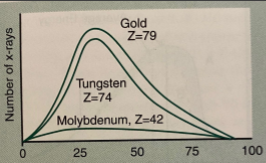
higher the atomic number = better x-ray beam quality
tungsten and gold
FILTRATION
located between the x-ray tube housing and collimator
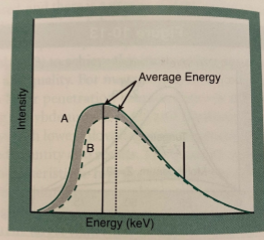
improves the overall penetration of the x-ray beam/ beam quality BY filtering out the low energy x-rays
high energy photons move thru easily while low energy photons don’t
important as it filters out x-rays which don’t contribute to beam quality but just increases PT dose
GENERATOR (SURFACE LEVEL)
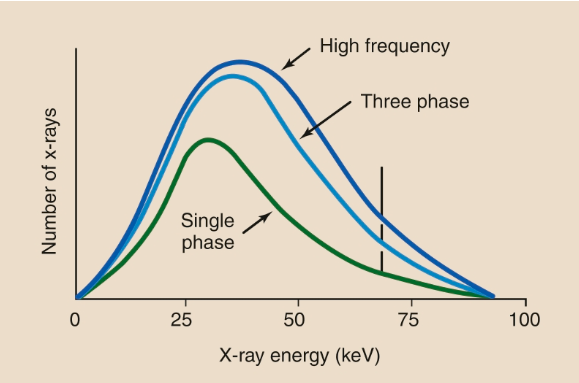
increasing amount of voltage ripple = decreases the consistency of high voltage current reaching the cathode = lower shift in avg energy AND decrease in quantity of x-ray photons
hence, common machines run high frequency generators
X-RAY INTERACTION WITHIN PT
photoelectric effect = interaction at an inner shell -e and has no photon release (does ionize the atom)
coherent scattering = energy is absorbed then released as a x-ray photon (does NOT ionize the atom)
compton scatter = interaction with outer shell -e (atom ionized and photon released)