10. Close Relationships
1980s there was an emergence of research on understanding relationships
Relationships science tries to understand:
Stages in a relationship
structure
changes over time
factors that influence the relationship
The importance of relationships
Core social motive → need to belong, have meaningful connections with others
Harvard study
Tracked 2 men over a 75 year period
Happiest people were those who prioritized relationships in their lives
Good relationships were happier and healthier
Trend with living longer
Theories in relationship science
Interdependence theory
rewards that partners can provide each other in different situations
Rewards judged against 2 standards:
Comparing and seeing if it is what they deserve
Perception of if you can get better( other fish in the sea)
Attachment theory
initially focused on caregiver and infants and eventually adapted to explain close relationships in adulthood
2 dimensions:
Anxiety: Reassurance that is needed, the person they love will stay with them
Avoidance: Extent to which people are uncomfortable with emotional intimacy and vulnerability
Assumes attachment style is fixed and wont change
papers to read by next class
What is a close relationship?
partners dependent on one another for positive outcomes
helps each other accomplish important needs and goals
4 types
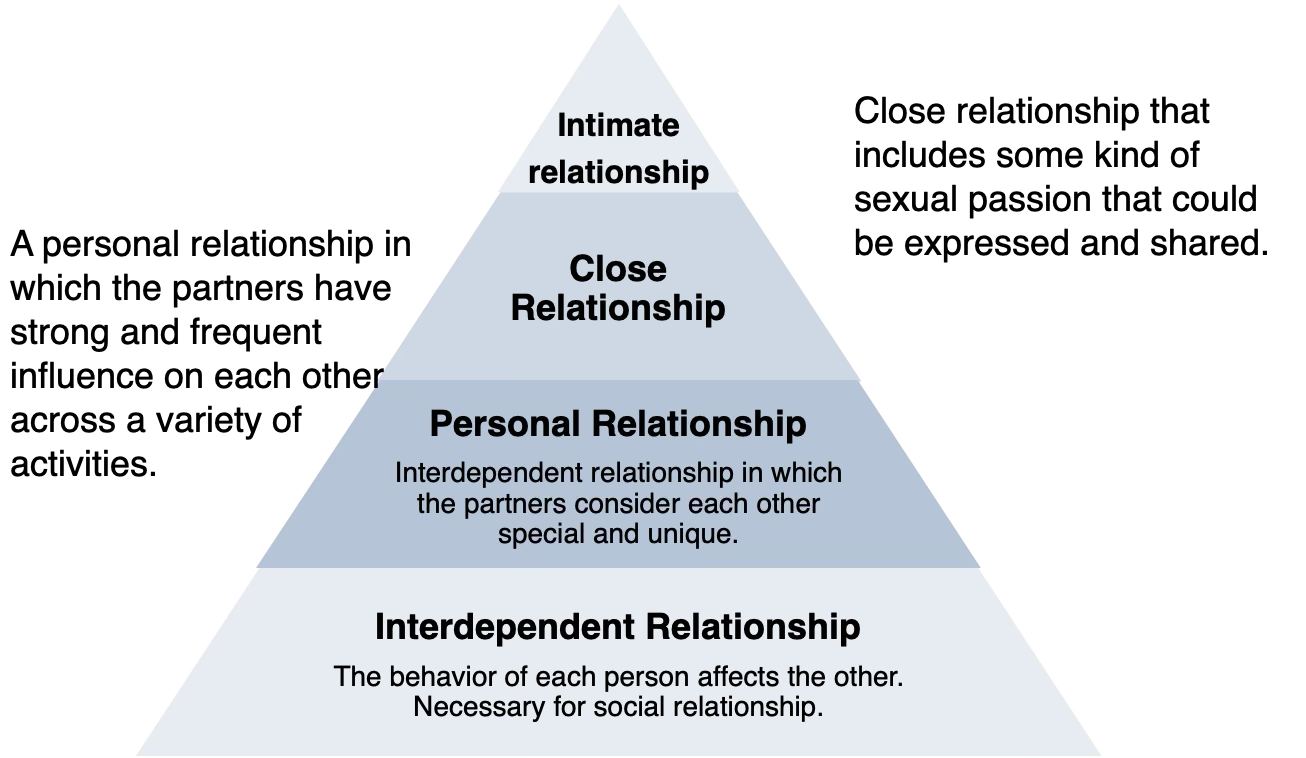
Intimate relationship
close relationship (friends, siblings)
personal relationship (grandparent & grandkids)
interdependent relationship (social roles → task focused, doctor & patient)
Uniqueness principle
Outcomes of a relationship are not only based on the 2 people, but depends on the unique pattern of interactions that happen in the relationships
Important to look at dyadic processes
How both people add to the relationship
Integration principle
peoples relationships develop overtime and the desire to maintain it should increase overtime
self-concepts become more intertwined as partners
self-concept can change because of the relationship
Trajectory principle
Long-term trajectory of a relationship is dependent on the people’s perceptions of the couple and experiences, which are updated continuously
How do relationships work?
Evaluation principle
People evaluate their relationships and partner on positive and negative constructs
6 constructs:
commitment, trust, love, passion, intimacy, and satisfaction
Responsiveness principle
When people engage in responsive behaviour it can increase the quality of the relationship
Responsiveness: being aware, sensitive and supportive of your partners core values and needs.
Increase in vulnerability → increases relationship quality
Resolution principle
how partners communicate and manage relationship events will influence the stability and quality of the relationship over time
constructive and active way in acting leads to better results in conflict resolution
Maintenance principle
people who are in committed relationships tend to have positive illusions when it comes to their partner
What do partners bring into their relationships?
Predisposition principle
People bring their personalities and temperament into a relationship, which can affect their partner
Peoples tendencies can be intensified or lowered by relationship events, their partner or environment
Instrumentality principle
Needs and goals also brought into relationships ,which influences how people are more or less successful in their goals while in their relationships
Standards principle
People bring standards and expectations into relationships
Interdependence theory and rewards → what people feel they should get in a relationship, and evaluate if they are getting that
More relationship well-being when people feel they are experiencing exceeding their expectations in the relationship
→ If people are happy , they align their expectations with their partner
How does context influence relationships?
Diagnosticity principle
situations vary in opportunities to look at the partners true motive and goals
conflict to stay in the relationship → tend to be more diagnostic
situations that require connection, vulnerability, self-protection, or avoidance of rejection are likely to be more diagnostic
Alternatives principle
Is there someone else out there thats more attractive (quality wise), or being single more appealing → relationship quality and persistence within the relationship will be threatened
Stress principle
when demands or stress happen outside the relationship, it leads to poor outcomes if the couple cannot cope with them
Vulnerability-stress-adaptation model:
when people experience stress it changes how they use their time (stress management vs being responsive to partners needs)
Less emotional and physical intimacy with partner from trying to regulate the stress
More likely to lash out, negatively affects relationship
Culture principle
relationships are naturally embedded in social networks, environment associated with norms, practices and traditions, can influence the trajectory of relationships
Family doesnt approve → stay or go?
Before, food and safety prioritized
Self-discovery and expansion prioritized now