Comprehensive Guide to Unit 4: Party and Electoral Systems
Political Parties and Party Systems
Political parties are the primary engines of political power in modern states. Unlike interest groups, which seek to influence policy, political parties aim to control government power by placing their members in office.
Functions of Political Parties
In comparative government, parties serve several universal functions, though the extent of their freedom varies by regime type (democratic vs. authoritarian):
- Interest Aggregation: Melding separate interests into a general platform (e.g., the UK Labour Party combining union interests with social progressive interests).
- Interest Articulation: Expressing the needs and demands of the people to the government.
- Political Socialization: Educating citizens on political issues and party ideology.
- Leadership Recruitment: Determining who will run for office (primaries in the US breakdown, vs. Party list selection in PR systems).
Types of Party Systems
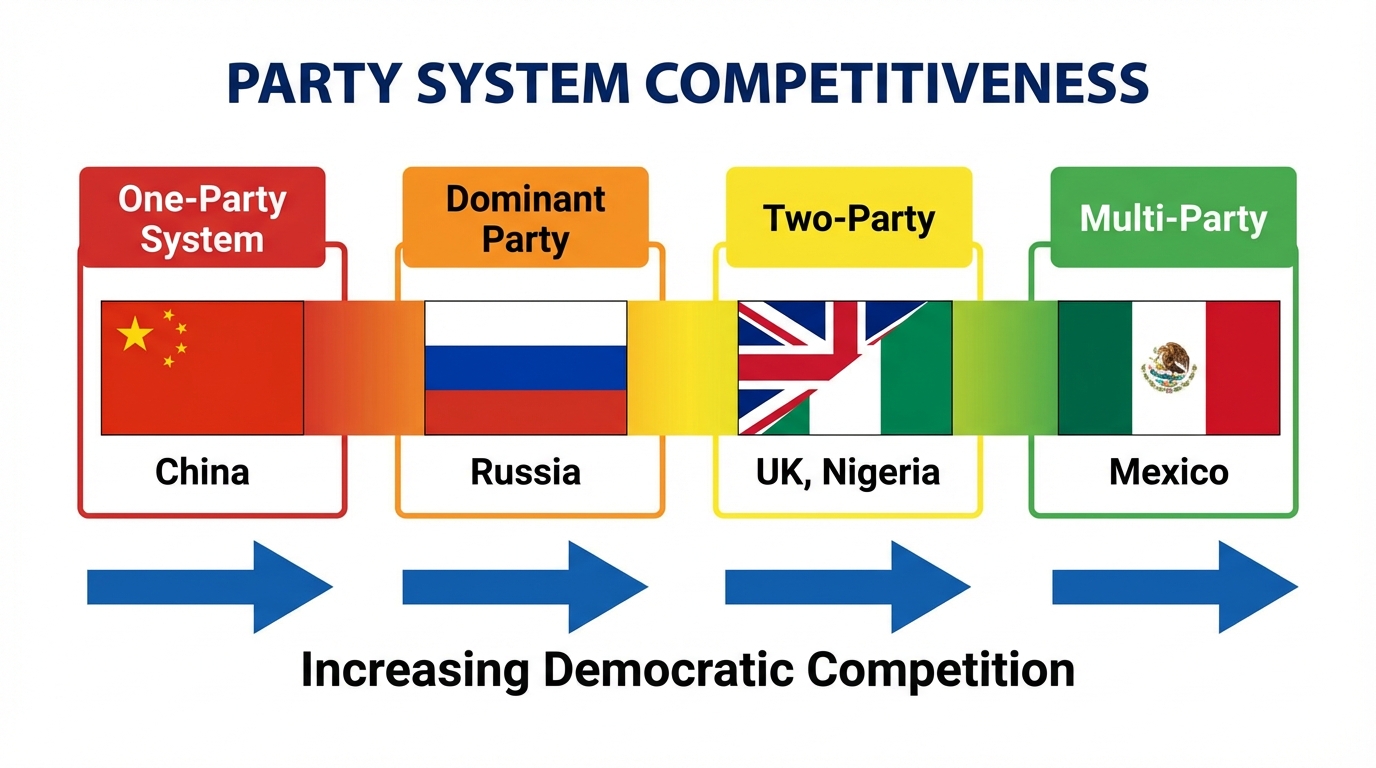
The number of effective parties determines the system type. This is broadly influenced by the electoral rules (see Duverger's Law below).
1. One-Party System
A system where rule by a single party is constitutionally mandated or reality inhibits any opposition participation.
- Example: China (Communist Party of China - CCP). While 8 "democratic" minor parties exist, they are subservient to the CCP and exist only for consultation, not competition.
2. Dominant-Party System
Multiple parties exist and compete in elections, but one party consistently wins and governs, often using state resources to maintain power.
- Example: Russia (United Russia). Opposition parties exist (like the Communist Party of the Russian Federation or LDPR), but United Russia holds a supermajority, often aided by media control and barrier-to-entry laws.
- Historical Example: Mexico under the PRI (Institutional Revolutionary Party) from 1929–2000.
3. Two-Party System
Two major parties dominate the legislature and executive, though minor parties may exist.
- Example: United Kingdom (Conservative vs. Labour). Small parties (SNP, Lib Dems) win seats but rarely form the government without a coalition.
- Example: Nigeria (APC vs. PDP). Power oscillates between these two major coalitions.
4. Multi-Party System
More than two parties have a realistic chance of holding power, often requiring coalition governments.
- Example: Mexico (Current). PAN, PRI, and MORENA all compete effectively.
Electoral Systems and Rules
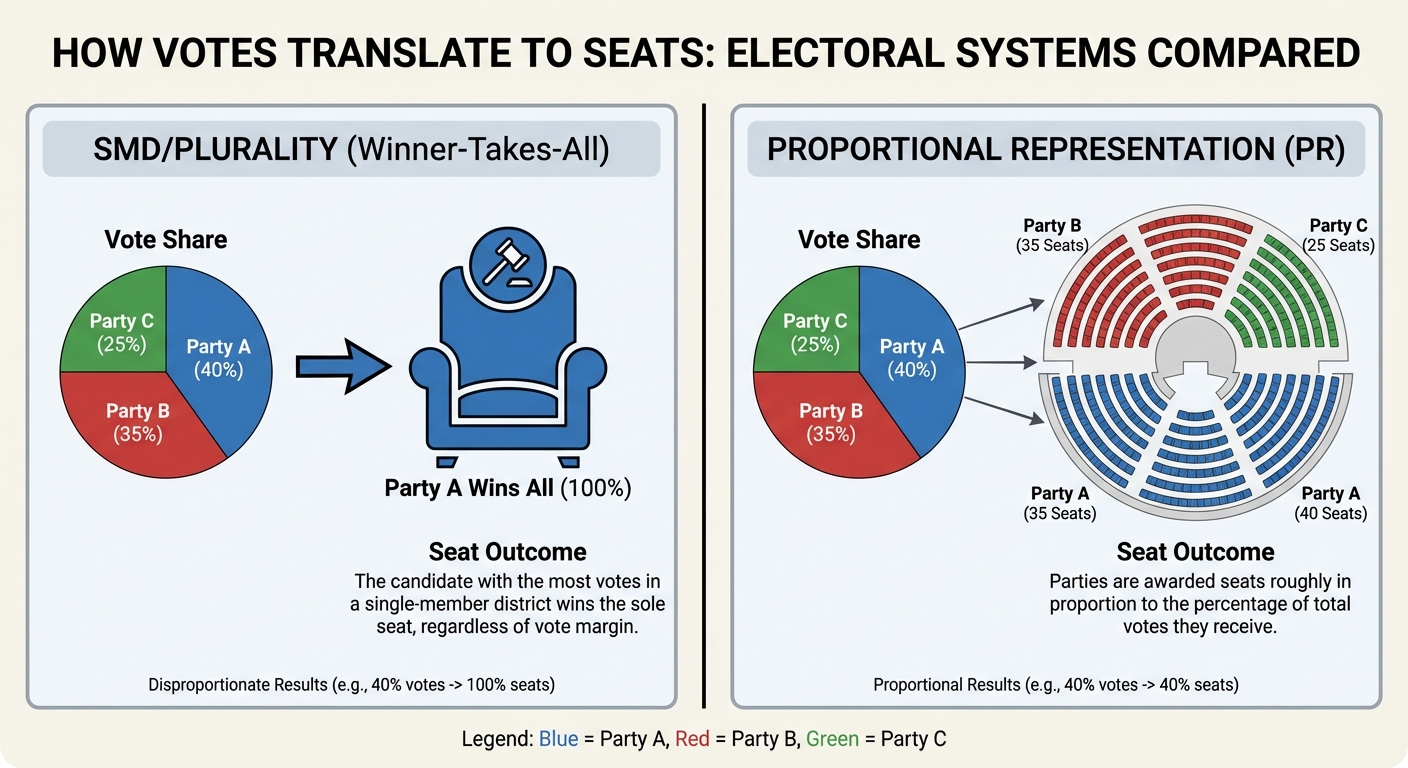
The rules of the game determine the outcome. The specific method used to translate votes into legislative seats is the single most important variable in party politics.
Single-Member District (SMD) / Plurality
Also known as First-Past-The-Post (FPTP).
- How it works: The country is divided into districts. Each district elects one representative. The candidate with the plurality (most votes) wins. No majority (50%+) is required.
- Impact: This system penalizes small parties with diffuse support. It encourages large, moderate catch-all parties.
- Duverger’s Law: A principle stating that SMD systems tend to produce two-party systems because voters do not want to "waste" their vote on a third party that can't win the single seat.
- Where it's used:
- UK: House of Commons.
- Nigeria: House of Representatives and Senate.
- Iran: Majles (though with a 25% threshold requirement).
Proportional Representation (PR)
- How it works: Voters vote for a party, not a specific candidate. The country (or large region) is the district. If a party gets 15% of the vote, they get roughly 15% of the seats.
- Impact: Beneficial for small parties, minority groups, and women. It usually results in multi-party systems and coalition governments.
- Thresholds: Most PR systems have a minimum percentage (e.g., 5% or 7%) required to enter parliament to prevent extremist fragmentation.
Mixed Electoral Systems
Many AP CoGo countries combine these systems to balance local representation (SMD) with proportionality (PR).
- Mexico: The Chamber of Deputies uses a mixed system (300 SMD seats + 200 PR seats). This ensures no single party can easily amend the constitution alone.
- Russia: The State Duma uses a mixed system (225 SMD seats + 225 PR seats). This change was reintroduced in 2016 to help United Russia capture SMD seats while maintaining the appearance of multiparty competition.
Executive Election Rules (The Presidency)
Electing a president often requires different rules to ensure legitimacy.
- Majority Runoff (Two-Ballot System): If no candidate wins 50% + 1 vote in the first round, the top two face off in a second round. This ensures the winner has a mandate from the majority.
- Russia: Used for Presidency.
- Iran: Used for Presidency.
- Nigeria: Modified version. Contentious. The winner must get the most votes AND at least 25% of the vote in 2/3rds of the states (to ensure the President is a national, not regional, leader).
Elections and Voting Behavior
Independent vs. State-Controlled Oversight
The integrity of elections depends on who counts the votes.
- Mexico (INE): The National Electoral Institute is an autonomous public organization responsible for organizing federal elections. Its creation in the 1990s was the key factor in ending PRI dominance and transitioning Mexico to a true democracy.
- Nigeria (INEC): The Independent National Electoral Commission attempts to reduce fraud, introducing biometric technology to prevent multiple voting, though challenges with violence and logistics remain.
- Iran (Guardian Council): Elections are technically competitive, but heavily vetted. The Guardian Council (unelected clerics and jurists) disqualifies thousands of candidates (mostly reformists and women) before the ballot is printed. This is vetting, not free selection.
Gender Quotas and Inclusivity
- Mexico: Requires "Gender Parity" (Paridad de Género). Parties must run 50% female candidates in legislative elections. This has made Mexico one of the world leaders in female representation.
- Iran: While women can vote and run for the Majles, they are constitutionally barred from the Presidency (the term "president" is interpreted as male-only by clerics).
Comparison of Course Countries: Legislative Elections
| Country | Lower House Name | Electoral System used | Party System |
|---|---|---|---|
| UK | House of Commons | SMD / FPTP | Two-Party |
| Russia | State Duma | Mixed (SMD + PR) | Dominant Party |
| China | National People’s Congress | Indirect Elections* | One-Party |
| Mexico | Chamber of Deputies | Mixed (SMD + PR) | Multi-Party |
| Nigeria | House of Representatives | SMD / FPTP | Multi-Party (leans 2-party) |
| Iran | Majles | SMD (w/ runoffs) | Factionalized (Conservative vs Reformist) |
Note on China: Direct elections happen only at the local village level. Higher bodies are elected by the body below them, not the people.
Common Mistakes & Pitfalls
Misconception: "China has no elections."
- Correction: China has elections! They have direct elections for local village congresses. However, these are not competitive at the national level, and opposition parties are not allowed to challenge the CCP's leadership.
Misconception: "Majority and Plurality are the same."
- Correction: Plurality means "the most votes" (even if it's only 30%). Majority means "more than half" (>50%). In the UK (SMD), you only need a plurality. In Russian Presidential elections, you need a majority.
Misconception: "Proportional Representation dictates who becomes President."
- Correction: PR is a legislative election term. Presidents are usually elected via national popular vote (or Electoral College in the US), not PR.
Misconception: "Iran is a dictatorship, so votes don't matter."
- Correction: Turnout in Iran is crucial for regime legitimacy. High turnout is essentially a vote of confidence in the Islamic Republic; low turnout (as seen in recent years) indicates protest. Factions within the Majles genuinely debate economic policy, even if they agree on theocracy.
Memory Aid: "PR vs. SMD"
- SMD = Shrinking Main Divide (Forces politics into 2 main camps).
- PR = Parties Rise (Allows many small parties to rise/grow).