Memory
Memory: set of processes used to encode, store and retrieve information over different periods of time
Encoding: input of imfornation into the memory system. Encodign occurs through autmoatic processing and effortful processing
Storage:retention of the encoded information
retrieval: getting the information out of memory and back into awarness
We recieve information and encode it through sensory information
Automatic processing: done without any conscious awarness, encoding of details like time, space, frequency and the meaning of words.
Effortful processing: remembering test material
Three types of encoding
semantic coding - words and their meanings, first demonstrated by William Bousfield in an experiement where he asked peolpe to remmember words
visual encoding - encoding of images
acoustic encoding - encoding of sounds, words in particular
Storage
Storage: creation of a permanent record of information
For a memory to go through storage it has to go through Sensory Memory, Short-term memory, and Long-term memoy
Sensory memory - stimulus from the enviornment is processed first in sensory memory. Storage of brief sensory events, such as sights, sounds and tastes. Its very brief storage. If something is valuable it moves on into short-term memory system.
Short term memory STM: Temporary storage system that processes incoming sensory memory; sometimes called working memory. Short term memory lasts about 20 seconds
Rehearsal: the concious repition of infomration to be remembered
To move STM into long term memory, is called memory consolidation
The capacity for short term memory is 7+/-2
LTM Long term Memory: continous storage of information. It has no limit. Enxompasses all the things you can remmeber that happened more than ust a few minutes ago to all of the thigs that you can remmeber that happened days, weeks, and years ago. Information taken into the hard-drive.
2 types of LTM
Explicit memory - those we consciously try to tremmeber and recall, like learning for an exam
Implicit memories - memories that are not part of our consciousness. They are memoreis formed from behaviors. Implicit memory is also called non-declarative memory
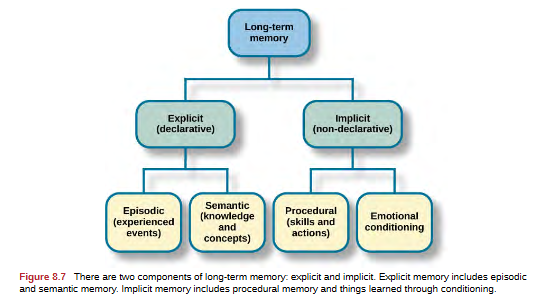
Procedural Memory - type of implicit memory. Stores information about how to do things. Memory for skilled actions like brushing your teeth, how to drive a car, how to swim freestyle. Things that can come back to you even after years of not doing the action.
Declarative Memory - has to do with storage of facts and events we personally experienced. Two parts to it
semantic memory - having to do with language and knowledge about language, knowledge about words, concepts, and language based knowledge and facts.
episodic memory - information about events we have personally experienced. The concep of episodic memory was proposed about 40 years ago. Since then, Tulvibng and others have looked at scientific memory about happenings in particular places at particular times, the what, where, and when of an even. It involves recollection of visual imagery as well as the feeling of familiarity. \
Retrival
After encoding information, how do you get it back when you need it?
Retrival - The act of getting information out of memory sotrage and back into conscious awareness.
3 ways to retrieve infromation out of your LTM storage system
recall - you can access infromation without cues
recognition - happens when you identify information that you have previously learned after encountering it again, you use this on a multiple choice test
relearning - learning infomration that you previously learned, atking spanish in high school but having to relearn it again
Engram: group of nerons that serve as the “physical representation of memory”
Equipotentiality hypothesis: if one par of one area of the barin invovled in memory is admaged, another part of the same area can take over taht memory function
Amygdala - main job is to regulate emotions such as fear and aggression. It plays a part in how memoeires are stored beccause storage is influences by stress hormones. Also involved in memory consolidation, which is the process of transferring new learning into LTM. It facilitates memories at a deeper level when the event is emotionally arousing.
The Hippocampus - involved in memory, specifically normal recognition as well as spatial memory. Another job is to project information to cortical regions that give memories meaning and connect them with other connected memoreis. It also plays a part in memory consolidation: the process of transferring new learning into LTM. Injury to this area leaves us unable to process new declarative memories.
Cerebellum and Prefrontal cortex - involved in people processing and retaining information. Also invovled in left frontal activity and encoding.
Neurotransmitters -