Martell - The Sociology of Globalization
- The rise of global communications made people feel that connections across the world were flowing more strongly and speedily, becoming more democratic
- People have become increasingly conscious of global problems
- Money flowed more freely
The Sociology of Globalization
- Large-scale global processes of economic restructuring and international political power have a big impact on our individual lives
- Culture is affected by economic and political forces
- Society includes the political and economic dimensions that affect aspects like culture and migration
- You can’t understand globalization without looking at its economic and political dimensions
- There are problems with this advocacy of a cosmopolitan sociology
Themes of the Book
- Capitalist economics and the pursuit of profit by private owners are a significant driving force
- Globalization is historical
Political and Pluralist Perspectives on Globalization
Table: Political ideologies and globalization
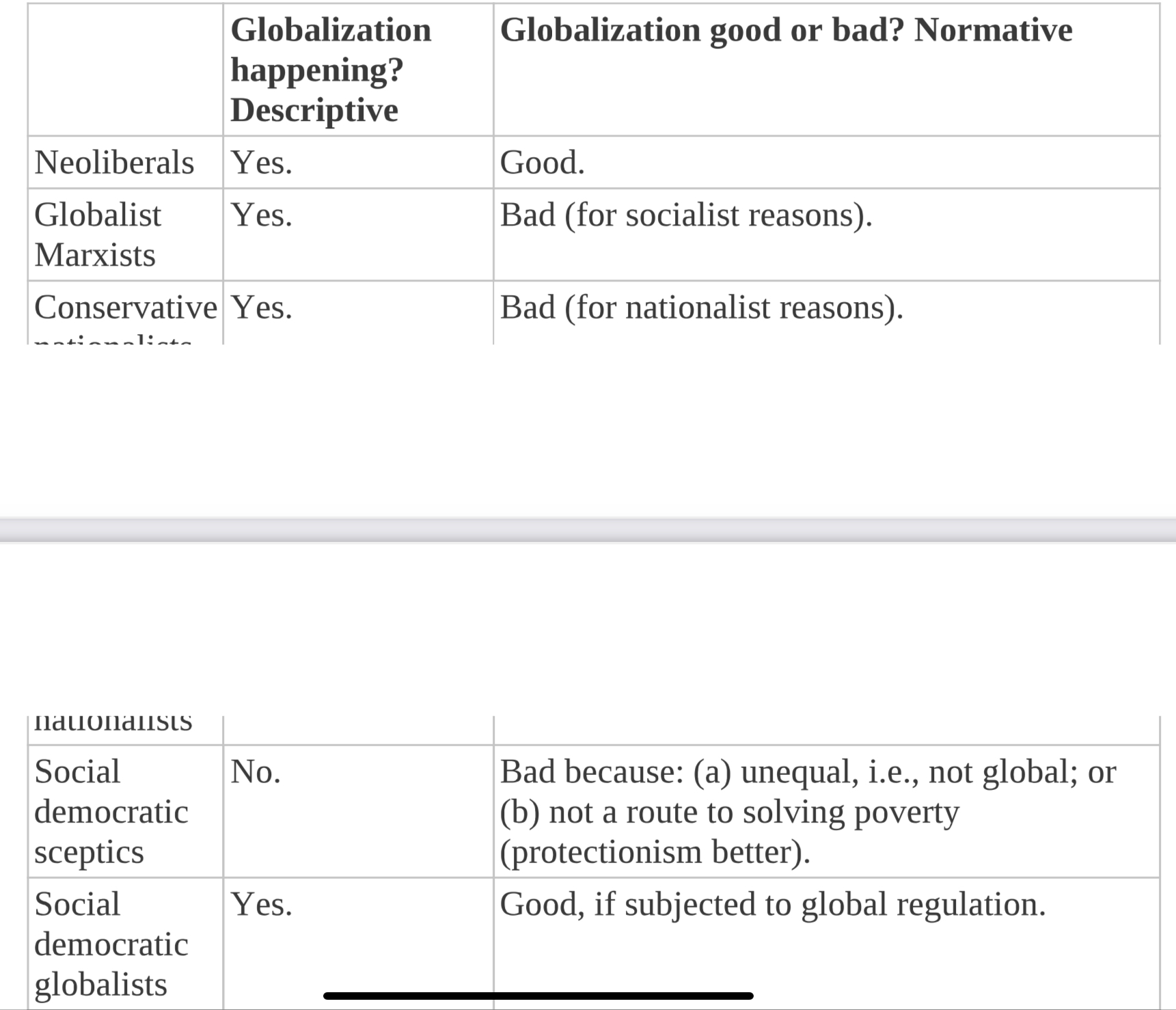
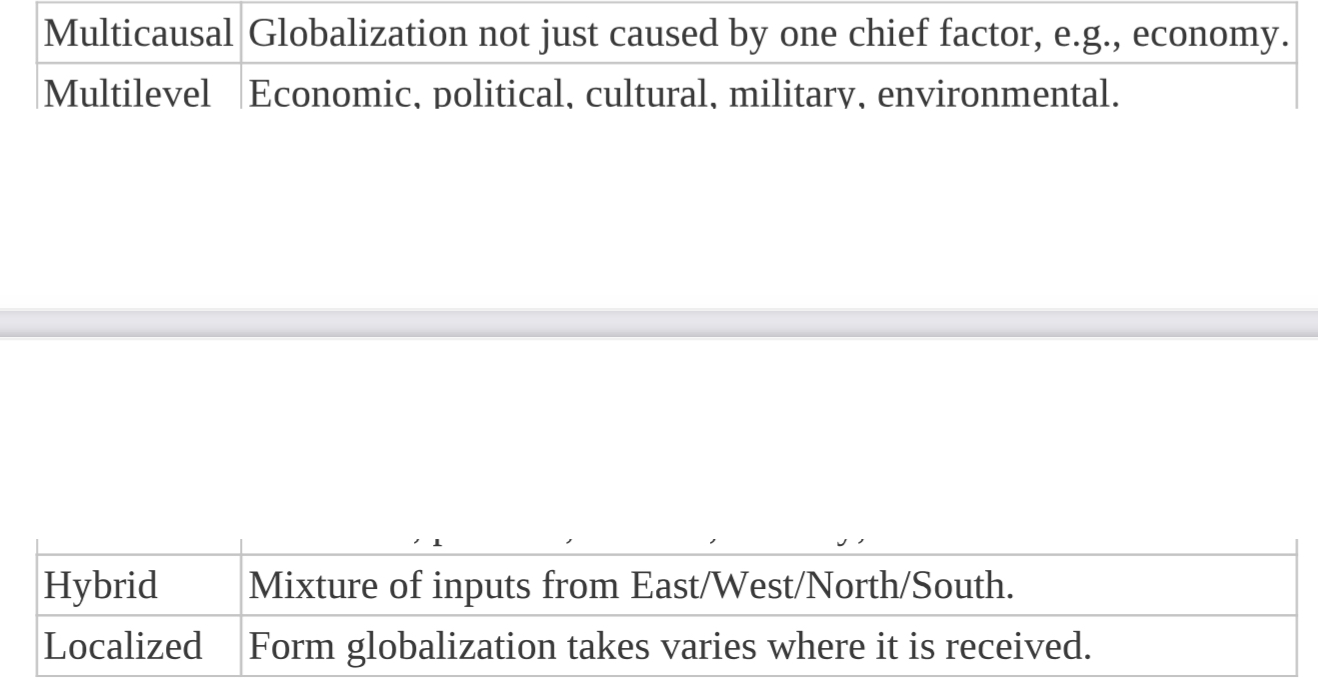
- Pluralist, hybrid and multidimensional views see globalization as operating at different levels, from the economic to the cultural or political
- Globalization is multidimensional
- There are dangers in seeing globalization as en equal and hybrid mix without seeing the primacy, dominance or determination of some factors over others
Table: Pluralist views of globalization
Concepts of Globalization
Globalization - Beyond Internationalization, Liberalization and Universalization?
- Scholte: rejects globalization as internationalization, liberalization, universalization or Westernization
- Internationalization: international transactions are nothing new
- Liberalization: different than globalization
- Universalization: there is nothing new about this (ex: world religions and trade)
- Westernization: globalization can go in non-Western directions
- Globalization is deterriorialization or supraterriorialism
- Supraterritorial relations involve not just an intensification of links across the world but different types of global connectivity
- Links transcend and are detached from territory
- Social relations = beyong terriotorial space
Sociologists and Historians Define Globalization
- Robertson
- Giddens
- Waters: globalization is a social process in which the constraints of geography on economic, political, social and cultural arrangements recede and people become increasingly aware of this and act accordingly. Globalization = process
- Holton
- Interconnection
- Interdependance
- Consciousness
- Agency and process
- Held et al
- Stretching of activities across frontiers
- Regularization of world relations
- Speeding up of global interactions and processes
- Impact of distant events being magnified
- Flows vs. networks
- Osterhammel and Petersson: globalization is different from imperialism
The Concept Summarized
- Globalization needs to be global in distance
- Globalization needs to be globally inclusive in inputs as well as reach
- There needs to be interdependency rather than just interconnection
- There needs to be stability and regularity in relations
- Involve more than elites and include the masses → global consciousness
Perspective on Globalization: Divergeance or Convergeance?
- Politically, the effects of globalization are uneven
- Many states are more globally powerful than others
- Culturally, nations respond to globalization differently
Beyond the 2nd Wave?
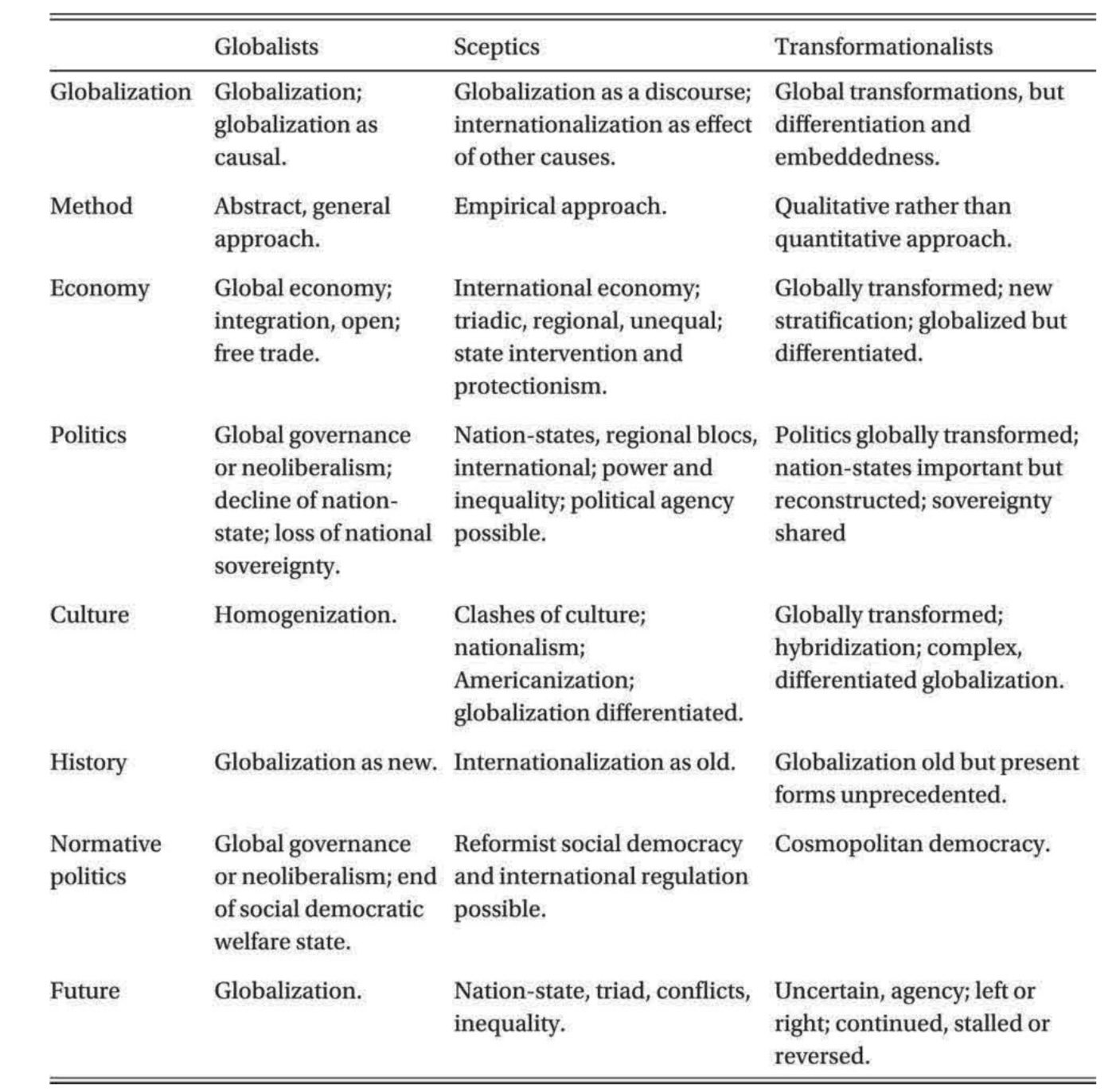
Table: Three waves in globalization theory
- Hirst and Thompson
- There has been internationalization of financial markets, technology and some sections of manufacturing and services, especially since the 1970s
- The current internationalized economy is not unprecendented
- Greater international trade and investment are happening but within existsing structures rather than as part of a new global economic structures rather than as part of a new global economic structure
- Transnational corporations are rare. Most companies are nationally based and trade multinationally
- Foreign direct investment is concentrated amongst advanced industrial economies
- The world economy is not global since it is concentrated in the triad of Europe, East Asia and North America
- The world’s most powerful states have the capacity to exert eocnomic governance over financial markers but choose not to for reasons of ideology and economic interests
- Radical expansionary and redistributive national economic management is not possible because of domestic and international requirements such as norms that need to be met to satisfy international financial markets
Held et al. - Transformationalists, a modified globalism
- Transformationalist approach
The 4th Wave in Globalization Theory
- Globalization has an ideotional force on us. It starts to happen when we behave in a globalized way because of what we think as much as because of what is actually there
- Globalization = discourse
- Foucault
- Globalization becomes a new symbolic experience
- Discourses are rooted in political and economic interests
- Ian Bruff