Foundations of Human Physiology
HUMAN BIOSCIENCES A: FOUNDATIONS OF HUMAN PHYSIOLOGY
ANATOMY AND PHYSIOLOGY
Definition:
Human anatomy: The scientific study of the body’s structures.
Human physiology: The scientific study of the body’s function.
Subdivisions of Anatomy:
Gross anatomy: Study of larger structures visible without magnification.
Microscopic anatomy: Study of structures visible with a microscope or other magnification devices.
Physiology:
Physiologists study the chemistry and physics of structures and their functions through laboratory experiments.
Structure and function are closely related; understanding structures aids in understanding function.
ORGANIZATION OF THE BODY
Levels of Organization:
Chemical level: Simplest building blocks of matter (atoms, molecules).
Cellular level: Cells are the smallest independently functioning units of living organisms.
Most physiological functions initiated/performed at the cellular level.
Tissue level: A group of similar cells working together to perform specific functions.
Organ level: Distinct structures performing specific physiological functions.
Organ system level: Groups of organs working together to perform major functions.
Organism level: A living being that can perform all physiological functions independently.
CELLS
Characteristics:
Basic biological units of the human body.
Structure and functions vary depending on the cell type.
Common Features of Cells:
Cell (plasma) membrane: Protective barrier regulating entry and exit of substances.
Nucleus: Control center that stores genetic instructions for protein manufacture.
Cytosol: Jelly-like substance providing a medium for biochemical reactions.
CELL STRUCTURE
Cell Membrane:
Composed of two layers of phospholipids (lipid bilayer).
Functions to separate the cell's inner contents from the external environment.
Membrane Proteins:
Facilitate material passage, cell recognition, receptor functions, and stability/contribute to fluidity.
CELL TRANSPORT
Overview:
Cell membrane is selectively permeable.
Movement across membrane:
Passive transport: Does not require energy.
Active transport: Requires energy (ATP).
Concentration:
Defined as the number of solute particles in a given space (e.g., ions, gas molecules).
Concentration Gradients:
Substances move from areas of higher concentration to lower concentration until evenly distributed.
Diffusion: Movement down concentration gradients (passive transport).
PASSIVE TRANSPORT
Simple Diffusion:
No energy required for small, lipid-soluble molecules (e.g., O2, CO2).
Facilitated Diffusion:
No energy required; molecules too large or poorly lipid-soluble aided by channels/carriers (e.g., glucose, sodium channels).
ACTIVE TRANSPORT
Requires ATP to move substances against their concentration gradient (e.g., sodium-potassium pump).
Examples:
Important for nervous system function: Na+ and K+ transported against their gradients.
TRANSPORT SUMMARY
Overview of transport mechanisms:
Simple diffusion: Passive, no energy required.
Facilitated diffusion: Passive, no energy required; helper proteins.
Active transport: Energy required, substances moved against concentration gradient.
TRANSPORT USING VESICLES
Active transport using vesicles allows the transportation of large materials.
Endocytosis: "Bringing into the cell" (e.g., phagocytosis, pinocytosis).
Exocytosis: "Taking out of the cell"; vesicles fuse with cell membrane.
OSMOSIS
Example of passive transport, referring to the diffusion of water through a semi-permeable membrane.
Water movement is essential for maintaining cellular environment, requiring equilibrium in solute concentrations.
CLINICAL SIGNIFICANCE OF OSMOSIS
Isotonic Solutions: Same concentration of solutes inside and outside the cell; no net water movement.
Hypertonic Solutions: Higher concentration of solutes outside the cell; water moves out of the cell, potentially causing cell shrinkage.
Hypotonic Solutions: Lower concentration of solutes outside the cell; water moves into the cell, risking cell swelling and bursting.
ORGANELLES
Membrane-enclosed structures in cells, performing unique functions vital for cell health.
Organelles make up around half the total cell volume.
DNA & PROTEINS
DNA: Blueprint for cell structure and physiology, containing genetic instructions to build proteins.
Protein Synthesis:
Two stages: Transcription in the nucleus and Translation in the cytoplasm.
mRNA carries the genetic code for protein synthesis.
CELLULAR DIFFERENTIATION
Process by which unspecialized cells become specialized to perform distinct functions.
Stages of differentiation lead to unique cell types (e.g., red blood cells vs. neurons).
STEM CELLS
Unspecialized cells capable of dividing and differentiating into various cell types.
Types: Embryonic, fetal, and adult stem cells, each serving different roles in development and tissue repair.
SPECIALIZATION
Cell specialization alters size, shape, metabolic activity, and function, governed by gene activation relevant to cell type.
STEM CELL RESEARCH
Aims to utilize stem cells for regenerative therapies while navigating ethical considerations surrounding embryonic stem cell use.
COMMUNICATION
Cells maintain vital interactions with their environment via complex signaling mechanisms.
Chemical Signaling: Involves signaling molecules that diffuse through extracellular space to target cells, eliciting responses.
TYPES OF TISSUES
Divided into four categories:
Epithelial Tissue: Covers surfaces, exhibits polarity, and regulates substance passage.
Connective Tissue: Includes diverse cell types within a matrix, supporting body structure and connection.
Muscle Tissue: Excitable and contractile, facilitating movement.
Nervous Tissue: Enables communication via signals between neurons and supports cell functions.
HOMEOSTASIS
The state of steady internal conditions maintained by living organisms, crucial for normal function, including temperature and pH balance.
Set Point: Physiological value where a normal range fluctuates, monitored via negative feedback systems.
Feedback Mechanisms:
Negative Feedback: Reverses deviations from set points (e.g., temperature regulation).
Positive Feedback: Intensifies physiological changes (e.g., childbirth).
ORGANIC MOLECULES
Carbohydrates: Sugars and starches vital for energy and structural components.
Lipids: Essential for energy storage, cellular structures (e.g., phospholipids), and hormone production.
Proteins: Composed of amino acids, crucial for structure, function, regulation, and enzyme activity in cells.
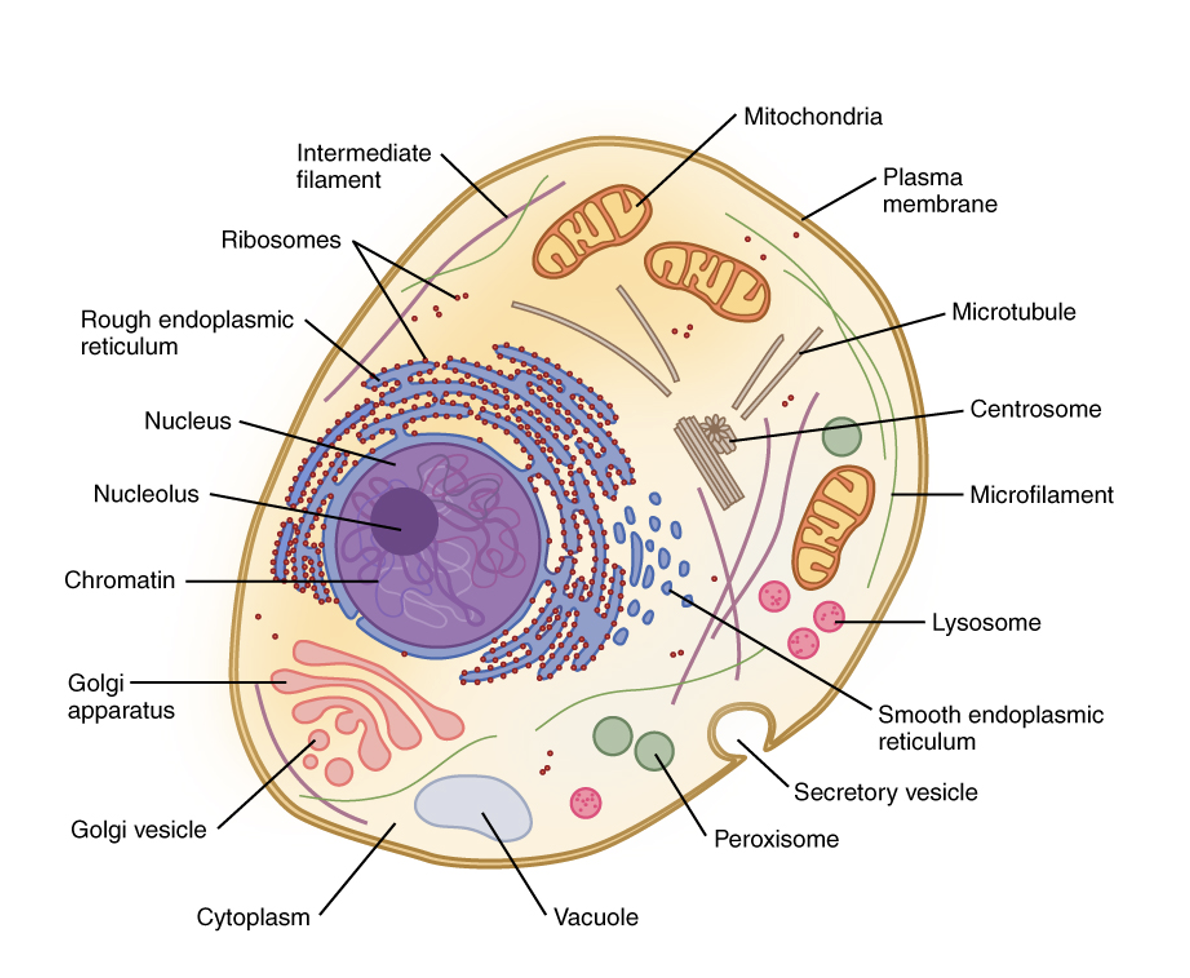
ORGANELLE
Lysosome (Clean up crew ): An organelle that digests unwanted cellular materials and helps in recycling components.
Mitochondria: Known as the powerhouse of the cell, mitochondria generate ATP through cellular respiration, providing energy necessary for cellular activities.
Smooth Endoplasmic Reticulum (ER): A membrane-bound organelle involved in lipid synthesis and detoxification processes in the cell. ( Rough ER: A membrane-bound organelle studded with ribosomes, responsible for protein synthesis and processing.
Mitchochondria: Double-membraned organelles known as the "powerhouses of the cell" because they generate ATP through oxidative phosphorylation and regulate cellular metabolism.
Golgi Apparatus: A membrane-bound structure that modifies, sorts, and packages proteins and lipids for secretion or delivery to other organelles. Lysosomes: Membrane-bound organelles containing enzymes that break down waste materials and cellular debris, playing a key role in cellular digestion and recycling.
Ribosome: The molecular machines responsible for synthesizing proteins by translating messenger RNA (mRNA) into polypeptide chains.
Rough endopasmic reticulum(RER): A type of endoplasmic reticulum studded with ribosomes, responsible for the synthesis of proteins that are either secreted from the cell or sent to an organelle.
Negative feedback: A regulatory mechanism in which a system's output acts to reduce or dampen the processes leading to the output of that system, thus helping to maintain homeostasis within the cell.