Protein Synthesis (Translation)
Translation
Occurs in cytoplasm on the ribosomes in both eukaryotic and prokaryotic cells
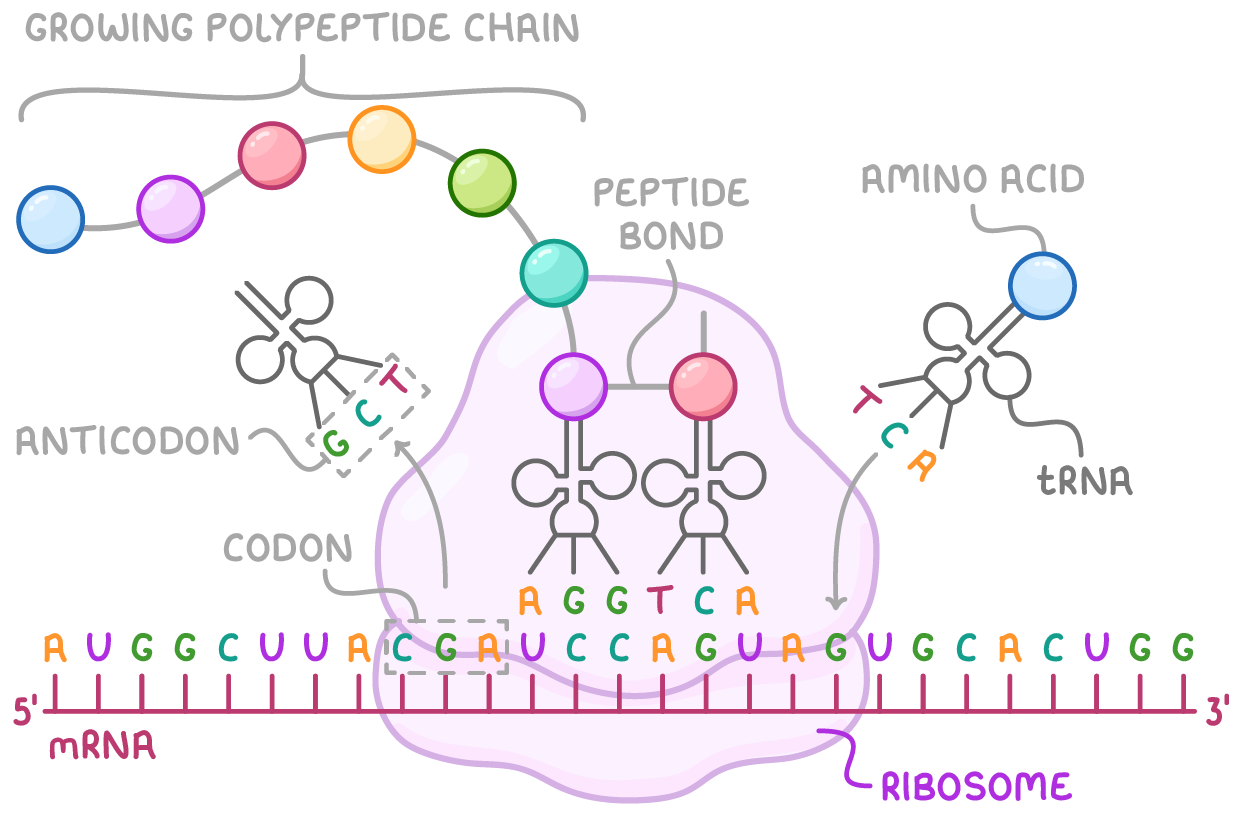
Translation is the process of decoding the information in mRNA to synthesise a polypeptide chain, with the help of tRNA. This chain them folds into a functional protein
Process of translation
The ribosome attaches to the mRNA strand at the start codon (AUG)
A tRNA molecule, carrying a specific amino acid and with an anticodon (UAC) that is complementary to the start codon, binds to mRNA
A second tRNA molecule with an anticodon complementary to the next mRNA codon, also carrying a specific amino acid, attaches to mRNA
The amino acid carried by the first two tRNA molecules are linked together by a peptide bond using ATP
The first tRNA molecule detaches from mRNA and is free to collect another amino acid for future use
The ribosomes moves along mRNA, allowing another tRNA molecule, carrying another amino acid, to bind to next codon on mRNA
The process from step 4-6 is repeated, which elongates the polypeptide chain
At any point during this process, two tRNA molecules can be attached to the ribosome
The sequence continues until the ribosome reaches a stop codon on mRNA
The completed polypeptide chain detaches from the ribosome