5 Bacterial cell features
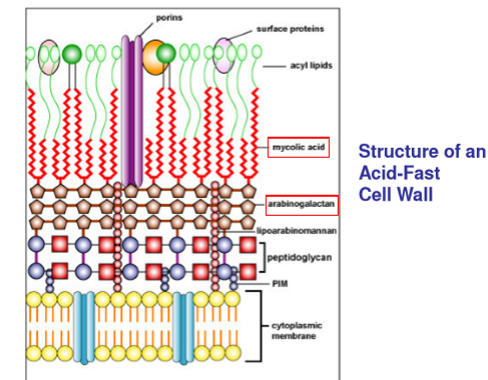
Acid-Fast Bacteria
Examples: Mycobacterium and Nocardia
Cell Envelope Complexity:
Mycolic acids (long, branched fatty acids) are attached to polysaccharide arabinogalactan.
Arabinogalactan is bound to peptidoglycan, forming a thick, waxy membrane layer that impedes gram staining.
Acid-Fast Staining Process
Primary Stain: Carbolfuchsin (red), which contains phenol and alcohol.
Decolorization Step: Acid alcohol removes carbolfuchsin not bound to mycolic acid.
Counterstain: Methylene blue, which does not penetrate mycolic acid but provides contrast to non-acid-fast cells.
Developed by Paul Ehrlich in 1882.
Structure of Acid-Fast Cell Wall
Components:
Porins
Surface proteins
Acyl lipids
Mycolic acid
Arabinogalactan
Lipoarabinomannan
Peptidoglycan
Cytoplasmic membrane
Additional Bacterial Structures
Features of Different Bacterial Groups:
Various components serve different functions based on genetic capability.
Ability to form non-essential components can be gained or lost over time.
Example: Streptococcus mutans forms a capsule only in the presence of sugar.
Capsular Polysaccharide
Also referred to as glyocalyx, which is a polysaccharide layer.
Capsules can significantly increase in size compared to the cellular structure.
Capsules inhibit phagocytosis by immune cells, aiding pathogenic bacteria.
Capsules may be lost during culture.
India Ink Stain:
Negative stain for bacterial capsules, resulting in cells appearing purple and capsules clear against a dark background.
Flagella
Etymology: From Latin, flagrum = whip.
Function: Motility in bacteria.
Structure Differences: Bacterial flagella consist of flagellin; they rotate instead of bending, powered by proton motive force. Used for chemotaxis (movement towards chemical stimuli).
Flagellum Types
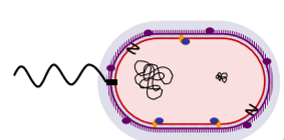
Types of Flagellar Arrangement:
a) Peritrichous
b) Polar
c) Lophotrichous
Structural components include:
Filament, Hook, Rings (L, P, MS), Rod, and Mot proteins.
Visualization of Flagella
Staining Technique: Leifson flagella stain
Method: Electron microscopy used for detailed visualization.
Pili (Fimbriae)
Functions:
Exchange of genetic material (conjugation).
Adhesive tips allow binding to specific receptors on host cells, enhancing pathogenicity and biofilm formation.
Plasmids
Definition: Double-stranded circular DNA separate from chromosomal DNA.
Independence: Can replicate independently and be passed to daughter cells.
Functions: Carry non-essential genes that may confer advantages, like antibiotic resistance or nitrogen fixation.
Example: Rhizobium sym plasmids contain nif genes for nitrogen fixation.
Endospores
Characteristics: Resilient structures containing bacterial DNA, protecting it under adverse conditions.
Formation: Typically produced by Clostridium and Bacillus genera; formation takes around 8 hours.
Components of Endospores
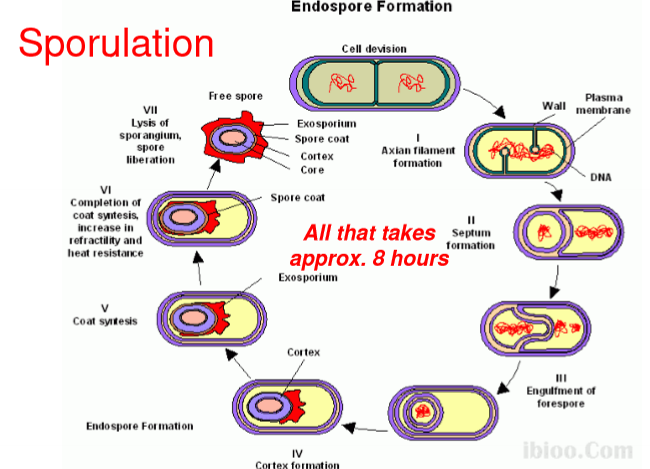
Core: Contains genome, ribosomes, enzymes, and dipicolinic acid; has a very low water content.
Coats: Three layers, including specific proteins and peptidoglycan.
Exosporium: Protein cover.
Resilience of Endospores
Endospores resist:
Chemicals (acids, alkalis, detergents)
Physical factors (heat, irradiation, desiccation)
They are extremely resistant due to low water content and the presence of dipicolinic acid.
Germination of Endospores
Triggering: Senses nutrient presence through receptors.
Activation: Cortex lytic enzymes are activated shortly after triggering.
Metabolism Begins: Complete metabolic activity is achieved approximately 1 hour after germination starts.
Importance of Endospore Formation
Many pathogenic bacteria form endospores, which are difficult to eliminate.
Standard boiling is ineffective; autoclaving is necessary (15 minutes at 121°C, 15 psi).
Endospore producers may contribute to food spoilage and poisoning, necessitating management in food production.
Example: Bacillus thuringiensis produces Bt-toxin during sporulation, which is effective for biological control of pests.
Questions
Name one group of acid-fast bacteria
How does a bacterial flagellum move?
Who is forming endospores?
When are endospores formed?