Forming-Bonds
Forming chemical bonds
Learning intentions: to understand why atoms form chemical bonds, to explore the three types of chemical bonds, to be able to predict which type of chemical bonds atoms might form, to become familiar with the properties of different substances formed by different chemical bonds.
Recall
- All matter consists of atoms, which are the smallest indivisible particle.
- Elements consist of one type of atom.
- Molecules are two or more atoms chemically bonded together.
- Compounds are two or more different types of atoms chemically bonded together.
Chemical Bonding
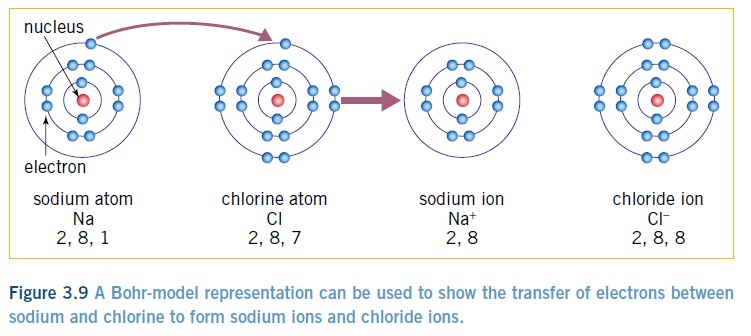
- All atoms, except noble gases, form chemical bonds to achieve a noble gas electron configuration. This is a stable configuration.
- Atoms either lose, share or gain electrons to achieve this configuration.
- All chemical bonding is electrostatic in nature, that is the force of attraction (or repulsion) between positively charged particles (protons, nucleus) and negatively charged particles (electrons)
- Like repel, opposites attract
Using the periodic table….
- Knowing the number of valence electrons an atom has can be used to predict what an atom will do to form chemical bonds (or to achieve a noble gas electron configuration).
- Less than 4 – will only lose electrons.
- Exactly 4 – will ‘tend’ to only share electrons.
- More than 4 – will share or gain electrons
- An exception is hydrogen as hydrogen share electrons.
Types of substances
- Substances are often defined by the predominant type of chemical bonding in the substance.
- The properties of these substances can be explained by the type of chemical bonding
- This is explored further in ATAR chemistry courses
Three types of chemical bonding
- Ionic – atoms lose or gain electrons to become ions
- Metallic – atoms lose electrons
- Covalent – atoms share valence electrons
- These forms of bonding are all considered strong chemical bonds, which means that significant energy is required to break them.
Ionic bonding
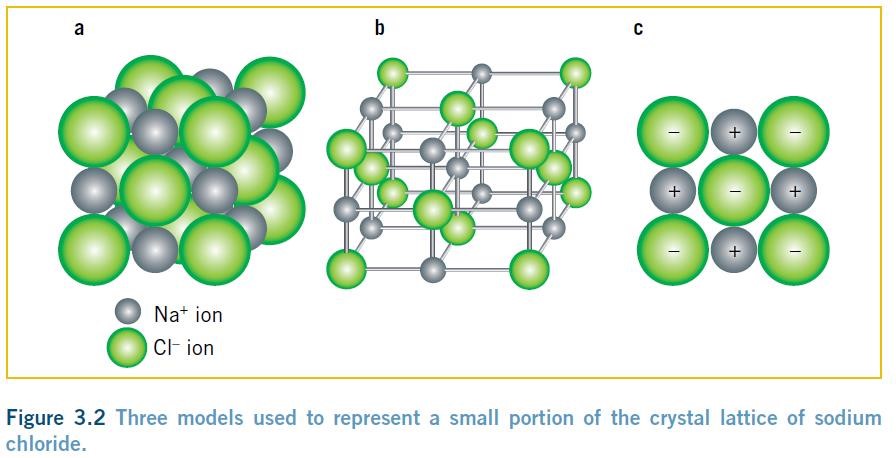
- Substances formed between ions, positive and negative
(Often metals and non-metals)
- These substances typically:
- Are hard, but brittle,
- Have very high melting and boiling points,
- Do not conduct electricity as a solid, but do when molten (liquid) or if dissolved in water.
- When as a solid they are referred to as a lattice (not a molecule).
Recall
- When atoms lose or gain electrons they become ions.
- Cations are positively charged ions (lost electrons, more protons than electrons)
- Anions are negatively charged ions (gained electrons, less protons than electrons)
- Overall substances are not charged, this means the total number of protons will be the same as the total number of electrons.
Metallic bonding
- Formed only by metals (and sometimes carbon).
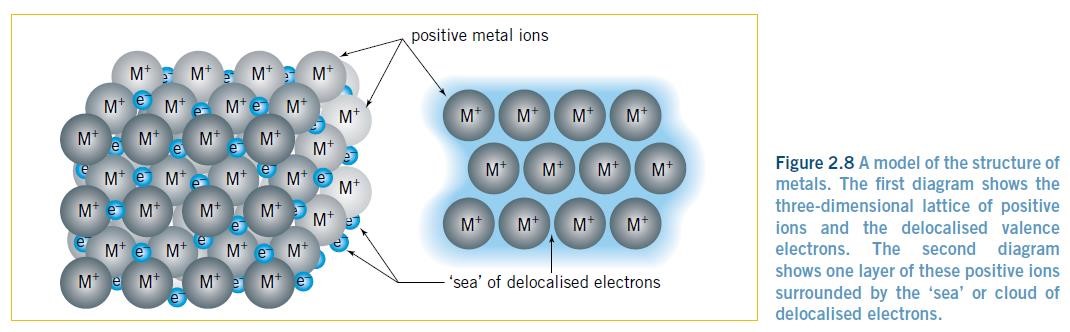
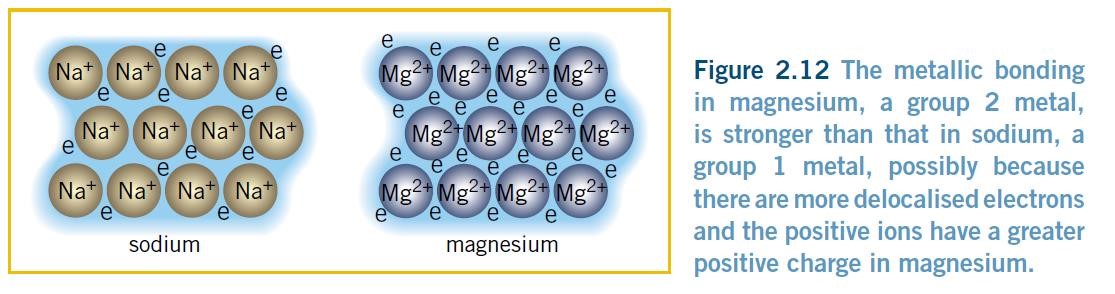
- Each atom losses its valence electron to form a lattice of cations surrounded by delocalised electrons.
Properties of Metals
Compared to non-metals, metals are
- Lustrous (shiny) when polished
- Malleable – change shape when a force is applied
- High density (are heavy for their size) • Ductile – can be stretched into wires
- High melting and boiling points.
- Good conductors of heat and electricity.
Covalent bonding
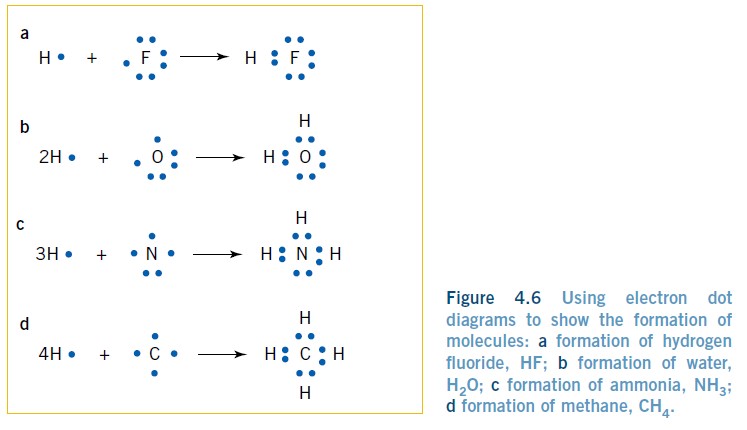
- Only formed between non-metals.
- Atoms share valence electrons to achieve noble gas electron configuration.
- Covalent bonding results in molecules and networks
(Two types of substance – networks are explored in ATAR chemistry)
- Covalent molecular substances typically:
- Have low melting and boiling points,
- Are soft and have an odour,
- Do not conduct electricity as solid, liquids or when dissolved in water (with some exceptions)
- Weak, Intermolecular forces exist between covalent molecules which explain their properties.
- This is explored further in ATAR chemistry.