Emotional Development and Attachment
Lecture Overview
This lecture examines classic attachment theory, contemporary developments, and the transferable skills gained from studying emotional development. It integrates foundational theory with modern critiques and applications.
Key point → link between attachment and emotional regulation
What Is Attachment?
Attachment refers to the human tendency to form strong emotional bonds with significant others. Early attachment experiences are proposed to shape later relationship functioning, emotional regulation, and psychological wellbeing. A key reflective question is whether later experiences can modify early attachment patterns - a major debate in contemporary research.
Bowlby’s Definition of Attachment Theory
Attachment theory conceptualizes humans as biologically predisposed to form affectional bonds. According to Bowlby (1977), attachment theory explains emotional distress arising from separation and loss, including anxiety, anger, depression, and detachment. The theory links early relationships to personality development and mental health outcomes.
Perspectives on Emotional Development
Emotional development can be understood through multiple lenses:
Genetic–maturational perspectives emphasize biological unfolding of emotional capacities.
Learning perspectives focus on reinforcement and conditioning.
Functionalist perspectives view emotions as adaptive for survival.
Biological and psychobiological views examine neural and physiological mechanisms.
Philosophical and sociological approaches consider cultural and social meaning.
Attachment theory integrates several of these perspectives but is strongly evolutionary and relational.
Bowlby’s Core Propositions
Bowlby argued that attachment is evolutionarily adaptive because proximity to caregivers increases infant survival. Both infants and caregivers are biologically programmed to form attachments. Maternal (or primary caregiver) responsiveness is central to secure attachment formation. Importantly, attachment supports not only physical survival but also psychological wellbeing.
Historical Attachment Ideas (1940s–1960s)
Earlier explanations of infant–caregiver bonds included:
Cupboard Love → attachment motivated by food association
Object Sucking → innate drive linked to feeding
Object Clinging → need for tactile comfort
Freudian womb longing → unconscious desire for prenatal security
Bowlby challenged these by emphasizing emotional security over feeding.
Development of Emotional Expression
Early emotional development unfolds in predictable stages.
Primary emotions:
Reflex smiles appear spontaneously at birth
Between 3–8 weeks, social smiling emerges
Infants begin attending to faces (eyes and mouth)
Duchenne smiles signal genuine social engagement
Negative emotions serve adaptive functions:
Fear activates fight-or-flight
Anger mobilizes energy to overcome obstacles
Sadness promotes withdrawal and support seeking
Disgust protects against harmful stimuli
The Attachment Behavioural System
Infants possess an “attachment toolbox” of behaviours designed to maintain caregiver proximity:
sucking
clinging
following
crying
smiling
These behaviours function to regulate distress and ensure caregiver availability.
Evidence from the “44 Thieves” Study
Bowlby’s clinical study of juvenile thieves found that around 40% had experienced prolonged maternal separation. These children often showed affectionless psychopathy. The study supported the importance of early relationships but is now critiqued for methodological limitations and causal overreach.
Imprinting and Critical Periods
Lorenz’s imprinting work suggested early sensitive windows for bonding in animals. Bowlby drew on this but applied it more cautiously to humans, proposing sensitive rather than strictly critical periods.
Harlow’s Rhesus Monkey Studies
Infant monkeys preferred soft cloth surrogate mothers over wire ones that provided food. When frightened, monkeys sought the cloth mother.
Key conclusion: comfort and emotional security outweigh feeding in attachment formation. This strongly supported Bowlby’s theory.
Proximity Seeking and Maintenance - core idea
Attachment functions as an alternative to fight-or-flight. When distressed, infants seek proximity to attachment figures. Over time, caregivers become targets of “proximity maintenance,” central to emotion regulation.
Internal Working Model (IWM)
Bowlby proposed that children develop mental representations of:
the self
the caregiver
the relationship between them
This model becomes relatively stable and guides expectations in later relationships.
Functions of the IWM include:
Safe haven - sense of security
Internalised expectations - relationship templates
Relational guidance - shapes social behaviour
Risk for maladaptive patterns if early relationships are dysfunctional
Attachment Developmental Phases
Pre-attachment (0–2 months): indiscriminate social responses
Attachment-in-the-making (2–6 months): preference for caregivers
Clear attachment (6 months–2 years): strong proximity seeking and separation anxiety
Goal-corrected partnership (3 years–adolescence): increasing tolerance of separation
Critical vs Sensitive Period Debate
Early theory proposed a strict critical period for attachment formation. Contemporary views favour sensitive periods, acknowledging developmental plasticity and potential for change.
Monotropy Hypothesis
Bowlby suggested children form a primary hierarchical attachment, typically with the mother. This relationship is qualitatively distinct and especially influential. Modern research questions the rigidity of monotropy and recognises multiple attachment figures.
Separation and Loss Responses
Children typically progress through three stages when separated from caregivers:
Protest → active distress
Despair → withdrawal and sadness
Detachment → apparent recovery but emotional distancing
These stages illustrate the emotional cost of disrupted attachment.
Safe Haven and Secure Base Concepts
A secure attachment figure provides:
Safe haven → comfort during distress
Secure base → confidence to explore
These dual functions support both emotional regulation and learning.
Caregiver Sensitivity
Sensitive caregiving → accurate perception and appropriate response to infant signals - is central to secure attachment formation.
Mary Ainsworth → made safe haven, secure base and caregiver sensitivity concepts testable.
The Strange Situation Procedure (SSP)
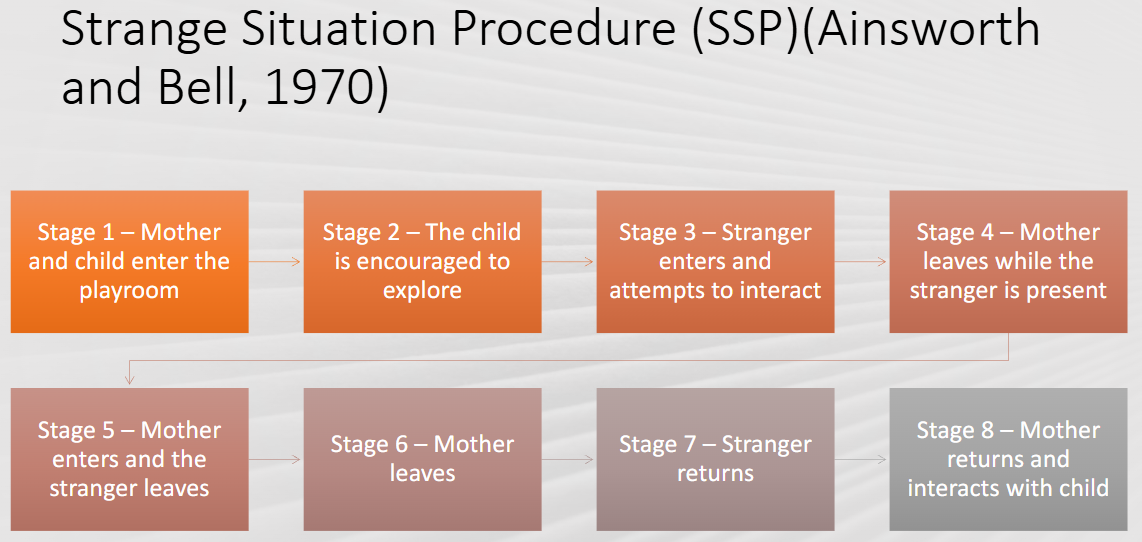
The SSP is a structured laboratory assessment of infant attachment involving separations and reunions with the caregiver.
Procedure overview:
Mother and infant enter playroom
Infant encouraged to explore
Stranger enters
Mother leaves
Mother returns
Mother leaves again
Stranger returns
Mother returns
Infant behaviour during reunion is the key diagnostic indicator.
Attachment Classifications
The Safe and Sound Protocol (SSP) is an evidence-based, clinician-guided listening therapy designed to calm the nervous system, improve emotional regulation, and enhance social engagement.
Adult Attachment Interview (AAI)
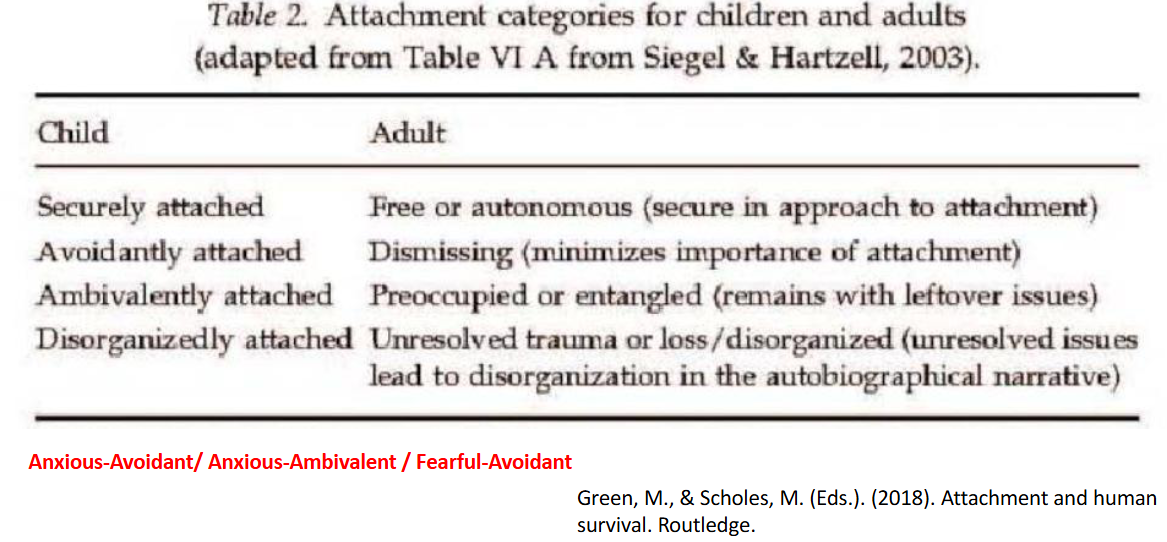
Mary Main extended attachment research to adults.
Adult categories:
Autonomous/Secure
Dismissing-Detached
Preoccupied-Entangled
Unresolved/Disorganised
The AAI assesses coherence of attachment narratives rather than behaviour.
Major Critiques of Attachment Theory
Common criticisms include:
Overemphasis on parents
Underestimation of social context (e.g., poverty)
Reductionism in categorising relationships
Conceptual vagueness
Western cultural bias
Insufficient attention to developmental plasticity
These critiques drive contemporary revisions.
Applications of SSP
The SSP is used in:
attachment disorder assessment
research contexts
parent–child therapy
pre-adoption screening
forensic and custody decisions
Its clinical influence is substantial but debated.
Contemporary Exam Guidance
For academic work:
Lorenz and Harlow → brief historical reference only
Bowlby → use for definitions and core theory
Ainsworth → essential for methodology (SSP)
Focus mainly on contemporary empirical research and applications
Evidence Supporting the Internal Working Model
Johnson et al. (2007) found that securely attached infants looked longer at unresponsive caregivers (violating expectations), while insecure infants showed the opposite pattern. This supports the idea that infants hold relationship expectations.
Attachment and Stress Physiology
Research measuring cortisol during the SSP showed:
Secure infants → no significant stress hormone rise
Ambivalent infants → elevated cortisol
Avoidant infants → no cortisol rise despite behavioural calm
This suggests avoidant infants may suppress outward distress while still experiencing stress internally.
Attachment and Emotional Attention
Eye-tracking research with preschoolers found attachment security predicts attention to emotional faces. Secure children attended longer to fearful faces, suggesting more open emotional processing.
Reactive Attachment Disorder (RAD)
RAD is a trauma- and neglect-related condition characterised by:
difficulty forming attachments
reduced positive affect
resistance to comfort
possible aggression when soothed
Research indicates RAD is distinct from standard attachment insecurity and reflects more pervasive social disruption.
Cross-Cultural Findings
Studies with Korean samples showed almost no avoidant classifications, though core attachment principles remained. Cultural concepts such as amae highlight different relational norms.
Key implication: attachment distributions vary culturally even if the system itself is universal.
Cultural and Social Validity Questions
Attachment security may look different depending on environmental realities. For example, parental distrust of society may be adaptive in dangerous contexts. This challenges simple secure/insecure interpretations.
Anti-Racist Perspectives in Attachment
Contemporary scholars argue attachment theory must consider:
historical trauma
systemic racism
community-based security
adaptive distrust
Questions include whether children can be securely attached within families but understandably wary of wider society.
Expanding Contexts for Attachment Research
Modern evaluation must consider diverse family structures and experiences, including:
fathers and varied father roles
LGBTQ+ families
adoption and fostering
single and working parents
poverty and wealth contexts
cross-cultural families
bereavement and illness
disability and neurodiversity
adverse childhood experiences
methodological bias
Attachment theory is increasingly viewed through an ecological lens.
The “Good Enough” Caregiver
Drawing on Winnicott, the lecture emphasises that caregivers do not need to be perfect. Consistent, responsive care that is “good enough” supports healthy development.
Transferable Skills from Studying Attachment
Beyond knowledge, the field develops important graduate skills:
Evidence-based reasoning
Research design literacy
Critical evaluation
Observational skills
Tolerance of ambiguity
Cultural reflexivity
Ethical sensitivity
Emotional literacy
Interpersonal insight
Applied theory translation
Perspective-taking
Reflective practice
Clear communication of complex ideas
Key Takeaway
Attachment theory remains one of the most influential frameworks in developmental psychology. However, contemporary work emphasises flexibility, cultural context, multiple caregivers, and resilience. Understanding attachment today requires both respect for Bowlby and Ainsworth’s foundations and critical engagement with modern evidence.