Working memory
Baddeley and Hitch (1974)
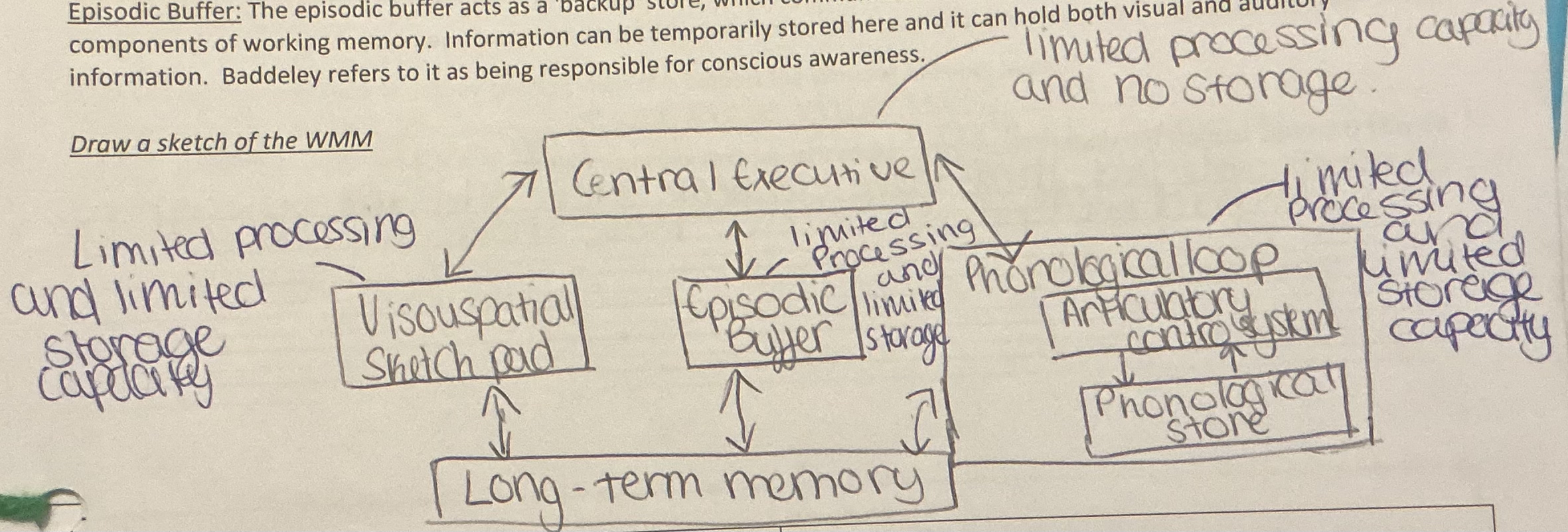
The working memory model proposes that STM includes several components: central executive, phonological loop, visuospatial sketchpad, and the episodic buffer.
Central executive: Drives the whole system and allocates data to the below. It can process any type of sensory information.
Phonological loop: deals with spoken and written material. It consists of two parts: Phonological store (inner ear): linked to speech perception, holds information in speech based form for 1-2 seconds. Articulatory control process (inner voice): linked to speech production & used to rehearse and store verbal information from the phonological store.
Visuo-spatial sketchpad: referred to as the inner eye. Responsible for storing and processing information in a visual or spatial form. The VSS is used for navigation & plays an important role in helping us keep track of where we are in relation to other objects as we move through our environment.
Episodic buffer: acts as a ‘back up’ store, which communicates with both LTM and the components of working memory. Information can be temporarily stored here and it can hold both visual and auditory information. Baddeley refers to it as being responsible for conscious awareness.
Strengths | Weaknesses |
|
|