Physical Chemistry Tutorial Questions
TUTORIAL 1
R = 8.314 J K-1 mol-1 0 °C = 273.15 K
1. A 750 mL flask contains a 1.75 g sample of CO2 at 22.5 °C. Calculate the pressure of the
gas in Pa. (10)
2. 4.036 g of a gas occupies a volume of 426 cm3 at 273 K and 1.00 atm. Calculate the molar
mass of the gas. (10)
3. A vessel contains 2.5 L of H2 gas at 350 mm Hg and 25.0 °C. Calculate the pressure of the
gas, in mm Hg and in Pa, if it is transferred to a 7.0 L flask at 0.0 °C. (10)
4. Sodium azide, the explosive compound in automotive air bags, decomposes according to
the following reaction equation:
2 NaN3(s) 2 Na(s) + 3 N2(g)
Calculate the mass of sodium azide required to provide the nitrogen needed to inflate a
70.0 L bag to a pressure of 1.70 atm at 25 °C. (20)
5. A mixture of nitrogen and carbon dioxide contains 26.2 % N2 by mass. Calculate the mole
fraction of nitrogen in the mixture. If the total pressure is 1.4 atm, calculate the partial
pressure of each gas in atm and in Pa. (20)
6. Determine the number of degrees of freedom (trans + rot) for each of the following gases;
Ne, CO2, H2O. Then calculate the average total kinetic energy (per mole) at 25 oC for each
gas. (12)
7. Calculate the root mean square speeds of He and Ar gas particles at 20.0 °C.
TUTORIAL 2
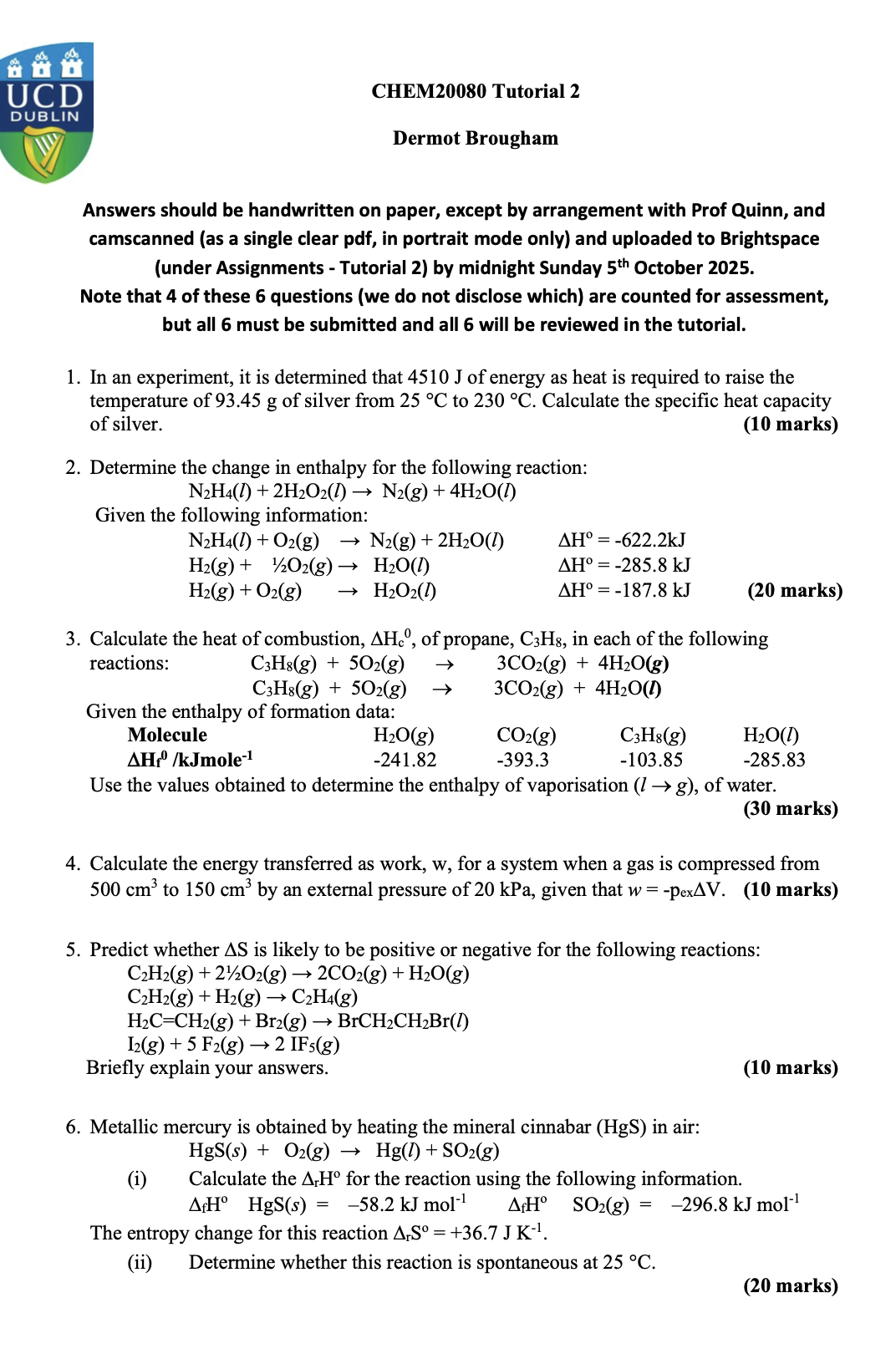
Question 2
To determine reaction enthalpy using Hess's Law…
Identify the Target Reaction:
Clearly write down the chemical equation for the overall reaction whose enthalpy change (ΔH) you want to find.
Record Known Reactions:
List all the given chemical reactions with their known enthalpy changes (ΔH).
Manipulate Known Reactions:
Reverse: If a reactant or product needs to be on the opposite side of the arrow to match the target reaction, reverse the entire equation. When you reverse a reaction, you must change the sign of its ΔH.
Multiply: If a substance appears with a different coefficient (number of moles) in a known reaction than in the target reaction, multiply the entire reaction and its ΔH by that same factor.
Cancel and Sum:
Add the adjusted known reactions together. Any species (reactants and products) that appear on both sides of the combined equations will cancel out.
Calculate the Final ΔH:
Add the adjusted ΔH values of all the manipulated known reactions. The sum will be the enthalpy change (ΔH) for the target reaction
Question 4
cm cubed to metres cubed is 10 to the power of -6
Question 5
Great question — this is a really important thermodynamics skill! 🌡
Let’s go step-by-step on how to predict whether ΔS (entropy change) is positive or negative for a chemical reaction.
🔹 Step 1: Recall what ΔS means
Entropy (S) is a measure of disorder or randomness of a system.
A positive ΔS means the system becomes more disordered (more microstates).
A negative ΔS means the system becomes more ordered (fewer accessible microstates).
🔹 Step 2: Look at the phases of reactants and products
Different states of matter have very different entropies:
Solids < Liquids < Gases
So:
If a reaction produces more gas molecules, ΔS is positive.
If a reaction consumes gases or forms liquids/solids from gases, ΔS is negative.
🔹 Step 3: Compare the number of gas particles
Count the moles of gas on each side:
[
\Delta n_\text{gas} = n_\text{gas(products)} - n_\text{gas(reactants)}
]
If Δn₍gas₎ > 0, → ΔS > 0 (entropy increases).
If Δn₍gas₎ < 0, → ΔS < 0 (entropy decreases).
If no gases are involved, then look at solids ↔ liquids transitions.
🔹 Step 4: Consider phase changes
Change | Effect on ΔS | Reason |
|---|---|---|
solid → liquid | + | more particle freedom |
liquid → gas | + | huge increase in randomness |
gas → liquid/solid | − | particles become more ordered |
solution formation (solid dissolves) | + | more dispersed ions/molecules |
precipitation (ions → solid) | − | less disorder |
🔹 Step 5: Think about molecular complexity
If the number of gas molecules doesn’t change much, the type of molecule can matter:
Larger, more complex or polyatomic gases have slightly higher entropy.
So converting small molecules → large flexible ones (in gas phase) can increase S slightly.
🔹 Step 6: Example summary
Reaction | Observation | ΔS sign |
|---|---|---|
H₂(g) + Cl₂(g) → 2HCl(g) | gas moles: 2 → 2 | ≈ 0 |
2H₂(g) + O₂(g) → 2H₂O(l) | gas → liquid | strongly − |
NH₄Cl(s) → NH₃(g) + HCl(g) | solid → 2 gases | strongly + |
CaCO₃(s) → CaO(s) + CO₂(g) | solid → solid + gas | + |
🔹 Step 7: Write your reasoning like this:
“Number of gas molecules increases (reactants 1 mol gas → products 2 mol gas), so disorder increases → ΔS > 0.”
or
“Gas molecules are converted to liquid water, decreasing randomness → ΔS < 0.”
Question 6:
Be able to calculate standard enthalpy change of reaction.
Be able to determine if a reaction is spontaneous.