Nutrition Basics: Macronutrients Carbohydrates
- ]]Describe the 3 functions that nutrients play in the body.]]
- Provide energy; biochemical reactions release the energy contained in carbs, protein and fat
- Form structures; water, protein and fat are the must abundant nutrients in our body. Together with minerals, they form and maintain the shape/structure of our body
- Regulate metabolic body processes
- ]]Define acceptable macronutrient distribution range and know the range for each macronutrient.]]
| 1g carbohydrate | 4 kcal of energy |
|---|---|
| 1g protein | 4 kcal of energy |
| 1g fat | 9 kcal of energy |
==Dietary reference intakes (DRI)==
- Recommended dietary allowance (RDA) - intakes sufficient to meet the nutrient needs of almost all healthy people in a specific life stage and gender group
- Adequate intake (AI) - when RDA does not exist
- Tolerable upper intake level (UL) - max daily intake that is unlikely to pose a risk
==Acceptable macronutrient distribution range (AMDR)==
- The range of intake for a particular energy source (carb, protein + fat) that provides adequate energy and nutrients and reduces the risk of chronic disease
- expressed as a % of total energy (kcal)
- %%Carbs: 45-65%%%
- %%Proteins: 10-35%%%
- %%Fats: 20-35%%%
- ]]Explain the classification of carbohydrates.]]
- Monosaccharides
- Disaccharides
- Polysaccharides
- All carbs are converted to ^^glucose^^ (major energy source) - only energy source the brain can use
- Excess glucose is stored as ^^glycogen^^ mainly in the liver, muscle, and as fat
- ]]Compare and contrast simple vs complex carbohydrates, including their: role in the body and food sources.]]
- ==Simple (sugar)==
- %%Monosaccharides%% - single sugar
- glucose, galactose, fructose
- water soluble
- %%Disaccharides%% - pair of monosaccharides
- Lactose (glucose + galactose)
- Maltose (glucose + glucose)
- Sucrose (glucose + fructose) - table sugar
- Healthy simple sugars: fruit, milk, milk products, vegetables
- Not so healthy: processed and refined foods, candy, pop, table sugar, syrup
- ==Complex==
- %%Polysaccharides%%
- contain hundreds to thousands of monosaccharide chains (mostly glucose units)
- 3 kinds:
- In plants called ^^starches^^ and ^^fiber^^ (soluble and insoluble)
- In animals called ^^glycogen^^ (note: not a dietary source of carbohydrates)
- Role of complex carbs:
- %%Glycogen%%
- Storage form of energy (glucose) in the body
- Storage sites: liver and muscle cells
- Yield energy
- %%Starch%% ^^(main food source of energy)^^
- Storage form of energy (glucose) in plants
- Yield energy
- Healthy: grains (wheat, rice, couscous, millet, rye, barley); root/tuber plants (yam, potatoes); and legumes (peas, beans)
- Less healthy: refined or processed foods (e.g. white bread, white rice, regular pasta - anything made with white or all-purpose flour)
- provide quick energy but little nutrition (unless enriched)
- %%Fibre%%
- Provide structure in plants - yield little energy
- Bonds can’t be broken by human enzymes
- ^^Unavailable carb^^ because produces no energy
- ==Simple (sugar)==
- ]]Describe suggested maximum sugar intake (Health Canada) and describe what is meant by “added sugar”]]
- Health Canada: %%<= 25%%% of total daily calories should come from added sugars
- Added sugars - supply energy but have no nutrients
- Syrup, pop, candy - handled the same way as naturally occurring sugars (e.g. fruits, milk, honey)
- Contribute to tooth decay
- Diets high in processed food (refined carbs) and low in fibre lead to dysbiosis (imbalance of gut flora)
- ]]Discuss the benefits of using sugar substitutes and identify which ones are considered safe for use in pregnancy.]]
- Less calories than sugar (may assist in weight control)
- Less effect on blood sugars (useful in diabetes)
- Safe in pregnancy:
- No rigorous studies
- Based on history of use: %%acesulfame, aspartame, and sucralose%% are considered safe
- ]]Explain the health benefits of insoluble and soluble fibre and provide a food source for each.]]
- %%Soluble fibre%% - dissolves in water turns into gel (viscous) - slows digestion; fermentable
- Oats, barley, flax seeds, seeds, beans, lentils, peas, some fruits (apples, oranges, pears, strawberries, blueberries), psyllium, some vegetables (celery, carrots)
- %%Insoluble fibre%% - does not dissolve in water but becomes bulkier - increases fecal bulk; speeds food transit through stomach, intestines; non-viscous, less readily fermentable
- Whole wheat, whole grains, wheat bran, corn bran, seeds, nuts, brown rice, fruits, vegetables (cabbage, broccoli, etc.), root vegetable skins
- Health benefits:
- Lowers risk of heart disease: lower BP, improve blood lipids, reduce inflammation → diets high in whole grains and soluble fibre
- Lower risk of diabetes: high soluble fibre foods can reduce risk of Type 2 diabetes → slows down glucose absorption
- Alleviate constipation: insoluble fibres (e.g. seeds, nuts, whole wheat) increase fecal weight and speed passage through the colon
- %%Soluble fibre%% - dissolves in water turns into gel (viscous) - slows digestion; fermentable
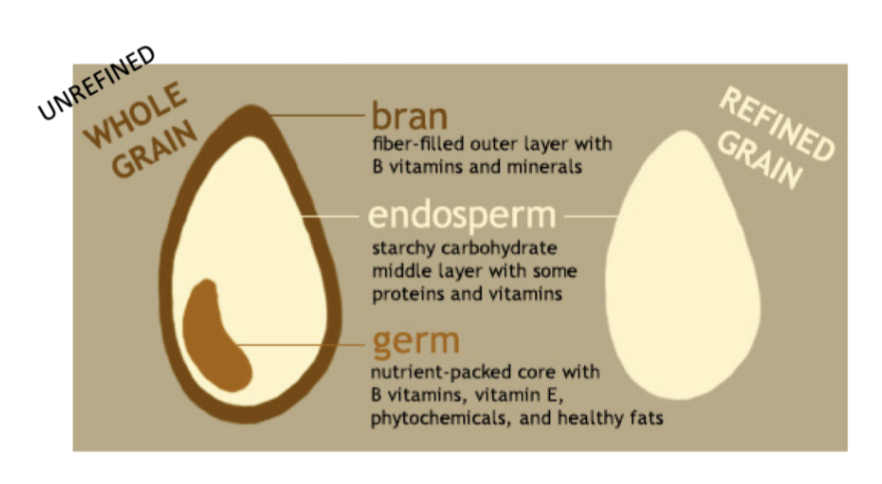
- ]]Explain the difference between wheat flour and whole grain flour.]]
- %%Wheat flour%% - any flour made from the endosperm of a wheat grain
- also known as refined flour
- Is generally enriched: has iron, thiamin, riboflavin, niacin, folate added
- %%Whole grain%% - made from the entire kernel of a cereal grain (e.g. quinoa, whole wheat, rye, oats, corn, brown rice, wild rice, whole grain pasta)
- Bran (outer coating of wheat kernel; rich in fibre)
- Endosperm (mainly starch, some protein)
- Germ (seed-rich in vitamins and minerals)
- %%Wheat flour%% - any flour made from the endosperm of a wheat grain
- ]]Discuss the glycemic index.]]
- %%Glycemic index%% - a scale that ranks carbohydrate-rich foods or drinks by how much (and how quickly) they raise blood glucose levels compared to a standard food (glucose or white bread)
- Low GI diet can help decrease risk of T2DM (lower HbA1c), heart disease, stroke; feel full longer; maintain or increase weight loss
- Combining carbs with fats and proteins will change how fast the food is absorbed
| Low GI (55 or less) | Choose most often |
|---|---|
| Medium GI (56-69) | Choose less often |
| High GI (70 or more) | Choose least often |