9.4 Body fluid; blood pressure regulation, Electrolyte Balance & Renin-Angiotensin-Aldosterone System
Body fluid
Intracellular fluid (ICF)
Located within cells
Major component of total body water (2/3)
Extracellular fluid (ECF)
Located outside the cell
Interstitial fluid: Between cells and tissue
Plasma: Fluid component of blood
Components: Water, protein, electrolytes, others
Functions: Transport/carriage, colloid osmotic pressure, membrane excitability, buffering
Compartments are separated by barriers
Capillary wall
Separates plasma and interstitial fluid
Movement passive via pores
Plasma (cell) membrane
Separates interstitial fluid and intracellular fluid
Movement regulated by passive and active mechanisms, such as channels, pumps
Fluid gain and loss
Fluid gain:
Ingested liquids, food, and metabolic production (e.g. from cellular respiration)
Fluid loss:
Urinary loss, sweating, respiratory evaporation, and gastrointestinal losses
Regulation of fluid balance:
Thirst mechanism: Activated by changes in serum osmolarity, detected by receptors in the hypothalamus
Water loss: regulated by kidneys, skin and lungs
Acidosis and alkalosis
Acid-base balance describes concentration of free hydrogen ions
A substance is an acid if it gives up H+ in solution
A substance is a base if it binds H+ in solution
a Major source of H+ is metabolically produced as a result of cellular respiration, particularly during the breakdown of glucose and fatty acids.
Acidosis
Blood pH falls below 7.35
Can cause CNS depression, coma
Results from an excess of H+ or insufficient bicarbonate (HCO3-)
Alkalosis
Blood pH rises above 7.45
Can cause CNS excitation, leading to seizures and spasms
Results from exceess bicarbonate or a loss of H+
Regulation
Respiratory system: adjusts CO2 levels to regulate H+ concentrations. Increased breathing reduces CO2 (raising pH), and decreased breathing increases CO2 (lowering pH)

Juxtaglomerular apparatus
It is a specialised collection of cells in the nephron, responsive to changes in blood pressure and sodium levels
Components
Granular cells (Juxtaglomerular cells): Release renin in response to low blood pressure or sodium levels
Macula densa: Senses changes in sodium concentration in the distal convoluted tubules and signals granular cells
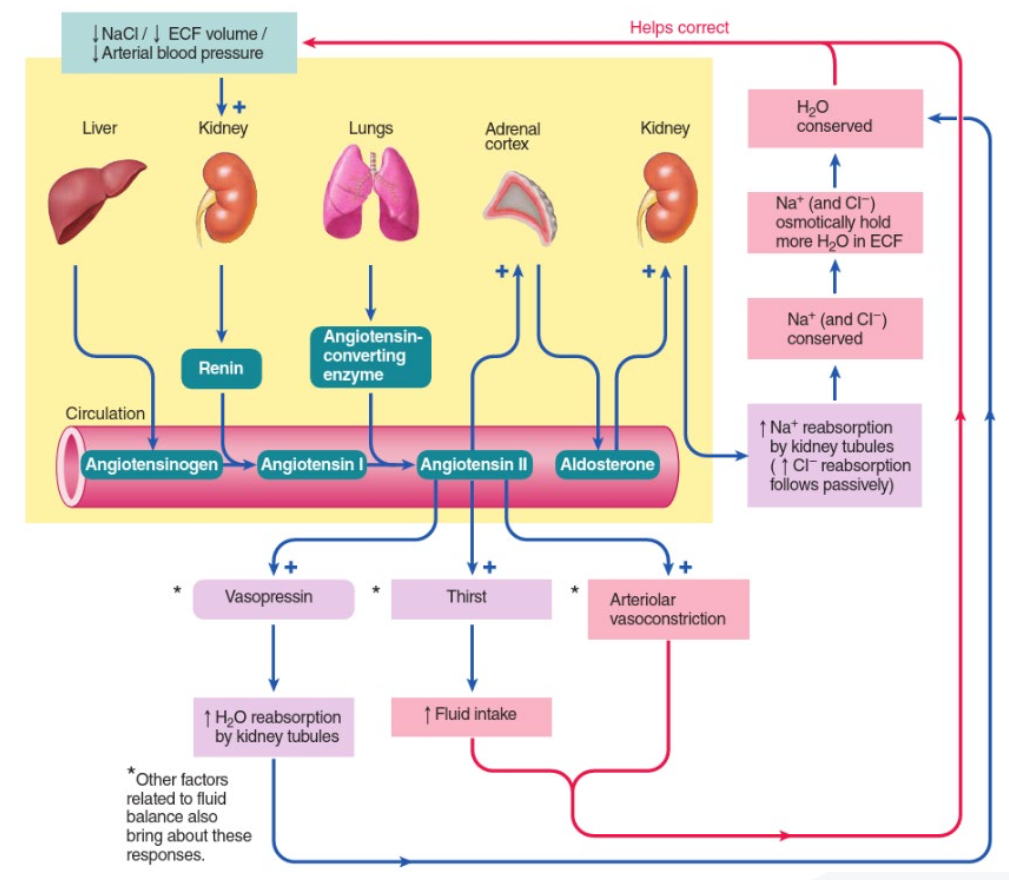
Function: regulates blood pressure and electrolyte balance by controlling the release of renin, which triggers the Renin-angiotensin-aldosterone system pathway
Renin-Angiotensis-aldosterone system
Renin release
Triggered by low blood pressure, low sodium levls, or sympathetic nervous system activation.
Renin converts angiotensinogen (from the liver) into angiotensis I, which is then converted to angiotensin II by the enzyme ACE (angiotensin-converting enzyme) primarily in the lungs
Angiotensin II effects
Vasoconstriction: increases systemic vascular resistance, raising blood pressure
Aldosterone release: Stimulates the adrenal glands to release aldosterone, which acts on the distal convoluted tubule and collecting duct of the nephron to
Increase sodium reabsorption
Promoted potassium secretion
Aldosterone
Acts on the principal cells of the distal convoluted tubule and collecting ducts, promoting sodium retention and potassium excretion
Chloride (Cl-) follows sodium passively, contributing to fluid balance.
End result: The RAAS pathway enhances sodium and water retention, elevating blood volume and blood pressure to maintain homeostasis.